Courtesy of: EFE
With each passing day of silence, the prospect that cancer-stricken Hugo Chávez will recover becomes less likely. Chávez has been absent from Venezuela for over a month and rumors about his death or incapacitation are rampant, leaving many wondering who will take over the presidency if he dies. On January 10, the constitutionally-mandated date Chávez was to be sworn in, government officials planned – and executed – an inauguration. International leaders flew in for the festivities, attended by thousands of Chávez supporters and government officials. But the main attraction – Chávez himself – was nowhere to be found, apparently still convalescing in a Cuban hospital. In lieu of the president, the president’s supporters took the oath, donning presidential sashes a well as signs and t-shirts that read “I am Chávez.”
Government officials announced they would go forward with a symbolic event in the president’s honor just one day before the inauguration, when the Supreme Court voted to delay the president’s inauguration.
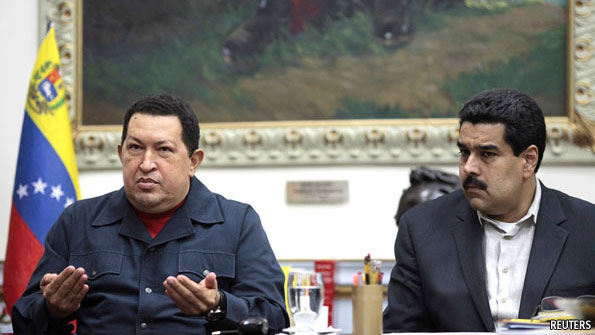
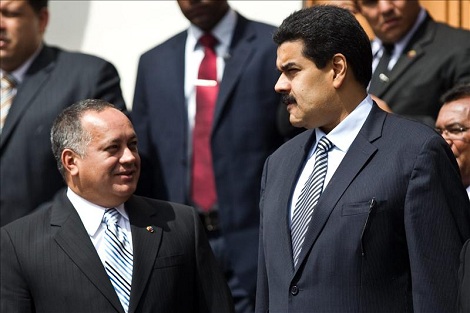
But as Venezuela remains in limbo, many are wondering what’s next for Venezuela. According to the constitution, four scenarios remain possible depending on when and if the president passes away. Despite the nuances of each, the one consistent fact is that if the president dies or is declared incapacitated, an election must be held. Henrique Capriles has emerged as the leader of the opposition and the likely candidate to run in a new presidential race. Within the Chávez government, however, are two possibilities. One is regarded as the head of the civilian, ideological members of the party: Cuban loyalist and Vice President Nicolás Maduro. The other, President of the National Assembly Diosdado Cabello, is known for his military ties and influence.
Below is a short background of each of the three possible presidential candidates.
1. Henrique Capriles: Henrique Capriles emerged as the opposition’s clear leader after winning Venezuela’s first ever primary election with 62 percent of the vote in February 2012. Despite losing the presidential election on October 7, Capriles earned 44 percent of the vote, the strongest challenge ever to president Chávez. His status as leader of the opposition was all but solidified two months later when he held on to his Miranda governorship in regional elections, defeating Chávez’s handpicked candidate and former vice-president, Elías Jaua. Capriles defeated Jaua despite significant losses for the opposition across the country.
Capriles’ national political career began in 1998, when at 26 he was elected to the then Chamber of Deputies, becoming the youngest elected member of Venezuela’s parliament. In 2000, Capriles was elected mayor of Baruta, a division of the Greater Caracas municipality in Venezuela. Following his second term as mayor, Capriles was elected in 2008 as Governor of Miranda, one of the largest and most densely populated states in the country, defeating Diosdado Cabello with 53 percent of the vote.
2. Nicolás Maduro: Nicolás Maduro has long been one of Chávez’s closest allies and advisors, both in Cuba and Venezuela. The relationship strengthened since June 2011, when Chavez underwent his first cancer surgery. During Chávez’s absence, Maduro assumed a leading political role, charged with conveying special messages from the president to Venezuelan public. Maduro was named vice-president shortly after October’s presidential election and was designated Chávez handpicked successor just before the president was rushed to Cuba to receive his fourth and most serious cancer surgery.
Chávez and Maduro have a long history together, going back to the founding of PSUV. Maduro even worked on Chávez’s 1998 presidential campaign. Coming from humble roots as a bus driver, Maduro is often regarded as a leader of the ideological faction of the PSUV – truly committed to the principles of socialism. He was elected Foreign Minister in 2006, developing strong ties with the Castros, and quickly becoming well regarded by the Cuban government. He is considered partially responsible for spearheading the creation of the Bolivarian Alliance for the Americas (ALBA) with other left-leaning Latin American governments. Maduro’s profile within Venezuela has continued to grow, acting as president since Chávez departed to Cuba.
3. Diosdado Cabello: Former member of the armed forces, Diosdado Cabello has been a long ally of president Chávez. The two participated in the failed coup attempt of February 1992, landing them both in jail. Cabello became Chávez’s chief of staff in 2001, later serving as Minister of Interior and Justice. During a two-day coup against Chávez in 2002, Cabello assumed the duties of the presidency. He showed his loyalty by quickly sending a group of elite navy troops to rescue Chávez as his first order. Cabello was rewarded with high-level offices, and was most recently re-elected as president of the National Assembly on January 5.
He governed the state of Miranda from 2004 until 2008 when he was defeated at the ballot by Capriles. In 2011 he became Vice-President of PSUV, making him the second most powerful figure in the party after Chávez. Cabello was first elected and sworn in as President of the National Assembly in 2012. As a former soldier, it is clear he has the military power within the party. His business interests and ties to narco-trafficking have raised questions, however, as he has been painted as one of the “boli-bourgeois” who have succeeded financially under Chávez’s government.