Aug
13
2012
Posted by
admin
Comments

ICYMI: Venezuela’s army – The vote that counts

Would the generals accept a presidential handover?

The Economist
August 11, 2012

SEVEN years before Hugo Chávez was elected as Venezuela’s president in 1998, he tried to seize power in a failed military coup. He has since been re-elected twice, but will face a strong opponent this October in Henrique Capriles, a former state governor. Although Mr Chávez leads in the polls, he has been receiving treatment in Cuba for cancer, and concerns about his health could weaken his support. The president says he will respect the voters’ decision. But some in the opposition fear that he may seek to stay in office even if he loses the election.

If Mr Chávez does try to flout the electorate, the army may determine the outcome. Legally, it must provide security and logistical support during elections. The constitution Mr Chávez enacted in 1999 limits it to a non-partisan role. And the officer corps as a whole is no more chavista than the general population.

However, the defence minister, General Henry Rangel Silva, said in 2010 that the army was “wedded” to the president’s leftist project, and Mr Chávez calls the army both socialist and chavista. Many senior generals have openly supported Mr Chávez politically, and would probably be sidelined if Mr Capriles wins. Some could face legal threats: the United States’ Department of the Treasury has put General Rangel Silva on a blacklist for allegedly aiding drug traffickers.

Mr Chávez further complicated the situation with a law in 2011 that assigned the president the military rank of commander-in-chief. A future president-elect, who would rank as his junior, might have to retire him. Although the constitution bans serving members of the army from standing for office, the electoral authority has looked the other way.

Even if the army does abandon Mr Chávez, he could still try to cling to power by other means. In recent years he has created a separate militia corps to aid the “construction of socialism”. The government puts its strength at 125,000, making it comparable in size (if not in firepower or training) to the formal army. Their loyalty is to Mr Chávez, not the Venezuelan state.

Mr Capriles is seeking to defuse this threat by courting the army himself. He recently promised to improve soldiers’ welfare benefits, base promotions on merit rather than patronage and end foreign meddling—a reference to the presence of senior Cuban officers. Mr Chávez then accused his rival of hating the army. Both candidates seem well aware that campaigning in the barracks could matter just as much as it does in the barrios.

To read this article on The Economist, please click here.
 
Aug
10
2012
Posted by
admin
Comments

A Feather in Capriles’s Cap

International Herald Tribune
August 10, 2012
By Francisco Toro

iht 0810 latitude toro art3 blog480 A Feather in Capriless Cap

Courtesy of: Carlos Garcia Rawlins / Reuters

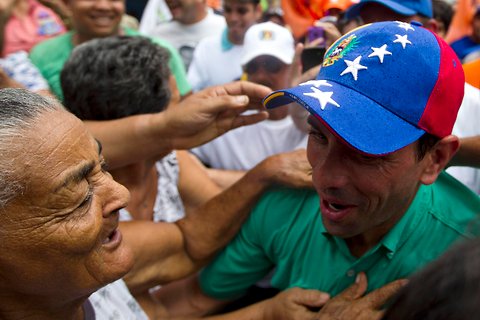
MONTREAL — Venezuela’s campaign for the presidential contest of Oct. 7 descended into farce last week when election officials chastised the opposition for abusing campaign rules. At issue was the hat worn by the opposition candidate Henrique Capriles at recent campaign events: a baseball cap adorned with the Venezuelan flag.

As they reminded President Hugo Chávez’s challenger that Venezuela’s elections law forbids candidates from using national symbols, the officials displayed an impressive imperviousness to irony.

Chávez has hardly been seen in public over the last several years not wearing some variation on Venezuela’s national colors. His trademark tricolor jacket has become a visual cliché. His campaign’s official logo features a heart-shaped Venezuelan flag. Chávez himself even wore a baseball cap exactly like Capriles’s when he lost his hair following chemotherapy.

Singling out Capriles for wearing the wrong hat ends up very publicly underlining the never-particularly-well-hidden partiality of Venezuela’s election authorities. The same electoral council that refuses to sanction Chávez for abusing the government’s privileged access to broadcast media for campaign purposes, for covering countless public buildings with yellow-blue-and-red campaign posters or for donning a campaign logo that is virtually identical to the national government’s latest “information campaign” logo — that same electoral council is shocked, shocked, at Capriles’s choice of headgear.

Of course, the baseball cap design quickly went viral. Photos proliferated on Twitter. In Caracas, activists began placing the hats on the bronze heads of historical statues around town. And when Capriles himself refused to give in to intimidation, he turned the cap into an unlikely symbol of defiance.

Baseball-hat-gate highlights once again how deeply the abuse of state power is enmeshed into the Chavista approach to governance. For a government committed to harshly divisive rhetoric and that explicitly paints all dissidents as foreign agents, the urge to usurp national symbols seems almost natural. In a recent speech, Chávez went to the ugly extreme of saying so explicitly: “If you’re not Chavista, you’re not Venezuelan.”

Capriles is running not just against a charismatic opponent, or against a powerful incumbent government, but against the machinery of the Venezuelan petrostate. When the purportedly independent institutions meant to ensure an even playing field are unambiguously allied with the president, there are no breaks left on the illegitimate use of state resources to ensure his re-election.

Given this context, it’s remarkable that the race still is competitive and the government nervous. While abusing power in the run-up to the elections is easy, actually stealing the vote on D-day would be logistically difficult. (The opposition has organized a major drive to place witnesses at nearly all polling stations.) Even if the stunt could be pulled off, it would carry major costs: it would disastrously undermine the government’s claim to legitimacy and international standing.

And so Chavismo is busy fighting back any attempt to reclaim the mantle of Venezuelanness as too dangerous to allow. Fortunately, Capriles understands that on Oct. 7, Venezuelans have one last chance to put an end to this madness. After all, as he says, “It is not the president who gets to decide who is Venezuelan; it’s Venezuelans who get to decide who is president.”

To read this article on the International Herald Tribune, please click here.

 
Jul
25
2012
Posted by
admin
Comments

Venezuela’s Free but Not Fair Elections

jose r cardenas Venezuelas Free but Not Fair Elections

José R. Cárdenas

José R. Cárdenas served in several foreign policy positions during the George W. Bush administration (2004-2009), including on the National Security Council staff. He is a consultant with Vision Americas in Washington, DC.

With Venezuela’s presidential election only a few short months away, international attention is starting to focus on the country leading up to the vote. Such scrutiny is welcome, given Hugo Chávez’s historical track record of tilting the playing field in his favor every time Venezuelans go to the polls.

In recent weeks, two reputable international organizations — Human Rights Watch (HRW) and the Brussels-based International Crisis Group (ICG) — have released comprehensive reports detailing the Chávez administration’s abuse of power, and the extremely difficult conditions being faced by the Venezuelan opposition prior to the October 7th election.

While the reports’ observations will not surprise anyone who has remained informed of Chávez’s systematic hollowing out of the country’s democratic institutions over the years, they are nonetheless important, non-partisan additions to the record by serious watchdog organizations. Try as he might, Chávez can hardly dismiss them as mouthpieces of “the empire.”

Human Rights Watch’s 133-page report, “Tightening the Grip: Concentration and Abuse of Power in Chávez’s Venezuela,” is a follow-up to their critical 2008 report that earned its authors an unceremonious expulsion from Venezuela. It concludes that basically nothing has improved and that, “the accumulation of power in the executive and the erosion of human rights protections have allowed the Chávez government to intimidate, censor, and prosecute critics and perceived opponents in a wide range of cases involving the judiciary, the media, and civil society.”

On the media in particular — which plays an essential role in ensuring freedom of expression in any electoral campaign — the report documents how “the Chávez government has used its regulatory authority to expand the number of pro-government media outlets, while reducing the availability of those that engage in critical programming.”

The International Crisis Group’s report, “Dangerous Uncertainty ahead of Venezuela Elections” paints an equally bleak picture: “Under President Chávez’s watch, power has been concentrated in the executive and checks and balances steadily eroded. Politics are polarised, society divided and levels of criminal violence high, while the proliferation of weapons and of pro-government armed groups offer easy opportunities for stoking violence.”

The report does an impressive deep-dive into all facets of the campaign and finds Chávez up to his old tricks: using his control of the state treasury and the media to try and steamroll any challenge, and to prevent the opposition from getting a fair hearing before the Venezuelan people.

For example, the report’s authors write, “Arguably the gravest symptom of CNE [Venezuela's electoral authority] bias is the failure to check blatant violations in the rules restricting the use of state resources for campaigning mostly – though not exclusively – by the ruling party.” The ICG report calls on Chávez to halt his practice of using the promise of government social programs to induce Venezuelans to vote for him.

On the media, they write, “…together the Chavista dominance of the state media, the cadenas [government-mandated broadcasts], the compliance or self-censorship of much of the non-state media and the harassment of outlets that openly support [opposition candidate Henrique] Capriles give the president a handy advantage.”

Nor does it appear that credible international observers will be present on election day, because the Chávez government has no intention of inviting any. Still, the ICG urges regional governments to press Venezuela for credible observers to monitor the election — a plea certain to fall on deaf ears in Caracas.

The ICG report also devotes some analysis to Henrique Capriles’ chances amidst Chávez’s continuing abuses of power. Most notable is the report’s assessment that Capriles’ campaign has not let itself become distracted by Chávez’s unfair tactics. It is focused, disciplined, moderate in tone, and absolutely committed to convincing voters that the opposition understands the country has changed and that working-class and poorer sectors’ interests will be respected.

Polls for October’s election continue to give the edge to Chávez, but his health remains the wildcard. The uncertainty – along with the substantial proportion of undecided voters – means events could go off in any number of directions should he succumb to his cancer. But the Capriles campaign remains clearly focused on the here and now. The playing field may be tilted in Chávez’s favor, but the opposition are clearly determined to take the campaign to him regardless of the disadvantages. In this they make Chávez, who continues to preposterously assert that his cancer is cured, look weak. It is indeed a measure of how far the Venezuelan opposition has come since the early days of Chávez’s rule.