Mar
8
2013
Posted by
admin
Comments

In Case You Missed It…Articles Roundup Week of 3/8/13

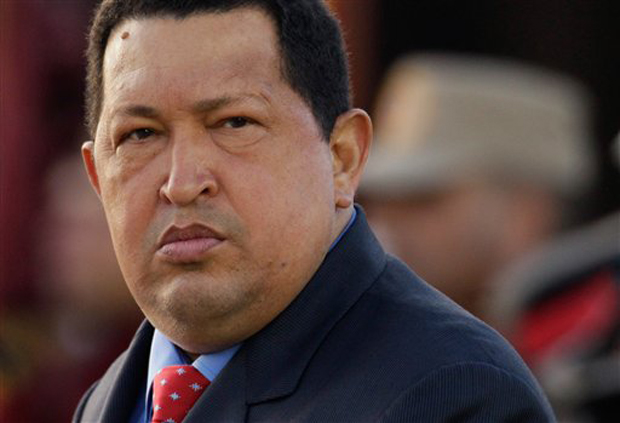
hugochavezobit e1362779431348 In Case You Missed It...Articles Roundup Week of 3/8/13

Courtesy of: Associated Press

This week: Nicolás Maduro announced Tuesday that President Hugo Chávez had succumbed to cancer, leaving behind a sharply divided country; with Chávez’s passing and subsequent funeral comes the question of his contradictory legacy, highlighted by his socialist policies; undoubtedly, Chávez will be remembered as a leader who transformed and shaped Venezuela; as Venezuela adjusts and evaluates its economy under Chávez, it becomes clear that his socialist agenda fell short of his promises; and like other socialist leaders, Chávez will be embalmed and put on permanent display inside a military museum. With Chávez’s death and upcoming elections, Venezuela’s interim leader Maduro is thrust into the spotlight; with Chávez gone, the U.S. reacts cautiously, weighing the prospects for a diplomatic thaw; a transition in Venezuela opens the path for eventual investment and expertise opportunities from oil companies; and Cuba mourns Chávez’s passing, while worrying about what the future may hold for the Cuba-Venezuela relationship. Finally, concern emerges over armed Chávez supporters poised to defend the revolution; the Venezuelan government plans to expel a U.S. Embassy official for allegedly meeting with military officers and planning to “destabilize the country”; Brayan Villarreal, a pitcher for the Detroit Lions, says his family was attacked in their home near Caracas; and the homicide rate in Venezuela between January and February reveals escalating violence in the country.

Chávez Dies, Leaving Sharp Divisions in Venezuela, The New York Times

President Hugo Chávez of Venezuela died Tuesday afternoon after a struggle with cancer, the government announced, leaving behind a bitterly divided nation in the grip of a political crisis that grew more acute as he languished for weeks, silent and out of sight, in hospitals in Havana and Caracas.

On Eve of His Funeral, Debating Chávez’s Legacy, The New York Times

Heads of state from around Latin America flocked to Venezuela for the funeral on Friday of Hugo Chávez, a tribute to the undiminished drawing power of the charismatic leftist leader, although perhaps not to the lasting influence of his socialist-inspired policies.

Obituary: Hugo Chavez – socialist showman who transformed Venezuela, Reuters

At two defining moments of his rule, Venezuela’s theatrical leader Hugo Chavez took a small silver crucifix from his pocket and held it above his head.

Venezuela’s Economy Under Chavez, by the Numbers, The Wall Street Journal

Many Venezuelans, mainly among the poor, are intensely mourning the passing Tuesday of President Hugo Chávez, whom they viewed as their “champion”, a father figure who after 14 years in power is taking on near saint-like meaning for them.

Like Lenin and Mao, Hugo Chavez’s embalmed body to be put on permanent display in Venezuela, Washington Post

Vladimir Lenin, Mao Zedong, Ho Chi Minh, and now Hugo Chavez.

Venezuela’s interim leader thrust into spotlight, CNN

He began his career as a bus driver in Caracas, and then rose through the ranks to become a member of Venezuelan President Hugo Chavez’s inner circle.

U.S. Hopes Chavez’s Passing Could Smooth Relations with Venezuela, TIME

U.S. officials are cautiously optimistic that the death of Venezuela’s Hugo Chavez could improve relations between the two countries, but they aren’t holding their breath.

Chavez Death Could Open Up Venezuela Oil, Wall Street Journal

The death of Hugo Chavez may have plunged Venezuela into political uncertainty. But oil markets have remained calm so far.

Cubans mourn Venezuela’s Chavez, worry about the future, Reuters

In many cities and towns, people filed through government-arranged memorials to pay tribute to the man who poured oil and money into the island nation to help revive its economy after a near-collapse in the 1990s.

The Wild Card in Venezuela: Armed Chavistas, ABC News

The banner just inside the poor neighborhood in western Caracas reads, “Loyal to Comandante Chavez.” The guard at the gate ensures no one enters without permission — not even the police.

Venezuela to expel U.S. Embassy official, Associated Press

Venezuela’s vice president, Nicolas Maduro, says the government of President Hugo Chavez plans to expel a U.S. Embassy official for meeting with military officers and planning to destabilize the country.

Brayan Villarreal’s family attacked, ESPN

Brayan Villarreal’s family home in Venezuela was attacked by three armed robbers who threatened to kidnap his relatives in the future, his agent told ESPNDeportes.com.

Number of homicides in Venezuela hits 2,576 in January-February, El Universal

Venezuela’s homicide rate in the first two months of the year dropped one percent with respect to the same period in 2012, according to figures recorded by the Scientific, Criminal and Forensic Investigation Agency (Cicpc).

 
Sep
13
2011
Posted by
admin
Comments

ICYMI: Chávez Exiting Global Forum?

Chávez Takes Steps to Exit Global Forum
The Wall Street Journal
By José De Córdoba

President Hugo Chávez of Venezuela has taken steps to pull out of the global forum most used to settle investor disputes, where Caracas faces more than $40 billion in claims for nationalized properties.

Documents show that Mr. Chávez, shown in August, is moving to avoid financial sanctions from abroad.

Venezuelan officials have drawn up plans, at Mr. Chávez’s order, to withdraw from the International Centre for the Settlement of Investment Disputes, or ICSID, a unit of the World Bank in Washington, according to recent documents reviewed by The Wall Street Journal.

A withdrawal would be the latest in a series of actions Mr. Chávez has taken to protect Venezuela’s international assets from possible seizure by foreign governments and now, perhaps, creditors. Last month, Caracas announced it would transfer $6 billion in cash reserves held in European and U.S. banks to Russian, Chinese and Brazilian banks. Mr. Chávez also said he would move some 211 tons of gold valued at $11 billion held in foreign banks to Venezuela’s Central Bank vault in Caracas.

Venezuelan government documents say the main reason for those actions was to avoid financial sanctions by the international community, such as those that have frozen billions of dollars of Libyan government funds under Moammar Gadhafi’s Libyan regime.

Analysts peg Mr. Chávez’s fears to the possibility Venezuela could have to pay billions of dollars in compensation from companies that have had assets expropriated, or that future unrest in Venezuela could lead to international sanctions.

Venezuela’s withdrawal from the ICSID also would fit well the nationalistic bent that has led Mr. Chávez to expropriate 988 companies, 401 so far this year, according to Conindustria, a Venezuela industry chamber.

“It’s pure demagogy,” said Roberto Dañino, a former head of the ICSID. “Venezuela would like investors to submit themselves to national tribunals where there are no guarantees or due process.”

The Venezuelan Embassy in Washington declined to comment. Lawyers at Arnold & Porter LLP and Curtis, Mallet-Prevost, Colt & Mosle LLP, the two principal firms that Venezuela uses to defend itself from claimants at the ICSID, declined to comment.

A Venezuelan foreign ministry official said the country wasn’t considering withdrawing from ICSID now, though he acknowledged meetings on the subject had been held. Another Venezuelan official countered that the move was, in fact, now being debated by high-ranking officials.

Lawyers familiar with ICSID procedures say a Venezuelan withdrawal wouldn’t have any impact on the 18 claims that Venezuela now faces at the World Bank unit. For starters, it would only take effect six months after notice is given to the center, said Dietmar W. Prager, a lawyer with the New York firm of Debevoise & Plimpton LLP who has represented investors with ICSID disputes with Venezuela.

Further, bilateral investment treaties bind Venezuela to ICSID arbitration for a period, depending on the treaty, from between 10 to 15 years after the cancellation of an agreement, according to lawyers and Venezuela’s own documents.

“The Venezuelans can’t say I’m taking my marbles and going home,” said Michael Nolan, a lawyer at the Washington office of Milbank, Tweed, Hadley & McCloy LLP, who has represented clients with Venezuelan claims at the ICSID.

Eventually, the government papers say, Venezuela’s goal is to replace ICSID with a dispute-settlement mechanism that would fit within the framework of Latin American integration groups such as the Bolivarian Alliance for the Americas or the Union of South American Nations, which were either founded by or heavily influenced by Caracas.

“It may be a combination to play to the balcony and make Chávez appear as a regional leader leading an attempt to gut the international investment protection system,” said James Lloyd Loftis, who heads law firm Vinson & Elkins’s international dispute resolution practice.

A withdrawal would send an unfriendly signal about Venezuela’s policy towards foreign investment, Mr. Prager said. To be sure, foreign investors have already gotten the message, as foreign companies have been taking more assets out of the country than they have been putting in it. Foreign direct investment was a negative $3.1 billion in 2009 and a negative $1.4 billion in 2010, according to the United Nations Conference on Trade and Development.

At ICSID, companies lining up to seek compensation from Venezuela range from oil giants to gold mining companies, and include some of the world’s largest cement manufacturers. ConocoPhillips by far has the largest claim. The oil company wants to recover $30 billion in compensation for stakes in two projects in the Orinoco heavy oil fields, according to Reuters. Another oil giant, Exxon Mobil Corp., has cut its claim for compensation to $7 billion for Mr. Chávez’s 2007 seizure of a heavy crude project from an initial $12 billion, Venezuela said last year. An Exxon spokesman declined to comment.

Mexican cement maker Cemex and Swiss cement maker Holcim are seeking compensation for Mr. Chávez’ seizure of their plants in 2008 as part of the Venezuelan government nationalization of the country’s cement industry.

Holcim recently reached a $650 million settlement with Venezuela. The Swiss company has temporarily suspended its legal action depending on whether Venezuela complies with the terms of the settlement, said a person knowledgeable about the case. Cemex’s action is ongoing.

This year, Crystallex, a Canadian gold miner, filed an action seeking $3.8 billion in compensation for the government’s unilateral termination of a giant gold mining project. A spokesman for Crystallex said the company’s legal action wouldn’t be affected if Venezuela were to withdraw from ICSID.

Since 2007, Mr. Chávez has publicly contemplated a pullout from the ICSID. Some of his closest allies have already left. Bolivia pulled out in 2007 and Ecuador followed suit in 2009. Lawyers familiar with arbitration disputes say their withdrawal from ICSID pullout has not had any noticeable impact on claims against the two countries.

Venezuelan documents show that withdrawing from the ICSID would only start a complex and difficult process. Caracas would have to renegotiate bilateral investment protection treaties with 23 nations, including European countries to allies including Iran and Russia.

 
Jun
18
2010
Posted by
admin
Comments

Polar fighting to survive

Although this article is a few days old, I wanted to touch on it again and relate it to the article published on El Universal on the interview to Ángel Alayón, economist and university professor on the case of the upcoming expropriation of Polar. According to Ayalón, unlike what the Chávez regime says “Polar continues being a very important national company, far from being a monopoly”
Today Venezuela’s biggest beer producer, food and drink giant Polar, is also the country’s largest company still in private hands after President Hugo Chavez’s nationalisation drive. Polar is a battleground in Hugo Chavez’s ‘economic war’. But unfortunately that may not be the case for long.

Polar fighting to live Polar fighting to survive

A few days ago, the BBC published an article on Chávez and the war he has declared on Polar (food and beer company). BBC said that Chávez stepped up his attacks on Polar’s billionaire owner, Lorenzo Mendoza, whom he has previously accused of pushing up food prices by hoarding products to cause artificial shortages.

Although this article is a few days old, I wanted to touch on it again and relate it to the article published on El Universal on the interview to Ángel Ayalón, economist and university professor on the case of the upcoming expropriation of Polar. According to Ayalón, unlike what the Chávez regime says “Polar continues being a very important national company, far from being a monopoly”

Today Venezuela’s biggest beer producer, food and drink giant Polar, is also the country’s largest company still in private hands after President Hugo Chavez’s nationalisation drive. Polar is a battleground in Hugo Chavez’s ‘economic war’. But unfortunately that may not be the case for long.

Wondering what is going to be expropriated next, since there is nothing left to take over…