Feb
21
2013
Posted by
admin
Comments

ICYMI: The homecoming

The Economist
February 23, 2013
By Fabiola Sanchez and Ian James
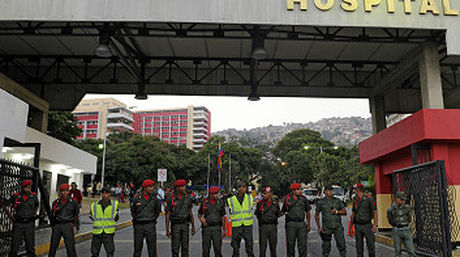
hospital chavistas celebraban presidente AFP NACIMA20130221 0259 19 ICYMI: The homecoming

Courtesy of: AFP

Ten weeks after flying to Cuba for his fourth cancer operation since June 2011, President Hugo Chávez returned to Venezuela in the early hours of February 18th. But the manner of his arrival suggested that he remains far too ill to govern. Only his closest aides, including a medical team, were on hand. Even senior cabinet members and leaders of the ruling United Socialist Party of Venezuela (PSUV) were kept in the dark. The president was taken to a military hospital, and installed in a tightly guarded ninth-floor ward reserved for senior officers. No images of his return were made available, but the party organised “spontaneous” demonstrations of joy on the part of his supporters once the news had been announced on the president’s Twitter account.

Since leaving Caracas for Havana on December 10th Mr Chávez, who has ruled his country in a hyperactive fashion for 14 years, has been neither seen nor heard. In a series of vaguely worded official communiqués, the government admitted that a severe post-operative lung infection left him with breathing difficulties. On February 15th it belatedly presented a “proof of life”, in the form of several photographs of the president with his eldest daughters, holding a copy of the Cuban government newspaper Granma from the previous day. But the photos (one of them is above) raised more questions than they answered. An accompanying statement said Mr Chávez is barely able to speak, thanks to a tracheotomy to ease his breathing (no tube was visible in the photos).

Despite all this, officials continue to insist that the president is in day-to-day control of the administration. They said, for example, that he had authorised a 32% devaluation of the currency, the bolívar, announced on February 8th, the eve of the Carnival holiday, when most Venezuelans are thinking about the beach. The president’s return has also served to distract attention temporarily from the deteriorating economy.

Nicolás Maduro, the vice-president, is to all intents and purposes running the country, but vehemently denies that he is the acting president. Mr Chávez’s return will at least obviate the need for ministers to make frequent visits to Havana for bedside consultations. Those visits fuelled speculation that instructions were being imparted by Cuba’s communist leaders, rather than by Mr Chávez. The homecoming cut short a growing protest against Cuban interference staged by students outside the island’s embassy in Caracas.

But in other ways Venezuela remains in the constitutional limbo that began on January 10th. That was the date on which Mr Chávez should have been sworn in for his fourth consecutive term after an election on October 7th. The supreme court, which Mr Chávez has turned into an appendage of the executive, ruled that as a re-elected president he could be sworn in whenever his doctors deemed him fit enough. More controversially still, they extended indefinitely the tenure of the existing cabinet, including the unelected Mr Maduro, whom Mr Chávez before his operation had anointed as his chosen successor. The court thus brushed aside constitutional stipulations concerning the president-elect’s incapacitation, which include the appointment of a medical board to determine his fitness for office.

Nevertheless, Mr Chávez’s return to Caracas makes possible his swearing-in, which is likely to be administered by a delegation from the court in private, rather than before the National Assembly. That in turn would give constitutional legitimacy to Mr Maduro’s role as vice-president (which technically lapsed on January 10th). But the government seems in no immediate hurry to take this step, perhaps because of the gravity of the president’s condition, including his speech impairment. Mr Chávez “will be sworn in when he’s good and healthy,” said Aristóbulo Istúriz, a state governor and leading PSUV member. The opposition Democratic Unity alliance is wondering aloud whether a man who is not fit enough to be sworn in can be considered fit enough to run the country.

Few but the president’s most fervent supporters believe he will recover sufficiently to serve his six-year term of office. Mr Chávez’s son-in-law, Jorge Arreaza, who is also the science minister, referred last week to “palliative treatments”, which suggested that the president has come home to die.

Foreign diplomats in close touch with the regime expect a fresh presidential election by June at the latest. This would almost certainly pit Mr Maduro against the opposition’s Henrique Capriles, who lost to Mr Chávez in October. The president’s death, his resignation or other “permanent absence” would, according to the constitution, trigger an election within 30 days. But the supreme court is skilled in creative interpretation of the constitution so as to suit the government’s cause.

Some analysts suggested that the devaluation, which is bound to spark an increase in inflation (already at 20% a year), was a sign that the regime had ruled out an early election. Rather, it may be an indication of the gravity of Venezuela’s economic plight. Wild spending ahead of the October election and the economy’s mismanagement pushed the fiscal deficit to 8.5% of GDP last year. Several staple goods are in short supply and the Central Bank’s liquid reserves are down to about $4.5 billion. In the illegal black market, the dollar buys 23 bolívares, compared with the new official rate of 6.3.

One indication that an election may come soon is that government newspapers have begun to publicise polls which suggest that Mr Maduro would easily beat Mr Capriles in a vote. Mr Maduro himself has been engaged in an undeclared campaign for some time: he blamed the devaluation and shortages on speculation and sabotage by what remains of Venezuela’s battered private sector. Some in the opposition coalition want to name their candidate so as to be ready for a snap election. Barring a miraculous recovery by Mr Chávez, Venezuelans may soon be going to the polls again.

To read this article at The Economist, please click here.
 
Feb
8
2013
Posted by
admin
Comments

In Case You Missed It…Articles Roundup Week of 2/8/13

92073vencemos e1360359042638 In Case You Missed It...Articles Roundup Week of 2/8/13

Courtesy of: TalCual

This week: Questions emerge as a former Iranian official is caught in Germany with an undeclared check worth around $70 million in Venezuelan currency; oddly, the Venezuelan government then accuses the opposition of corruption, as doubts grow that “chavismo” will survive without President Hugo Chávez; the anniversary of Chávez’s failed coup in 1992 calls into question who is actually in control of Venezuela; and foreign minister Elías Jaua visits China seeking further loans as shortages continue to frustrate consumers. The Economist Intelligence Unit considers Caracas, Venezuela the most expensive city in the Americas by; in the two months since Chávez’s last public appearance, shortages of staple foods continue to pile up throughout Venezuela; and the state-owned oil company Pdvsa receives more money from the Central Bank, adding more bolivars into circulation and thus boosting inflation. Lastly, after slamming the idea of spending cuts during election season, Chávez’s government moves to enact spending cuts to delay a currency devaluation; the increasing political and economic uncertainties facing Venezuela continue to impact global markets; and Venezuelan officials find over 100 firearms and 8,000 rounds of ammunition inside the Uribana prison, where a deadly riot last month killed 58.

Iran Official Probed on Undeclared Check, The Wall Street Journal

Germany is investigating a former head of the Iranian Central Bank for smuggling after customs officials seized what they said was an undeclared $70 million check he was holding from a Venezuelan state-run bank.

Venezuela rivals trade blows on corruption, Financial Times

The Venezuelan government has accelerated a mud-slinging campaign to discredit the opposition, accusing it of corruption, as doubts grow that the socialist revolution can survive without President Hugo Chávez to lead it.

On Venezuela’s coup anniversary, the big question: Who’s in control?, The Dallas Morning News

Today is the anniversary of Hugo Chavez’s failed 1992 coup attempt against then-President Carlos Andres Perez. Chavez was an army lieutenant colonel at the time of the coup, and he was responsible for deaths and blood spilled in his attempt to subvert democracy and seize power by force.

Venezuela Foreign Minister Jaua in China For More Loans as Shortages Bite at Home, Latin American Herald Tribune

Venezuela Foreign Minister Elías Jaua Milano is in Beijing holding meetings with his counterpart of the People’s Republic of China, Yang Jiechi, as well as Senior Communist Party of China (CPC) leader Yu Zhengsheng, seeking further loans as shortages of goods caused by a lack of foreign currency as well as price controls continue to frustrate consumers in the oil rich Latin American nation.

Caracas, Venezuela Is Most Expensive City In The Americas, Says Economist Intelligence Unit, The Huffington Post

Caracas, Venezuela is the most expensive city in the Americas and the 9th-most expensive in the world, according to the Economist Intelligence Unit. The Venezuelan capital jumped 25 spots from last year, according to CNN.

Venezuela’s economy: Out of stock, The Economist

IT IS now two months since Venezuelans last saw or heard from their president, Hugo Chávez, who remains in intensive care in a high-security Havana hospital, battling what seems to be terminal cancer. But it is an absence of a different kind that is uppermost in many people’s minds

Pdvsa’s higher funding to central bank spurs inflation, El Universal

In a forum organized by the Venezuelan-American Chamber of Commerce (VenAmCham), Pedro Palma, an economist and a professor at the Higher Business Studies Institute (IESA), remarked that since Venezuela’s state-owned oil company Pdvsa receives more funds from the Central Bank of Venezuela (BCV), there are more bolivars in circulation, thus boosting inflation.

Chavez Enacts Cuts He Once Slammed to Delay Devaluing, Bloomberg News

Hugo Chavez coasted to re-election last year warning Venezuelans that a victory for the opposition would lead to a “giant package” of spending cuts.

Venezuela faces increasing political and economic uncertainty, FTSE Global Markets

Due to Venezuela’s President Hugo Chavez being unable to attend the inauguration for his next presidential term originally scheduled to take place on Thursday, January 10 because of his seemingly terminal cancer, Venezuela faces a period of heightened political and economic uncertainty.

Uribana Prison Arsenal: Guns, Ammo Found In Venezuela After Deadly Riot, Official Says, The Huffington Post

Venezuelan officials found 106 firearms and more than 8,000 rounds of ammunition inside a prison following a riot last month that killed 58 people, nearly all of them inmates, the country’s top prison authority said Thursday.

 
Feb
5
2013
Posted by
admin
Comments

Venezuela’s Economy: Papering Over the Cracks


4e7a2d0fa37e1d03280f6a706700d32d2 e1360094179201 Venezuelas Economy: Papering Over the Cracks

Courtesy of: Associated Press

For years, the Venezuelan economy under Chávez has languished. As the rest of the world emerged from the global recession of 2008, Venezuela has continued to struggle. Soaring inflation – topping 27 percent in 2011 and currently at 20.1 percent – has crippled Venezuelans’ purchasing power. Rampant expropriations, price controls and other heavy-handed policies have harmed business and left farmland idle, sapping more than 11 percent from the country’s gross domestic product between 2005 and 2010.

One would have expected such dreary economic news to make it difficult, if not impossible, for the incumbent Chávez to win reelection last year. But Chávez, in addition to leveraging his control of Venezuela’s media, spent recklessly, using oil revenues to keep the country’s economy afloat through the election cycle. It was also reported that Chávez loyalists offered free goods, such as refrigerators, to induce poorer Venezuelans to turn out at the polls for the president. Such measures, however, are akin to economic steroids; they offered an illusory sense of growth during the politically-vital election period, but severe side-effects are not far behind.

Indeed – as Chávez remains secluded in Cuba – it seems the ruling PSUV are running out of tools to forestall the inevitable reckoning. The nation’s debt continues to mount, leaving the country’s economy ill-equipped to handle any new stress; a recent International Monetary Fund analysis found that Venezuela’s already-high public debt would “balloon” to 145 percent of GDP in the event of a crisis. Expropriations and heavy-handed price controls, meanwhile, are crippling Venezuela’s ability to produce goods domestically. Over the last decade, as Chávez tightened his price controls on goods from flour to chicken to maize, shortages of these staple commodities have tripled. A dearth of flour has prevented Venezuelan bakeries from making bread.  The Wall Street Journal reported Sunday that “the worst food and consumer-goods shortages in nearly four years are making buying flour and other goods such as meat, sugar, cooking oil and toilet paper into a harrowing ordeal. Even medicines, like asthma inhalers, are hard to come by.”

After years of unsustainable policies, the Venezuelan economy still has far to fall. The price of oil has risen threefold over the last decade, hiding the underlying weakness of the nation’s public finances. If and when oil prices dip, Venezuela’s debt crisis would worsen. Chávez spent the run-up to the election siphoning off PDVSA oil revenues into an off-budget discretionary fund. But now, in a tacit acknowledgement of the economy’s weakness, much of this revenue will be re-directed back into the economy. Also, foreign Minister Jaua is now asking China for more loans to staunch the economic pain felt throughout Venezuela.

Meanwhile, unchecked inflation has crippled the value of Venezuela’s currency, the Bolivar. This has made foreign goods ludicrously expensive, even as shortages force Venezuelan people to rely ever more on imports. Economic analysts continue to predict that the government will be forced to devalue Venezuela’s currency in order to support oil revenues. This measure, however, will weaken the Bolivar still further, making imports more costly, eroding living standards and fueling Venezuela’s already sky-high inflation rate.

With the continuing uncertainty surrounding Chávez’s health – and the potential for a new election should he be unable to return – analysts expect the government to delay this devaluation for at least several months longer. In the end, however, years of government mismanagement mean that the Venezuela’s abysmal economic fundamentals cannot be concealed for much longer. As they say, what goes up must come down. The Chávez government has pumped Venezuela with spending, relying on borrowed money and unsustainable oil prices. Meanwhile, the foundation of the nation’s economy – her infrastructure and domestic industry – continues to crumble. Chávez’s cancer may yet claim his life, but the Venezuelan people will remain to feel the pain his policies have wrought.