Oct
3
2012
Posted by
admin
Comments

Will Venezuelans Oust Chavez? Miracles Do Happen

Bloomberg
October 3, 2012
By Enrique Krauze
i6afTBb119I8 Will Venezuelans Oust Chavez? Miracles Do Happen

Illustration by Forest

If Henrique Capriles Radonski triumphs in Venezuela’s elections on Oct. 7, it will be a democratic feat without precedent in Latin American history.

It is possible that an opposition candidate has never faced a force like that represented by Hugo Chavez. His government doesn’t employ physical violence as a state policy, but it exercises another kind of coercive and menacing violence, manifold and oppressive. Its power comes from the ballot box under the tight control of arms — his arms.

When democracy finally edged out dictatorships in Argentina, Uruguay and Chile, the military establishment — because of public repudiation of its genocidal acts — found itself in irreversible retreat.

At the other end of the ideological spectrum, perhaps the only case of an authoritarian leftist regime democratically overturned was that of the Sandinistas in Nicaragua in 1990. But the difficulties then weren’t as great as those involved in the Venezuelan process, for the very reason that the Sandinista government — already in decline at the end of the 1980s — wasn’t democratic, nor did it pretend to be.

Either way, whether against the militarist right or the revolutionary left, democracy wasn’t obliged to retrace a path, but to forge it.

Reclaiming Democracy

In Venezuela, the democrats must go back to before the beginning: They must restore true meaning to what has become a corrupted democracy. Chavez’s explicit aim has been to rule until at least 2030, when he will be 76 (and if he makes it to 76, there is no question he will want to continue). But unlike Fidel Castro of Cuba (and the Sandinistas or the old South American dictators such as Jose Gaspar Rodriguez de Francia of Paraguay or Juan Vicente Gomez of Venezuela), Chavez has astutely used democracy to do away with democracy.

He has accomplished this step by step, institution by institution, imposing his designs and spokesmen on the Legislature, the judiciary, the fiscal and electoral bodies. If he hasn’t finished his demolition work, it is because a broad sector of Venezuelan society hasn’t forgotten the meaning of freedom. In an unequal contest (because Chavez enjoys the private property of public resources, and uses them lavishly to his advantage), that sector has displayed an admirable spirit of unity, and it has in Capriles a young, sensitive and visionary leader. The possibilities of victory are real, but the adversary — despite (or thanks to) his illness — is formidable.

Chavez isn’t just a caudillo: He is a redeemer. To play up that twisted religious dimension, he has abused the media pulpit. For many years, he appeared on the Sunday program “Alo, Presidente,” a six-hour-long reality show in which Chavez delivered monologues, danced, sang, recited, read letters, declared his love for the people, railed at the empire and the “pitiyanquis” (or “little Yankees,” the purported allies of the U.S. within Venezuela), gave lessons on “21st-century socialism,” recalled scenes from his autobiography (which in his peculiar understanding of it is the incarnation of Venezuelan history) and issued thundering decrees.

Before his Cabinet members (all dressed in red, silent and as obedient as children in a classroom), he dictated expropriations, troop movements, diplomatic insults and public policies.

Many people in Venezuelan society rejected this spectacle. But more than half of the electorate celebrated it. For them, Chavez has been the reincarnation of Simon Bolivar and even Christ’s representative on earth, now more so than ever as Chavez has turned his grievous illness into a public calvary.

Chavez Loyalists

Beyond that incarnation is his social role. A considerable number of poor Venezuelans have been grateful to him for the “misiones” he established in 2003 (staffed mainly by Cubans, who have also taken charge of the security apparatus) with the aim of providing health care, food and education.

Though many of these programs have faced serious operational problems and are designed not to promote people’s autonomy, but rather their dependence on government, the “Chavistas” don’t see it that way. The near monopoly on public truth (which Chavez has enjoyed since he expropriated the major public-television channels) has masked reality. Millions of Venezuelans take his word as the mirror of truth, particularly if they are public employees whose income depends — or so they believe — on his munificence.

But the concealment of the truth has been massive. Will Venezuelans ever assess the incredible squandering of the almost $700 billion that passed through the coffers of Petroleos de Venezuela SA, the state-owned oil company that was once a bigger example of modernization than Brazil’s Petroleo Brasileiro SA? It’s impossible to know.

Many understand that Venezuela is in the midst of a crisis: Inflation and crime rates are among the highest in South America, and there are persistent shortages of goods. Basic services are also in chaos as a result of harassment in the private sector and because of inefficiency and corruption.

The Capriles campaign has been brave and conciliatory. His proposals seek to restore financial sense and protect social progress (real or perceived). Chavez has accused him of wanting to end the “misiones”; Capriles insists he will touch them only to improve them. Chavez points to him as the reincarnation of the political old guard of Venezuela; Capriles has shown how the bad practices of Chavismo are similar to those of the so- called Fourth Republic and pledged that his government will correct both.

Chavez has vilified him incessantly with crude insults and has committed the sacrilege of calling him a Nazi, knowing that Capriles’s great-grandparents were exterminated by the Nazis. Capriles, meanwhile, has remained unruffled.

Opposition’s Opening

Anything can happen, including an outbreak of the endemic violence that has plagued Venezuelan history. The fascination with a sick Chavez and his far-reaching control of the state apparatus may bring him victory.

If this is the case, the opposition must press on without pause or discouragement. Chavez may triumph, but it will be a hollow victory, and after his eventual death, divisions within his group as well as internal and international pressures may pave the way for a return to full democracy. Such a development would have the additional effect of precipitating the Cuban transition, drawing us nearer to the emergence — unprecedented in history — of an entirely democratic Latin America.

This outcome, which until recently would have seemed utopian, is at hand if Capriles wins. We have witnessed such a result before, in the December 2007 referendum, when Venezuelans, against all forecasts, voted down a plan for constitutional reform that would have turned the country into a new Cuba.

I have faith in that civic miracle. And I hope that such a victory will herald not only the return of democracy but something much more important and necessary: the reconciliation of the Venezuelan family, divided today by an ideological hatred that is alien to it, that has poisoned it for almost 15 years, and that has choked all possibility of harmony.

(Enrique Krauze is a historian and author of “Mexico: A Biography of Power” and of “Redeemers: Ideas and Power in Latin America.” The opinions expressed are his own. This article was translated from the Spanish by Natasha Wimmer.)

To contact the writer of this article: Enrique Krauze at [email protected].

To contact the editor responsible for this article: Katy Roberts at [email protected].

To read this article on Bloomberg, please click here.
 
Oct
2
2012
Posted by
admin
Comments

Venezuelan President Faces First Real Threat

The Wall Street Journal
October 2, 2012
By José De Córdoba and Kejal Vyas

WO AL294 CAPRIL G 20121002203421 Venezuelan President Faces First Real Threat

Courtesy of: European Pressphoto Agency

CARACAS—Henrique Capriles is a skinny marathon runner and opposition governor who has done something no Venezuelan politician has managed in the past 14 years: pose a serious threat to President Hugo Chávez.

This Sunday, Venezuelans vote in presidential elections that will be the first time since Mr. Chávez won power in 1998 that the outcome isn’t a foregone conclusion.

Opinion polls vary widely, partly because Venezuelans mistrust pollsters. Some surveys show Mr. Chávez with a 10- or even 20-point lead. Others show the race neck-and-neck. Respected local pollster Consultores 21 said Tuesday its last pre-election survey shows Mr. Capriles ahead by 48.9% to 45.7%.

In all polls, however, Mr. Capriles has been gaining ground. And while the president remains the favorite, Mr. Capriles seems poised for the best showing for an opposition politician against Mr. Chávez to date—an outcome likely to position him as the leader of the opposition for years to come.

A close election in this highly polarized country could reverberate far beyond Caracas. Venezuela holds the world’s largest oil reserves. Political turmoil could send oil prices soaring.

No one is sure whether Mr. Chávez would accept a narrow defeat. The opposition plans to have at least two witnesses at every polling station to make sure the vote is counted correctly.

Defeat for Mr. Chávez would transform the political landscape in Latin America. For the past decade, he has been a beacon for anti-American sentiment and symbolic leader of a populist left that governs in Bolivia, Ecuador, Nicaragua and Argentina.

Mr. Capriles, a 40-year-old known as “El Flaco,” or “The Skinny One,” says he would normalize relations with Washington and multinational companies, which have been hit hard by nationalizations under Mr. Chávez.

But the governor’s surge in the polls has little to do with promises to play nice with Uncle Sam or private companies. Rather, he has hit on a formula for challenging the populist president: veer to the left on economic issues and play up the populism. The state governor has vowed to keep Mr. Chávez’s emphasis on the poor as well as the president’s spending programs, some 30 so-called missions that provide everything from subsidized food and housing to free basic medical care.

“We have to improve, strengthen and legalize the Missions,” Mr. Capriles, the grandson of a Holocaust survivors, said in an interview. A devout Catholic, he describes himself as center-left.

Mr. Capriles’s economic team pledges to launch a $100 billion infrastructure spending program and start a cash transfer program for the poor modeled on Mexico and Brazil. It wants to raise the minimum wage and index it to prices—a move that worries economists in Venezuela, which has among the world’s highest inflation rates.

The head of Mr. Capriles’s Justice First Party, Julio Borges, said a Capriles administration would try to make social spending more efficient, but makes no bones about what sells politically in this oil-rich nation of 29 million: “Our movement is called Justice First, not Markets First.”

Mr. Chávez tells supporters that Mr. Capriles is lying about keeping the social programs. In a televised interview Sunday morning, the president complained that his rival is hiding his true colors. “The right wing has had to disguise itself as the left,” he said. Mr. Chávez’s message may be working: Some 44% of Venezuelans believe a Capriles victory would end their social handouts, according to Consultores 21.

And even in the face of Mr. Capriles’ surge, the charismatic president remains the favorite for the vote on Sunday thanks to a mixture of carrots and sticks. Last year, state oil monopoly Petroleos de Venezuela alone spent $30 billion on social programs at Mr. Chávez’s command, including new high-rise apartment towers for the poor that dot the Caracas skyline, according to company data. His government also controls most television and radio.

In the past, opposition candidates have run against a Chávez they have demonized, convinced that most Venezuelans disliked the president as much as they did. But they offered little to Venezuelans who sympathized with the president.

Mr. Capriles seems determined to win Chávez supporters. During the campaign, he has visited more than 300 towns, dashing through hard-bitten hillside slums. He tells crowds that Mr. Chávez did the right thing by putting the poor first, but that his government has been disorganized and corrupt.

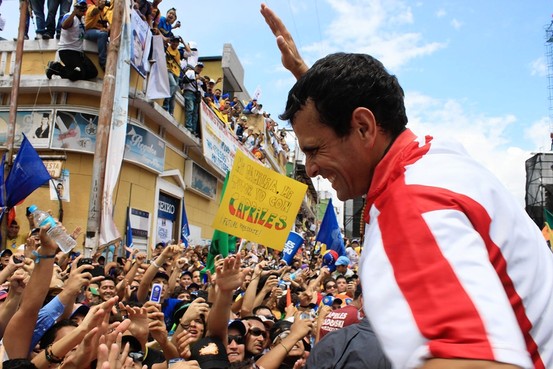
Increasingly, he is getting a rock-star reception even in Chávista strongholds, with women throwing themselves at him to touch or kiss him. One fan, saying she wanted to see what he tasted like, bit the candidate in the hand.

Everywhere he goes, Mr. Capriles focuses on the daily ills that plague Venezuelans like electricity and food shortages, drawing a contrast to Mr. Chávez’s often grandiose goals. The president’s campaign platform calls for the development of a new geopolitical balance that “permits the equilibrium of the universe and guarantees peace on the planet.”

“The people have told us their problems with public services, blackouts, with highways, and with the lack of high schools and housing which the government keeps promising,” Mr. Capriles said during a recent stop in Mr. Chávez’s home state of Barinas.

Even if Mr. Capriles loses, he may get another shot. The president, who has battled cancer for much of the past two years, may be seriously ill. His health is a state secret in Venezuela. If Mr. Chávez dies within the first four years of his term, Venezuela’s constitution calls for holding new presidential elections.

Mr. Capriles plays down his background as the son of wealthy entrepreneurs. Instead, he talks about his grandparents on his mother’s side, Polish and Russian Jews who survived the Warsaw Ghetto before emigrating to Venezuela with a suitcase of clothes and a movie reel that Mr. Capriles’s grandfather used to begin what eventually became Venezuela’s most important movie house chain.

Now a marathon runner, Mr. Capriles was a chubby, shy kid, says one of his best school friends, Alejandro Barrios. Mr. Barrios says that when they were both teens in high school, Mr. Capriles told him he wanted to be president. “I laughed out loud,” said Mr. Barrios. “He was just a normal guy.”

After law school, Mr. Capriles got an early jump on his political career, becoming the youngest ever member of Venezuela’s congress by winning a seat in 1998 elections, the same vote that brought Mr. Chávez to power.

Within two years, he became mayor of Baruta, a key municipality in the capital. In 2004, as mayor, he was imprisoned on charges that he had led a mob against the Cuban embassy during a 2002 coup, which briefly ousted Mr. Chávez from power. He spent four months in jail before being eventually absolved of all charges.

At the time, the jailing was widely seen as a government attempt to sideline Mr. Capriles as an up-and-coming opposition figure. But if so, it backfired. That same year, he won re-election as mayor with 79% of the vote.

He went on to defeat a key Chávez ally, Diosdado Cabello, to become governor of Miranda state. During his tenure, he expanded social programs like free food and housing. He also overcame efforts to undermine him from the federal government, including a move to disarm his state police.

Write to José de Córdoba at [email protected] and Kejal Vyas at [email protected]

To read this article on The Wall Street Journal, please click here.

 
Sep
28
2012
Posted by
admin
Comments

Henrique and Hugoliath: Even if he wins, the Chávez aura is gone

The Economist
September 28, 2012

20120929 LDP003 0 Henrique and Hugoliath: Even if he wins, the Chávez aura is gone

Courtesy of: Reuters

IMAGINE an election in which the incumbent routinely commandeers the nation’s airwaves for endless campaign broadcasts while his opponent gets just three minutes a day. The incumbent uses all the resources of the state—money, vehicles, buildings—for his campaign, and he has branded state social-welfare programmes as his own personal gift. He controls the courts and the electoral authority. His opponent’s supporters fear that the ballot is not secret, and that for those of them who work in the public sector, voting against the incumbent could cost them their jobs. That is Venezuela’s presidential ballot on October 7th. No wonder that Henrique Capriles, the opposition candidate, calls the contest between himself and Hugo Chávez, who has ruled Venezuela for almost 14 years, one of David against Goliath, and that one of his allies says that the election will be “free but not fair”.

Yet despite all these unfair advantages, Goliath is threatened. Although he rules as an autocrat and has hollowed out Venezuela’s democracy, Mr Chávez’s legitimacy derives from the ballot box. That is both his greatest strength—and his biggest potential weakness. Unlike his idol, Fidel Castro, Mr Chávez has regularly held himself accountable to the voters, and so far always prevailed. There are two main reasons for that. Even his biggest detractors would have to concede that the president is a political communicator of genius, who enjoys a unique rapport with many poorer Venezuelans. Second, he has been fortunate that his rule has coincided with an unprecedented rise in the price of oil, his country’s main export. That has allowed him to shower tens of billions of dollars on social programmes, and to deploy largesse in order to pose as the champion of the downtrodden throughout Latin America. Had it not been for the oil boom, Mr Chávez would surely have long since become a footnote in Venezuelan history.

A convincing challenger

But there are clear signs that Mr Chávez’s appeal is finally fraying (see article). And so it should: by any objective standard, he has squandered his extraordinary oil windfall. His regime is corrupt and incompetent. His hounding of the private sector has made the country ever more dependent on the state oil company, which he has turned into a bloated all-purpose development agency. Venezuela’s infrastructure is decaying. Unchecked violent crime has made it one of Latin America’s most dangerous places.

For its part, the opposition has learned from its travails. It has put aside past squabbles and united behind Mr Capriles. He is sensibly trying to close Venezuela’s partisan divide by promising to maintain and improve most of Mr Chávez’s social programmes, while pledging to crack down on corruption and boost the economy by seeking the foreign investment the president has shunned.

For all these reasons, Mr Capriles deserves to win, and he just might do so. Although most opinion polls give the president a five-to-ten-point lead, many voters say they are undecided. And although the campaign has been unfair, the electronic voting system itself seems tamper-proof.

If Mr Capriles does win, it will be up to the army and the rest of Latin America to ensure that the result is respected. The unpicking of Mr Chávez’s Bolivarian Revolution would make for a difficult transition. Even if Mr Chávez prevails once more, he is unlikely to enjoy the sort of landslide he got in 2006. His health is uncertain and his pre-election spending binge will force him to tighten the purse-strings later this year. Win or lose, Latin America’s most controversial autocrat is a diminished figure.

To read this article on The Economist, please click here.