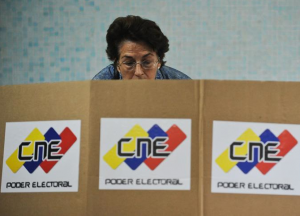
A woman votes on Sunday elections in Venezuela.
By Francisco Toro*
Venezuelan politics doesn’t make much sense at the best of times, and last night was not the best of time. An electoral system mandated by the Constitution to establish Proportional Representation in legislative election has given Chávez’s ruling United Socialist Party of Venzuela (PSUV) some 95 seats (60% of the National Assembly) on the back of just 48% of the National Popular Vote. The Opposition Alliance, meanwhile, despite nearly matching the government’s tally with 47% of the vote, was left languishing with just 62 out of the Assembly’s 165 seats.
A small dissident leftist party won 2 seats, with six more too close to call and still to be adjudicated.
While the Opposition did manage to hold the government below its stated goal of a 2/3rd Supermajority in the Assembly, the real story is that the government had a shot at it in what was, basically, 50-50 election. This was only possible through the use of a mass of biased rules that, taken together, demonstrate how easily the government can now bend the country’s institutions to suit its narrow, electoral purpose.
Of course, non-proportional congressional elections are not, in and of themselves, undemocratic. It’s well known that First Past The Post voting systems, like the ones used in the U.S. and other Western democracies, routinely produce disproportionate seat distributions.
This may strike you as fair or unfair, but it’s certainly not unconstitutional: the U.S. constitution never set out to establish proportional representation in Legislative Elections.
What’s remarkable about the Venezuelan case is that our Constitution quite explicitly enshrines Proportional Representation in Legislative Elections. This is not some holdover from the ancien-regime, it’s the Constitution President Chávez championed in 1999 that contains this clause.
And, indeed, the Venezuelan voting system includes elaborate safeguards to ensure proportional results. Chief among them is list voting. In effect, in congressional elections, Venezuelans vote twice: first in first-past-the-post constituencies, and then again in state-wide party lists. List voting was designed to preserve proportionality in the overall results, counteracting the non-proportionality in First Past the Post voting.
The rub, of course, is that the National Elections Council – the body charged with organizing elections – is a fully controlled subsidiary of the Chávez movement. Through a mixture of gerrymandering and one subtle change to the List Voting rules, the Council managed to create a system that retains the appearance of proportional voting, while yielding entirely disproportional results.
Take, for example, the industrial state of Carabobo – the kind of Urban state the opposition needed to do well in. CNE divided Carabobo into 5 heavily gerrymandered districts that elect 7 members to the Assembly (since not all constituencies are single-member), with a further 3 members elected by statewide proportional list. Overall, then, the state elects 10 deputies.
Last night, in list voting, the opposition out performed the government by 54 to 46% in Carabobo state. But due to a heavily gerrymandered map, the opposition won just one First Past the Post seat, leaving the government with the other six district seats.
In a proportional system, list voting would step in to try to correct that distortion, awarding all three of the List seats to the opposition to bring the overall Seat Distribution to 6 for the government and 4 for the opposition: note that, in this case, the government would still get most of the seats in a state it had lost, thanks to gerrymandering.
But it gets worse: it’s at this point that that sneaky rule change I mentioned earlier comes in. The Elections Council lifted the link between list voting and circuit voting, making the List voting a stand-alone election run alongside the district voting. This seemingly innocuous change ensures that the government receives one of the three ”List seats” as well. Rather than adding proportionality to the system, List Voting now further skews the results away from it.
In Venezuela’s “proportional” election system,the government won 7 seats out of 10 in a state where it lost the vote by 54% to 46%
And so, in Venezuela’s “proportional” election system, the government won 7 seats out of 10 in a state where it lost the vote by 54% to 46%!
Repeated throughout the country’s 24 states, this gerrymandered map together with a non-proportional list voting system added up to a government landslide…on 48% of the vote.
Of course, in a functioning democracy, the opposition would have redress of some sort: access to a court able to put this flagrant violation of the constitution right, some means of enforcing the Electoral norms established – paradoxically – by their opponents. In Chávez-era Venezuela, though, with courts that are as committed to the power of the ruling party as our Elections Council is, there’s no such recourse is possible.
Amid this grim outlook, one reality remains: chavismo does still accept the need for electoral legitimacy, and the kinds of rules-based shennanigans that allowed Chavista elections officials to grant the government 60% of the seats on 48% of the vote only work in a complex congressional election. In a simpler, nationwide vote – such as the upcoming 2012 presidential election – that dog just won’t hunt. Which is why we can be sure that the government’s failure to clear the 50% mark last night will weigh heavily on chavista shoulders.
Francisco Toro is a Venezuelan journalist, political scientist and blogger. He edits since 2002 Caracas Chronicles, a well-known blog about Venezuela.