Jan
18
2013
Posted by
admin
Comments

In Case You Missed It… Articles Roundup Week of 1/18/13


628x471 In Case You Missed It… Articles Roundup Week of 1/18/13

Courtesy of: Associated Press

This week: Venezuelan Vice-President Nicolás Maduro travels to Cuba to meet ailing President Hugo Chávez, who has not been seen or heard in public for over five weeks; Maduro and other powerful Venezuelan officials meet with the Castro regime in Havana, angering Venezuela’s opposition; Brazil urges Venezuela’s government to follow the constitution and hold elections if Chávez dies; and the Venezuelan government uses accusations of hoarding and price speculation to deflect blame for shortages and their failed economic policy. Maduro delivers short state-of-nation address amid Chávez’s absence, sparking legal debates about his legitimacy; Chávez’s absence and the surprise appearance of his signature on an official decree sparks doubts and questions; and Venezuela’s opposition leader Henrique Capriles demands proof that Chávez is still alive and in charge of the country. Lastly, human rights groups condemn government crackdown against Globovisión, Venezuela’s only TV channel critical of Chávez; Moody’s Investors Service changes Venezuela’s outlook to negative because of increased political uncertainty; and a divided military is expected to play the role of central power broker between the government and Venezuela’s opposition.

Venezuela’s Maduro Arrives in Cuba to Visit Ailing Chavez, Bloomberg

Venezuelan Vice President Nicolas Maduro arrived in Havana today to visit President Hugo Chavez, who hasn’t been seen in public for a month since going to the Caribbean island for a fourth cancer operation.

Meeting in Cuba Angers Venezuelan Opposition, New York Times

With the president absent and ailing, the country on edge and the government eager to portray a sturdy sense of continuity, there might be nothing unusual about the most powerful officials in Venezuela meeting over the weekend, except for the location they chose for the sit-down: Havana.

Exclusive: Brazil wants Venezuela election if Chavez dies – sources, Reuters

Brazil is urging Venezuela’s government to hold elections as quickly as possible if President Hugo Chavez dies, senior officials told Reuters on Monday, a major intervention by Latin America’s regional powerhouse that could help ensure a smoother leadership transition in Caracas.

Venezuela cracking down on businesses accused of hoarding food amid sporadic shortages, Associated Press

Mireya Bustamante spent most of the day trying in vain to find flour to bake a birthday cake for her 4-year-old son. Like most Venezuelans, the single, 33-year-old officer worker has periodically struggled with such food shortages for years, and, like many in the country, thinks they’re getting worse.

Venezuelan vice president delivers short state-of-nation address amid Chavez’s absence, Associated Press

Venezuelan Vice President Nicolas Maduro took the place of the country’s ailing president Tuesday by delivering a short state-of-the-nation address amid legal debate about his legitimacy. Maduro submitted the report in writing from ailing President Hugo Chavez, who is receiving treatment in Cuba after undergoing his fourth cancer surgery.

Critics Question Chávez Signature on an Official Decree, New York Times

A tempest in an ink pot has broken out over the signature of President Hugo Chávez, which suddenly appeared on a government decree this week despite his long absence from the country.

Chávez Opponent Asks For Proof Leader is Alive, Wall Street Journal

Venezuela’s opposition leader Henrique Capriles on Wednesday demanded that ailing President Hugo Chávez prove that he is still alive and in charge of his country.

Rights Groups Condemn Crackdown on Venezuela TV, Associated Press

Rights groups are condemning an order by Venezuela’s broadcast agency for a television channel to stop showing clips that question the legality of postponing President Hugo Chavez’s inauguration.

Moody’s changes Venezuela’s rating outlook to negative, Moody’s

Moody’s Investors Service today changed Venezuela’s outlook to negative from stable and affirmed the B1 local currency and B2 foreign currency government bond ratings.

Venezuela military to play central power broker, Associated Press

In a country riven by political strife, Venezuela’s military often has served as the arbiter of power. It has launched coups and frustrated them and dispatched soldiers to guarantee stability, distributing food, fighting crime and securing oil fields.
 
Jan
18
2013
Posted by
admin
Comments

ICYMI: 5 Ways Hugo Chavez has Destroyed the Venezuelan Economy

ABC News
January 17, 2013
By Stephen Keppel

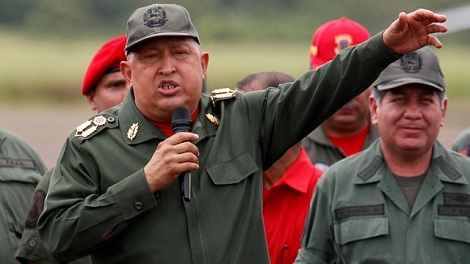
ap chavez military uniform wg ICYMI: 5 Ways Hugo Chavez has Destroyed the Venezuelan Economy

Courtesy of: Associated Press

It is unclear if Venezuelan president Hugo Chavez will make a full recovery from his most recent surgery in Cuba. Whatever happens, he always stirs a lot of passions. Certainly that is the case when thinking of what his lasting legacy in Venezuela will be.

On the left he is seen as a socialist hero who broke the Venezuelan “oligarchy” and defended the country against the “American Empire.” On the right he is the socialist anti-Christ who “brought Afghanistan to South America.” But perhaps one of the simplest ways to judge his reign, is to remove the politics and look closely at his economic record.

Take gross domestic product, or GDP. In that case the record is certainly mixed. There was strong economic growth from 2004 to 2008 but GDP fell in 1999, 2002, 2003, 2009 and 2010. From the time Chávez took office in 1999 to 2011 Venezuela’s economy grew by an average of 2.8% per year. During this same period Latin America as a whole grew by 3.3% per year and Brazil grew by 3.4% per year.

Others will argue that we must judge Chavez on his record of reducing poverty and inequality. According to the UN’s Economic Commission for Latin America, the percentage of the population living under the poverty line in Venezuela fell from 49.4% in 1999 to 27.8% in 2010. That is a pretty good record but there were similar trends across Latin America. In the region as a whole poverty dropped from 43.8% in 1999 to 31.8% in 2010. A few countries, like Peru, Brazil and Panama, faired even better than Venezuela. Poverty rates in Peru dropped sharply from 54.7% in 2000 to 31.3% in 2010—all three have solidly capitalistic economies.

Inequality has declined in Venezuela but it has across other parts of Latin America as well particularly in Brazil, Chile and Colombia.

When you take a closer look at the entire economy, and where Venezuela is headed, the record is not a good one. Here are five major ways that Chavez has really undone the Venezuelan economy:

1. Venezuela has gone from being dependent on oil to being extremely dependent on oil.

Former minister Gerver Torres points out that in 1998 oil represented 77 percent of Venezuela’s exports but by 2011 oil represented 96 percent of exports. That means today only around 4 percent of the goods that Venezuela exports are non-oil products! The Venezuelan economy relies almost exclusively on the price of oil and the ability of the government to spend oil revenues. This will take years to reverse because of item two below.

2. The Chavez government has crippled private businesses and national industry through expropriations and nationalizations.

The Chavez government has expropriated or nationalized numerous companies (no one seems to be able to count them all) involved in various sectors including aluminum, cement, gold, iron, steel, farming, transportation, electricity, food production, banking, paper and the media. The number of private companies in industry has dropped from 14,000 in 1998 to only 9,000 in 2011, according to Torres.

Companies need investment to grow and hire new workers. One of the biggest failures of the Chavez government has been to drive away both domestic and foreign investors. In 2011 Latin America enjoyed a record of more than $150 billion in foreign investment with Brazil receiving $67 billion. Venezuela’s neighbor Colombia received $13 billion while Venezuela received only $5 billion. To avoid expropriation and find investment a number of Venezuelan companies have moved to Colombia, Panama and the United States.

3. The Venezuelan currency is a mess.

The new currency, the Bolivar fuerte, is anything but strong. The Bolivar fuerte has lost nearly two-thirds of its value since it was launched in 2008. Many analysts expect Venezuela will have to go through a painful devaluation sometime this year or next. This will further reduce the value of wages and sharply increase the costs of imports of basic staple goods. Life will get tougher for most Venezuelans but Chavez probably won’t be around to see it.

4. Prices in Venezuela have gone up by 23 percent a year for more than ten years.

Inflation in Venezuela has averaged 23 percent during 1999-2011 compared to a Latin American average of 4.6 percent. Imagine what life would be like if the price of groceries went up 23 percent every year. This craziness combined with stringent price controls has completely distorted the economy, creating black markets and shortages. In 2012 Venezuela will again have one of the highest inflation rates in the world.

5.Under Chavez Venezuela has become one of the most violent countries on the planet.

The murder rate per 100,000 citizens has risen from 25 in 1999 to 45.1 in 2011. This is not an economic stat per se but violence has an economic impact. It is more challenging and dangerous than ever to do business and go to work in Venezuela. When you consider these points, it’s hard to call the economic legacy of Chavez and his band of 21st Century Socialists a good one.

To read this article on ABC News, please click here.


Jan
15
2013
Posted by
admin
Comments

Key Players in a Post-Chávez Venezuela

00004995115 Key Players in a Post Chávez Venezuela

Courtesy of: EFE

With each passing day of silence, the prospect that cancer-stricken Hugo Chávez will recover becomes less likely. Chávez has been absent from Venezuela for over a month and rumors about his death or incapacitation are rampant, leaving many wondering who will take over the presidency if he dies. On January 10, the constitutionally-mandated date Chávez was to be sworn in, government officials planned – and executed – an inauguration. International leaders flew in for the festivities, attended by thousands of Chávez supporters and government officials.  But the main attraction – Chávez himself – was nowhere to be found, apparently still convalescing in a Cuban hospital. In lieu of the president, the president’s supporters took the oath, donning presidential sashes a well as signs and t-shirts that read “I am Chávez.”

Government officials announced they would go forward with a symbolic event in the president’s honor just one day before the inauguration, when the Supreme Court voted to delay the president’s inauguration.

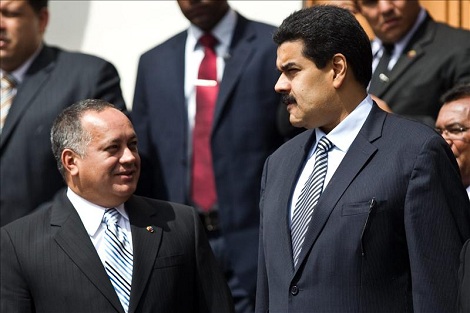
But as Venezuela remains in limbo, many are wondering what’s next for Venezuela. According to the constitution, four scenarios remain possible depending on when and if the president passes away. Despite the nuances of each, the one consistent fact is that if the president dies or is declared incapacitated, an election must be held. Henrique Capriles has emerged as the leader of the opposition and the likely candidate to run in a new presidential race. Within the Chávez government, however, are two possibilities. One is regarded as the head of the civilian, ideological members of the party: Cuban loyalist and Vice President Nicolás Maduro. The other, President of the National Assembly Diosdado Cabello, is known for his military ties and influence.

Below is a short background of each of the three possible presidential candidates.

1. Henrique Capriles: Henrique Capriles emerged as the opposition’s clear leader after winning Venezuela’s first ever primary election with 62 percent of the vote in February 2012. Despite losing the presidential election on October 7, Capriles earned 44 percent of the vote, the strongest challenge ever to president Chávez. His status as leader of the opposition was all but solidified two months later when he held on to his Miranda governorship in regional elections, defeating Chávez’s handpicked candidate and former vice-president, Elías Jaua. Capriles defeated Jaua despite significant losses for the opposition across the country.

Capriles’ national political career began in 1998, when at 26 he was elected to the then Chamber of Deputies, becoming the youngest elected member of Venezuela’s parliament. In 2000, Capriles was elected mayor of Baruta, a division of the Greater Caracas municipality in Venezuela. Following his second term as mayor, Capriles was elected in 2008 as Governor of Miranda, one of the largest and most densely populated states in the country, defeating Diosdado Cabello with 53 percent of the vote.

2. Nicolás Maduro: Nicolás Maduro has long been one of Chávez’s closest allies and advisors, both in Cuba and Venezuela. The relationship strengthened since June 2011, when Chavez underwent his first cancer surgery. During Chávez’s absence, Maduro assumed a leading political role, charged with conveying special messages from the president to Venezuelan public. Maduro was named vice-president shortly after October’s presidential election and was designated Chávez handpicked successor just before the president was rushed to Cuba to receive his fourth and most serious cancer surgery.

Chávez and Maduro have a long history together, going back to the founding of PSUV. Maduro even worked on Chávez’s 1998 presidential campaign. Coming from humble roots as a bus driver, Maduro is often regarded as a leader of the ideological faction of the PSUV – truly committed to the principles of socialism. He was elected Foreign Minister in 2006, developing strong ties with the Castros, and quickly becoming well regarded by the Cuban government. He is considered partially responsible for spearheading the creation of the Bolivarian Alliance for the Americas (ALBA) with other left-leaning Latin American governments. Maduro’s profile within Venezuela has continued to grow, acting as president since Chávez departed to Cuba.

3. Diosdado Cabello: Former member of the armed forces, Diosdado Cabello has been a long ally of president Chávez. The two participated in the failed coup attempt of February 1992, landing them both in jail. Cabello became Chávez’s chief of staff in 2001, later serving as Minister of Interior and Justice. During a two-day coup against Chávez in 2002, Cabello assumed the duties of the presidency. He showed his loyalty by quickly sending a group of elite navy troops to rescue Chávez as his first order. Cabello was rewarded with high-level offices, and was most recently re-elected as president of the National Assembly on January 5.

He governed the state of Miranda from 2004 until 2008 when he was defeated at the ballot by Capriles. In 2011 he became Vice-President of PSUV, making him the second most powerful figure in the party after Chávez. Cabello was first elected and sworn in as President of the National Assembly in 2012. As a former soldier, it is clear he has the military power within the party. His business interests and ties to narco-trafficking have raised questions, however, as he has been painted as one of the “boli-bourgeois” who have succeeded financially under Chávez’s government.