Jul
12
2013
Posted by
admin
Comments

In Case You Missed It… Articles Roundup Week of 7/12/13

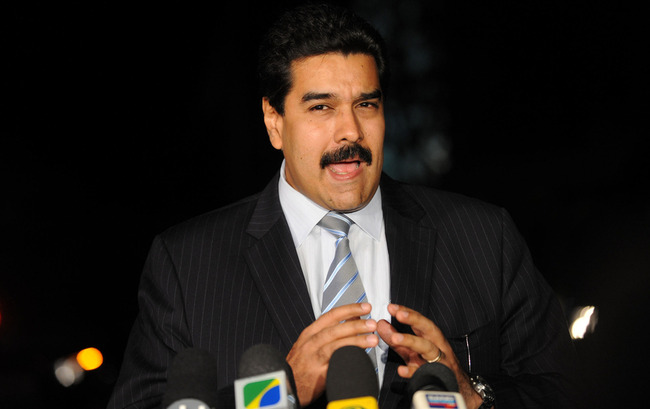
1 photo e1373659882830 In Case You Missed It… Articles Roundup Week of 7/12/13

Courtesy of: Policy Mic

This week: In defiance of Washington, Venezuela offers asylum to NSA leaker Edward Snowden; 44 percent of Venezuelans seek better relations with the United States; if asylum is granted, Venezuela may face economic and diplomatic sanctions by the United States; Maduro faces a potential revolt from radical sectors of his party who think he is negotiating with the United States. Human Rights Watch sends a letter to the United Nations criticizing the Venezuelan government for using criminal investigations to intimidate the opposition; Venezuelan “birther” movement further questions Maduro’s legitimacy; swarms of motorcycles in Venezuela’s capital are linked to violent crime; facing a shortage of hard currency, Christmas toys may be in short supply this year in Venezuela. Venezuelan inflation rises to 4.7 percent in June, reaching a staggering 40 percent for the past year; Venezuelan Central Bank says it will sell $200 million at auction in an attempt to alleviate shortages; the Central Bank of Venezuela removes the cap on the amount of U.S. dollars individuals are allowed to buy via Sicad; Venezuela’s restrictive hiring and firing practices discourage companies from filling openings, further dampening investment in the country; and Venezuelan daily oil exports to US fall 8.3 percent in the first half of 2013.

Venezuela offers asylum to U.S. fugitive Snowden, Reuters

Venezuela’s President Nicolas Maduro offered asylum to Edward Snowden who is believed to be holed up in the transit area of Moscow’s Sheremetyevo international airport; this action was made in defiance of Washington, which is demanding his arrest for divulging details of secret U.S. spy programs.

Many Venezuelans want better relations with the U.S., Pew Research Center

Poll shows that a plurality of Venezuelans (44%) prefer to have a closer relationship with the US than existed during the presidency of Chavez, while Maduro’s offer of asylum to Snowden would entail worsening ties with US, something that the Venezuelan public would avoid.

Venezuela may face economic sanctions if it grants asylum to Snowden, El Universal

Venezuela will face economic and diplomatic sanctions by the United States if Nicolás Maduro’s government grants asylum to former CIA agent Edward Snowden, who formally requested asylum to Venezuela on Monday.

With Snowden offer, Venezuela’s Maduro is on world stage, The Washington Post

American fugitive Edward Snowden’s diminishing possibilities of remaining free to continue releasing information about secret U.S. surveillance programs increasingly appear to hinge on Venezuela, which awaited word Monday on whether the former National Security Agency contractor would accept its offer of asylum and fly to the oil-rich country.

Letter to the UN about post-electoral violence in Venezuela, Human Rights Watch

Human Rights Watch is extremely concerned that Venezuelan authorities are using criminal investigations as a political tool to accuse the opposition, without adequate justification, of the commission of crimes.

Venezuela ‘Birther’ Movement Questions President’s Eligibility, Bloomberg

Venezuela’s opposition has been questioning Maduro’s Venezuelan nationality, since he was born in Colombia to Colombian parents, which would make his presidency fall foul of the constitution.

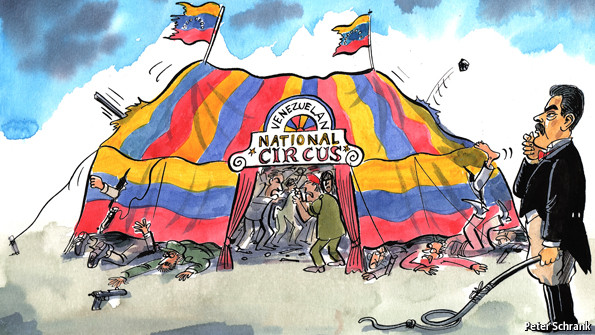
A circus without a ringmaster, The Economist

During the presidency of Hugo Chávez, who ruled from 1999 until his death from cancer in March, the domineering personality of the comandante left no doubt as to who was in charge of Venezuela.

Swarms of motorcycles in Venezuela’s capital tied to traffic chaos, violent crime, Washington Post

Ronald Alvarez was driving in chaotic, bumper-to-bumper traffic when he heard a throaty buzz and insistent “Beep! Beep! Beep!” approaching rapidly from behind.

Christmas toys may be in short supply in Venezuela, Reuters

Whether they’ve been naughty or nice, Venezuelan children might be stuck without Christmas presents this year.

Venezuela’s 12-Month Inflation Rate Advances to Just Shy of 40% in June, The Wall Street Journal

Venezuela’s 12-month inflation approached 40% in June after jumping 4.7% in June and 6.1% in May, pressured by a rise in government spending last year and in the wake of the country’s latest currency devaluation in February.

Venezuela central bank to sell $200 mln in forex auction, Reuters

Venezuela’s central bank said it will sell $200 mill at auction, of which $170 million would be allocated to businesses and $30 million to individuals, under its revamped currency system as government increases imports to alleviate the product shortages.

Central Bank of Venezuela removes cap in sale of US dollars to individuals, El Universal

The Central Bank of Venezuela (BCV) removed a cap limiting the amount of US dollars that individuals are allowed to buy via the Sicad.

Venezuela Forces Employment Even With Shuttered Factories, Bloomberg

Jean Salero gets up at dawn to clock in for his daily shift at a shuttered beer factory in the Venezuelan city of Barquisimeto.

Venezuela’s oil exports to the US fall in 2013, El Universal

Venezuelan oil exports to the US in the period Jan-Jun 2013 hit their lowest level since the 1990s, hitting 754,000 barrels per day from 823,000 bpd in 2012, amidst Venezuela’s strategy to prioritize clients and allies such as China or India and curb oil shipments to the US.
 
Jul
8
2013
Posted by
admin
Comments

ICYMI: A circus without a ringmaster

The Economist
July 6, 2013

20130706 AMD001 0 e1373308466257 ICYMI: A circus without a ringmaster

Courtesy of: The Economist/Peter Schrank

During the presidency of Hugo Chávez, who ruled from 1999 until his death from cancer in March, the domineering personality of the comandante left no doubt as to who was in charge of Venezuela. By contrast Chávez’s successor, Nicolás Maduro, a former foreign minister, has yet to convince people that he is the one running the show. His disputed, razor-thin election victory on April 14th undermined his legitimacy (indeed, the supreme court has yet to resolve the opposition’s claim of fraud). Now the president faces problems within the ranks of the ruling coalition, and in particular his United Socialist Party of Venezuela (PSUV). In the absence of Chávez, there are worries that the PSUV will turn out to be held together, as the colourful Venezuelan metaphor has it, “with parrot spit”.

Fourteen years of chavismo have left the country in a mess. Despite the high price of oil, growth this year will be minimal or negative. Thousands of private companies have gone under, dragged down by regulations and threatened with fines, temporary closure or expropriation. Others have switched from production to importing. Even that is losing its appeal, now that foreign-exchange control mechanisms have seized up and dollars are scarce. Mr Maduro has sought to deal with the concerns of ordinary Venezuelans, as well as striking radical poses to please hard-core chavistas. Crime, poor public services, corruption and food-scarcity have been targeted with loudly trumpeted initiatives. But actually solving these problems will mean confronting powerful interests, and here Mr Maduro has little room for manoeuvre.

Moderates were encouraged when early in his presidency Mr Maduro sidelined Jorge Giordani, Chávez’s Marxist finance minister, and brought in Nelson Merentes, a former governor of the Central Bank who is seen as more ideologically flexible. But subsequent appointments seem designed to appease other interests. Amid talks with the private sector on how to get the wheels of commerce turning again, Mr Maduro last month reappointed Eduardo Samán head of the powerful consumer-protection body, a post he held under Chávez. A self-proclaimed “ultra-radical”, Mr Samán believes that inflation (heading for 40% a year) and empty supermarket shelves are caused by private-sector hoarding and speculation. “Humanity”, he has written, “will succeed in solving the food crisis only with the end of capitalism.”

Tentative efforts to tame corruption have also been undermined by a need to stay on friendly terms with the Chávez clan. On June 12th Argenis Chávez, the late president’s crafty youngest brother, was appointed head of the body that controls the administration of the justice system. On his brother’s watch, the younger Chávez had led the electricity ministry as well as Corpoelec, the graft-riddled state-run electricity giant. On becoming president, Mr Maduro quickly booted him out of both jobs. His return to office demonstrates the enduring power of the Chávez clan, as well as Mr Maduro’s willingness to subordinate the justice system to his political requirements.

Managing these rival factions has forced the PSUV to suspend internal party democracy. Grass-roots chavista radicals had backed Mr Samán’s bid to stand for mayor of Caracas. But party leaders, who see Mr Samán as a loose cannon, ruled out holding a primary that he might have won. Now the PSUV has cancelled all the primaries that were to have been held ahead of local elections, which have been postponed until December 8th. It remains to be seen whether choosing candidates by executive fiat will ruffle fewer feathers than the primaries would have done.

Our man in Havana

Rumours swirl that Mr Maduro could face a more immediate challenge to his own leadership. In a recorded conversation that was leaked on May 20th Mario Silva, the presenter of a state-television talk-show called “The Razor Blade”, was heard apparently passing information to a Cuban intelligence officer. In the recording Mr Silva warned the spy that Diosdado Cabello, the speaker of the National Assembly, wanted to overthrow Mr Maduro. It was a matter of urgency, he said, to cut off Mr Cabello’s sources of income, including the tax authority, which is run by his brother, José David Cabello. A few weeks later police arrested members of an alleged gang within the customs agency, which is part of the tax authority.

A former lieutenant who took part in a failed coup by Chávez in 1992, Mr Cabello has powerful friends in the army. The annual round of military promotions, due to be announced as The Economist went to press, may strengthen his hand. Henrique Capriles, the leader of the opposition, jeers that Mr Maduro’s role is confined to signing the promotions list. “Nicolás, you’re a laughing stock in the armed forces,” Mr Capriles tweeted.

During the presidential election campaign, Mr Maduro was seen as the favoured candidate not just of his predecessor but also of Cuba, Venezuela’s closest ally. A month ago, however, Mr Cabello made a three-day visit to Havana, holding meetings with President Raúl Castro and his brother, Fidel. The trip came shortly after the leaking of the Silva recording. No one knows what sort of deal the Cubans may have struck with Mr Cabello. For the moment, he and Mr Maduro are locked in a macho Latin embrace, of the kind some say was devised as a way for each man to frisk the other for weapons.

To read this article at The Economist, please click here.


Jun
24
2013
Posted by
admin
Comments

U.S. Companies to Chavismo’s Rescue?

jose r cardenas U.S. Companies to Chavismo’s Rescue?

José R. Cárdenas

José R. Cárdenas served in several foreign policy positions during the George W. Bush administration (2004-2009), including on the National Security Council staff. He is a consultant with Vision Americas in Washington, DC.

News that oil giant Chevron is lending $2 billion to the bankrupt regime in Venezuela has raised eyebrows in both Washington and Caracas.  Red flags went up after the parties to the loan issued conflicting cover stories about its intended purpose.  Venezuelan Oil Minister Rafael Ramirez announced that it would be used “to boost production” at the government’s joint venture with Chevron, Petroboscan, in western Venezuela (a line echoed by Chevron’s head of Latin America operations, Ali Moshiri).  However, Chevron CEO John Watson told Spain’s ABC that the loan was instead “designed to facilitate the repatriation of funds and facilitate further operational activity in the Boscan field.”

According to sources in the oil industry, the loan was likely meant to merely maintain operations at the Boscan field and partly to repay PDVSA’s debt to Chevron resulting from non-payment of proceeds from the joint venture.  Indeed, one expert shot down Ramirez’s rosy scenario of increasing production by telling ABC that would require an infusion of at least $8 billion.

Why does this shell game matter?  We know that PDVSA has been bled dry by the late Hugo Chávez and now by his successor Nicolas Maduro, who have siphoned off its revenues to finance massive domestic programs.  Reinvestment in maintenance and oil production has been neglected, which has led to declining output, a shortage of cash, and a failure to repay some $16.5 billion in debts to oil partners.  In other words, this story matters if it means a U.S. company is helping to mask PDVSA’s insolvency.

Chevron is already the only U.S. major oil company to remain in Venezuela after Chávez tore up existing contracts with oil companies to give his government majority control of oil projects.  Chevron’s shareholders have a right to know just what risks the company is taking by lending money to a regime widely recognized for its corruption and mismanagement – not to mention its swelling debt. The Venezuelan people, meanwhile, also have a right to know just what their government is committing to in terms of repayment of the loan.

Here are some of the questions that the Venezuelan people and Chevron shareholders ought to be asking.  What exactly is the $2 billion for?  What is PDVSA’s current debt to Chevron?  What portion of the loan will be used to recoup what PDVSA already owes Chevron?  Given PDVSA’s chronic shortage of dollars, do the terms of repayment include oil, and, if so, at what price per barrel?  Who exactly will receive the proceeds of the loan?  Will it be PDVSA, Petroboscan, or will it remain under Chevron’s control?  In other words, what guarantees are there that the loan will go to its ostensible purpose – whatever that is – and not be squandered by an unaccountable government?  Given the Venezuelan government’s notorious record of abrogating contracts with foreign companies, what guarantees are there that Chevron will recoup its loan?

There are other troubling issues.   It is well-known that the Venezuelan government has for some time been using the threat of canceling its current contracts to strong-arm its oil partners into investing more money in Venezuela. Already this year, Russian and Chinese firms given Venezuela $9 billion in new financing, while the oil services giant Schlumberger has granted Venezuela a revolving credit line of $1 billion.

Finding salvation in Chinese and Russian companies is one thing.  It is quite another when U.S. companies are exposing their shareholders by helping the chavista government dig itself out of the economic hole it has created at great cost to the Venezuelan people and U.S. interests in the region.

That’s why anyone concerned about Venezuela’s future needs to take a hard look at what deals the Maduro government is cutting to keep afloat, especially if it involves U.S. companies.  Maduro’s desperation is great and so likely will be his proclivity to mortgage more of the country’s oil future for short-term political gains.  All concerned should demand transparency and accountability, not only of the Maduro government, but from companies like Chevron, as well.