Jan
11
2013
Posted by
admin
Comments

In Case You Missed It… Articles Roundup Week of 1/11/13

20131713263484734 20 In Case You Missed It… Articles Roundup Week of 1/11/13

Courtesy of: Associated Press

This week: Venezuelan lawmakers re-elect Diosdado Cabello as the head of the National Assembly, who could become the likely caretaker president if Hugo Chávez does not recover; the state television runs videos of Chávez around the clock trying to portray an image of stability during his absence; PDVSA bonds drop amid concern of a succession crisis in the country; and a 0.8 percent setback is recorded in PDVSA’s refining operations due to problems and operative failures. Meanwhile, Venezuela’s Supreme Court rules that Chávez’s inauguration can be postponed, circumventing the wording in the constitution by characterizing him as a  “president re-elect;” too ill to attend, Chávez becomes the first president in Venezuela’s history to miss his inauguration; on inauguration day, the government carries out a celebration on his behalf, further accentuating his absence; and the Obama administration embarks on a discreet but concerted diplomatic initiative to open channels of communication with Venezuela. Lastly, a low supply of US dollars hampers the normal flow of imports, threatening the supply of goods; and Venezuela’s telecom opens an eighth administrative proceeding against private TV news channel Globovisión.

Venezuela lawmakers elect Chavez ally as Assembly chief, Reuters
Venezuelan lawmakers re-elected a staunch ally of Hugo Chavez to head the National Assembly on Saturday, putting him in line to be caretaker president if the socialist leader does not recover from cancer surgery.

With Chávez Ill and State in Flux, Videos Offer an Image of Stability, New York Times
They run around the clock on state television, highly polished videos of President Hugo Chávez hugging children, kissing grandmothers, playing baseball and reciting poetry.

PDVSA Bonds Drop on Mounting Concern About Chavez Succession, Bloomberg Businessweek
Bonds of Petroleos de Venezuela SA, the state oil company, plunged the most in six months amid concern that there will be a succession crisis if President Hugo Chavez is unable to be sworn for a third term on Jan. 10.

Venezuela’s oil refining slips 0.8% in 2012, El Universal
Problems and operative failures in different refineries, including the explosion reported in Amuay refinery, northwestern Falcón state, in August 2012, are accountable for the setback (0.8%) recorded in the refining operations of state-run oil company Pdvsa in 2012.

Venezuela court endorses Chavez inauguration delay, Reuters
Venezuela’s top court endorsed the postponement of Hugo Chavez’s inauguration this week and ruled on Wednesday that the cancer-stricken president remained the South American OPEC nation’s leader.

A Celebration That Accentuated an Absence, New York Times
President Hugo Chávez is famous for speeches that last for hours, and Thursday should have been a special day for the loquacious socialist to let loose.

In Chavez’s absence, U.S. works to open communication with Venezuela, Washington Post
With cancer-stricken President Hugo Chavez battling for his life, the Obama administration has embarked on a discreet but concerted weeks-long diplomatic initiative to open channels of communication with his sharply anti-American government.

Shortage of US dollars threatens food supply in Venezuela, El Universal
Since Venezuela’s domestic demand of goods is higher than production, the gap is filled with imports. Nonetheless, a low supply of US dollars is currently hampering a normal flow of imports, thus threatening the supply of goods.

Venezuelan telecoms board starts proceedings against Globovisión, El Universal
Seeking sanctions, Venezuela’s National Telecommunications Commission (Conatel) has opened an eighth administrative procedure against private TV news channel Globovision.
 
Oct
19
2012
Posted by
admin
Comments

In Case You Missed It… Articles Roundup Week of 10/19/12

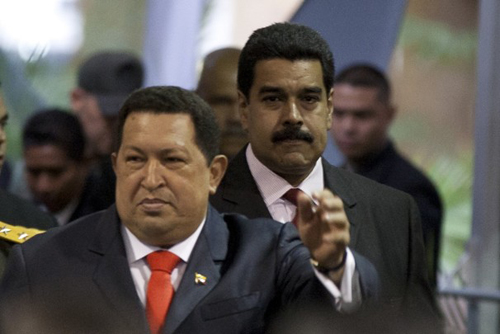
Venezuela Chavez Maduro In Case You Missed It… Articles Roundup Week of 10/19/12

Courtesy of: AP

Less than a week after winning reelection, Chávez swore in his new Vice President, former Foreign Minister Nicolas Maduro and six other cabinet ministers. On Monday Chávez will submit his fiscal year 2013 budget to the National Assembly, largely based on his socialist model. According to the National Institute of Statistics (INE), Venezuela’s inflation rate will reach almost 20 percent by the end of the year. The country’s international reserves are also far below an optimal level. Recent political polarization is threatening freedom of speech in Venezuela, as a new report reveals “mistreatment, detentions, insults, confiscation of equipment, and fundamental rights violations” against journalists, camerapersons, and others in the press. Meanwhile, Chávez has begun to develop Venezuela’s defense industry with plans to build drones with the help of China, Russia and Iran. Chávez breaks diplomatic ties to Paraguay with his decision to expel their diplomats following the ouster of his ally, former President Fernando Lugo. Simultaneously, Chávez’s ties to former Brazilian President Lula are strained after Lula said in a recent interview that Chávez should prepare for his succession. In most recent news, the Venezuelan National Assembly stirs up controversy as they take steps to regulate cable TV.

Venezuela’s Chavez swears in vice president, 6 other ministers in post-election shake up, The Washington Post

CARACAS, Venezuela — Venezuelan President Hugo Chavez swore in his new vice president and six other Cabinet ministers on Saturday, less than a week after winning a new mandate to extend his self-styled Bolivarian revolution.

Venezuela’s 2013 budget bases on socialist model, El Universal

The Venezuelan Government on Monday will summit to the National Assembly a FY2013 draft budget that will be based on the socialist model.

Venezuela Official Inflation Just Under 20%, Latin American Herald Tribune

CARACAS — According to the government’s National Institute of Statistics (INE), Venezuela’s September inflation came in at 1.6%, above the value in August of 1.1%. Factoring in September’s rate, inflation for the first nine months of the year has been 11.5%. One-year inflation stands at 19.98%.

Venezuela’s international reserves far from optimal level, El Universal

Venezuelan international reserves remain below the optimal level (USD 26.8 billion) established by national authorities.

Polarization threatens freedom of speech in Venezuela, El Universal

The Venezuelan Press Block (BPV) presented a report on Sunday at the 68th Inter-American Press Association (IAPA) General Assembly, held at the city of Sao Paulo, Brazil, denouncing increased aggressions against journalists, due to political polarization in Venezuela.

Venezuela serious about producing drones, UPI.com

CARACAS, Venezuela, Oct. 16 (UPI) — Venezuelan President Hugo Chavez is pursuing plans to develop a home-grown defense industry topped by a drone built reportedly with Chinese, Iranian and Russian help.

Venezuela’s government expelling the last of Paraguay’s diplomats in Caracas, envoy says, Fox News

CARACAS, Venezuela – Venezuela’s government has decided to expel Paraguay’s remaining diplomats from the country, the top envoy at the Paraguayan Embassy said Wednesday. Charge d’affaires Victor Casartelli said that he and three other Paraguayan diplomats in Caracas were told by Venezuela’s Foreign Ministry to leave within three days.

Venezuela’s oil exports to Asia to jump to 2.8 million bdp, El Universal

State-run oil holding Petróleos de Venezuela (Pdvsa) is in negotiations with India’s Reliance Industries and Oil & Natural Gas Corp (ONGC) for investments in the Ayacucho and Boyacá oil fields, informed on Wednesday Pdvsa’s Corporate Planning Executive Director, Fadi Kabboul, at a press conference in India.

Venezuela’s Chavez should prepare for succession: Lula, Chicago Tribune

BUENOS AIRES (Reuters) – Venezuela’s newly re-elected president, Hugo Chavez, should start preparing to hand over power, former two-time Brazilian President Luiz Inacio Lula da Silva said in a newspaper interview published on Thursday.

Venezuela’s National Assembly to regulate cable TV, El Universal

The Venezuelan National Assembly (AN) is to make a law for the regulation of subscription television services, informed the President of the People’s Power and Media Committee of the AN, Darío Vivas, deputy for the ruling party United Socialist Party of Venezuela (PSUV).

 
Sep
20
2012
Posted by
admin
Comments

Can PDVSA Survive Chávez?

jose r cardenas Can PDVSA Survive Chávez?

José R. Cárdenas

José R. Cárdenas served in several foreign policy positions during the George W. Bush administration (2004-2009), including on the National Security Council staff. He is a consultant with Vision Americas in Washington, DC.

The recent explosions at the Amuay oil refinery in Punto Fijo that killed some 41 people could not have come at a worse time for Hugo Chávez, as it has drawn intense scrutiny on what has become of the state oil company PDVSA since Chávez imposed total state control over its operations in 2002.

It is not a pretty sight. In fact, the company stands at the center of a cautionary tale about the destructive impact of Chávez’s politically-motivated policies. For today, PDVSA represents less a modern oil company than it does a political operation designed only to boot the political fortunes of the President.

One would think that a company sitting atop what is believed to be the world’s largest oil reserves at a time of record prices could absorb some measure of short-sighted policies and still function ably. That PDVSA is not is a measure of how disastrously Chávez has ignored critical re-investments in maintenance, safety, and the development of new means of production.

Instead, the company’s last ten years have been marked by decreasing production, safety mishaps, politicization of management, inflated payrolls, and corruption. All the while, Chávez has directed PDVSA to take an ever-larger role in activities that have little or nothing to do with extracting and refining oil.

First, production. The government claims it is producing 2.9 million barrels per day (b/d), but experts claim that with refineries today operating at 69 percent capacity the actual output is more like 2.4 million b/d. In 1997, the year before Chávez was first elected, output was around 3.6 million b/d, one-third more than today. Experts say that given Venezuela’s prospects, it should be producing 5 million b/d. So far, high international prices have masked the impact of the declining cash flow, but that mirage will not last forever.

Secondly, those with knowledge of the Venezuelan oil industry say there has been a critical lack of re-investment into maintenance and production. They say investment in oil related activities has averaged $9 to $10 billion per year over the last four years — half of what is necessary to maintain production and just one quarter of what PDVSA needs to expand production and build new facilities.

So where is the money going? Into an account controlled directly by Hugo Chávez, bypassing the Central Bank and the National Assembly, meaning there is no accountability and no transparency of how the funds are dispersed. We do know, however, that earlier this year Finance Minister Jorge Giordani said that the government had invested more than $500 billion in social programs.

Now, there is certainly nothing wrong in using oil revenues to boost the social sector; the critical question is whether those revenues are being used efficiently and with an eye towards the long-term health of PDVSA and Venezuela. But it seems all that is lost on Hugo Chávez. The political goal of – getting re-elected – is all encompassing and trumps concerns of productivity and safety.

Today, PDVSA is involved in activities wholly outside its competence: including managing food imports and distribution, building houses, mining, agriculture, and meat production. Indeed, the list is being constantly expanded according to Chávez’s whims. As such, the number of PDVSA employees has expanded from some 40,000 in 2002 to around 115,000 today. The results have been predictably slap-dash.

Clearly, poor re-investment, declining production, diversion to non-oil related activities, bloated payroll, and skyrocketing debt are taking their toll on PDVSA. With no indication Chávez has any intention to change his policies, it’s an open question how long the company can maintain its present course. But PDVSA’s fate is intricately linked to Chávez’s populist political project. He came to power claiming to the masses that for decades “others” (elites, foreign interests) had plundered Venezuela’s national patrimony at their expense. He was to be their avenger, making up for years of neglect by squeezing every last ounce of Venezuelan crude out of the ground for the people’s benefit — even if he effectively kills Venezuela’s ability to secure oil revenues in the process. Populism may have been a great way to get elected, but it is a terrible way to govern.