Oct
19
2012
Posted by
admin
Comments

In Case You Missed It… Articles Roundup Week of 10/19/12

Venezuela Chavez Maduro In Case You Missed It… Articles Roundup Week of 10/19/12

Courtesy of: AP

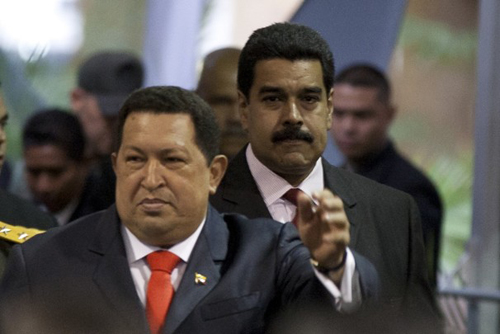
Less than a week after winning reelection, Chávez swore in his new Vice President, former Foreign Minister Nicolas Maduro and six other cabinet ministers. On Monday Chávez will submit his fiscal year 2013 budget to the National Assembly, largely based on his socialist model. According to the National Institute of Statistics (INE), Venezuela’s inflation rate will reach almost 20 percent by the end of the year. The country’s international reserves are also far below an optimal level. Recent political polarization is threatening freedom of speech in Venezuela, as a new report reveals “mistreatment, detentions, insults, confiscation of equipment, and fundamental rights violations” against journalists, camerapersons, and others in the press. Meanwhile, Chávez has begun to develop Venezuela’s defense industry with plans to build drones with the help of China, Russia and Iran. Chávez breaks diplomatic ties to Paraguay with his decision to expel their diplomats following the ouster of his ally, former President Fernando Lugo. Simultaneously, Chávez’s ties to former Brazilian President Lula are strained after Lula said in a recent interview that Chávez should prepare for his succession. In most recent news, the Venezuelan National Assembly stirs up controversy as they take steps to regulate cable TV.

Venezuela’s Chavez swears in vice president, 6 other ministers in post-election shake up, The Washington Post

CARACAS, Venezuela — Venezuelan President Hugo Chavez swore in his new vice president and six other Cabinet ministers on Saturday, less than a week after winning a new mandate to extend his self-styled Bolivarian revolution.

Venezuela’s 2013 budget bases on socialist model, El Universal

The Venezuelan Government on Monday will summit to the National Assembly a FY2013 draft budget that will be based on the socialist model.

Venezuela Official Inflation Just Under 20%, Latin American Herald Tribune

CARACAS — According to the government’s National Institute of Statistics (INE), Venezuela’s September inflation came in at 1.6%, above the value in August of 1.1%. Factoring in September’s rate, inflation for the first nine months of the year has been 11.5%. One-year inflation stands at 19.98%.

Venezuela’s international reserves far from optimal level, El Universal

Venezuelan international reserves remain below the optimal level (USD 26.8 billion) established by national authorities.

Polarization threatens freedom of speech in Venezuela, El Universal

The Venezuelan Press Block (BPV) presented a report on Sunday at the 68th Inter-American Press Association (IAPA) General Assembly, held at the city of Sao Paulo, Brazil, denouncing increased aggressions against journalists, due to political polarization in Venezuela.

Venezuela serious about producing drones, UPI.com

CARACAS, Venezuela, Oct. 16 (UPI) — Venezuelan President Hugo Chavez is pursuing plans to develop a home-grown defense industry topped by a drone built reportedly with Chinese, Iranian and Russian help.

Venezuela’s government expelling the last of Paraguay’s diplomats in Caracas, envoy says, Fox News

CARACAS, Venezuela – Venezuela’s government has decided to expel Paraguay’s remaining diplomats from the country, the top envoy at the Paraguayan Embassy said Wednesday. Charge d’affaires Victor Casartelli said that he and three other Paraguayan diplomats in Caracas were told by Venezuela’s Foreign Ministry to leave within three days.

Venezuela’s oil exports to Asia to jump to 2.8 million bdp, El Universal

State-run oil holding Petróleos de Venezuela (Pdvsa) is in negotiations with India’s Reliance Industries and Oil & Natural Gas Corp (ONGC) for investments in the Ayacucho and Boyacá oil fields, informed on Wednesday Pdvsa’s Corporate Planning Executive Director, Fadi Kabboul, at a press conference in India.

Venezuela’s Chavez should prepare for succession: Lula, Chicago Tribune

BUENOS AIRES (Reuters) – Venezuela’s newly re-elected president, Hugo Chavez, should start preparing to hand over power, former two-time Brazilian President Luiz Inacio Lula da Silva said in a newspaper interview published on Thursday.

Venezuela’s National Assembly to regulate cable TV, El Universal

The Venezuelan National Assembly (AN) is to make a law for the regulation of subscription television services, informed the President of the People’s Power and Media Committee of the AN, Darío Vivas, deputy for the ruling party United Socialist Party of Venezuela (PSUV).
 
Oct
5
2012
Posted by
admin
Comments

Survey Gives Edge to Chávez Opponent

The Wall Street Journal
October 5, 2012
By Kejal Vyas

OB UW131 1005ve G 20121005141618 Survey Gives Edge to Chávez Opponent

Courtesy of: Reuters

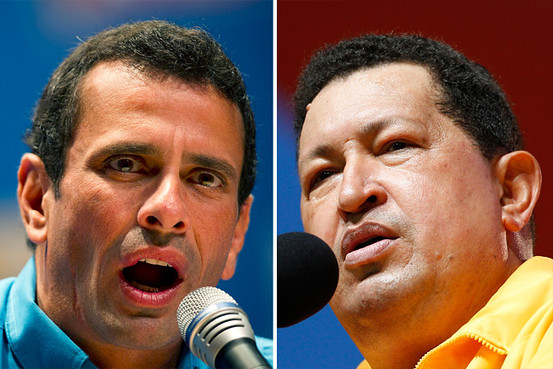
CARACAS—Venezuelan opposition presidential candidate Henrique Capriles has extended his lead over President Hugo Chávez in the latest survey released just days ahead of the hotly contested vote.

Venezuelans head to voting stations this Sunday in a race that is proving to be Mr. Chávez’s greatest challenge after nearly 14 years in office. The president has promised a deepening of his statist policies if he wins another six-year term. However, his campaign was slowed down over the past year as he battled an undisclosed type of cancer, which Mr. Chávez says he has overcome.

The survey conducted by local private pollster Consultores 21 found the challenger increasing his support to 51.8% while Mr. Chávez declined to 47.2%, according to Saul Cabrera, director of the firm. The survey was conducted as a vote simulation between Sept. 27 and Oct. 2 using 1,546 respondents. It had a margin of error of 2.5%.

Earlier this week, Mr. Cabrera said that his firm didn’t use telephone surveys because they found respondents hesitant to answer questions on political affiliation to unknown people. He said those surveys typically found the number of undecided voters shoot up past 20%.

Mr. Capriles, a 40-year-old energetic state governor, has embarked on an aggressive nationwide “house by house” tour since winning the opposition primaries in February. The center-left candidate has pledged to keep many of the social programs that Mr. Chávez spearheaded but says he wants to run them more efficiently and sees a greater role for the private sector in Venezuela’s economy.

Both candidates officially ended their campaigns on Thursday. Mr. Chávez delivered his final appeal to voters during a rain-soaked gathering of thousands of red-clad government supporters who filled the streets of downtown Caracas. Meanwhile, Mr. Capriles capped off his campaign with speeches in three western Venezuelan states.

Though Consultores 21 is one of only two pollsters calling for a close race, most surveys have shown Mr. Capriles closing the gap in recent months.

Venezuelan electoral laws prohibit the publication of polls in the week ahead of elections but Mr. Cabrera said their privately commissioned survey was made available only to clients.

Consultores 21′s last poll published in September had recorded Mr. Capriles leading with 48.9% while 45.7% supported Mr. Chávez. That survey was conducted using a secret ballot and gave Mr. Capriles a wider lead than a separate poll conducted by the firm using open questions, which showed the contender holding a one point advantage.

Venezuela’s political arena remains highly polarized and some critics have challenged the validity of polls.

Write to Kejal Vyas at [email protected]

To read this article on The Wall Street Journal, please click here.

 
Jul
3
2012
Posted by
admin
Comments

Who will Succeed Hugo Chávez?

Over the past several months, What’s Next Venezuela has reported on the uncertainty surrounding Hugo Chávez’s health, including the speculation about who will take Chávez’s place on the ballot should he be unable to stand for re-election on October 7. Over the next several weeks, we will profile the most likely successors to Hugo Chávez, starting today with Elías Jaua.

VICE PRESIDENT ELÍAS JAUA

elias jaua Who will Succeed Hugo Chávez?

Courtesy of: Reuters

Named earlier this year as the head of the newly-created Council of State, current Vice President and Minister of Agriculture Elías Jaua is one of several on the short list to succeed Venezuelan President Hugo Chávez.

Since the return of Chavez’s cancer in February, Jaua has spent significant time in the spotlight. Polls show that he is the most popular member of Chávez’s party, after the president himself. In recent months, he has served as a proxy for Chávez, leading rallies, giving speeches, and attacking the opposition while the president received treatment in Cuba. He remains the government’s point-man for denying any negative reports about President Chávez’s health; when bad news breaks in Venezuela about Chávez’s cancer, Jaua is often the first to brand the stories as rumors and publicly state that the president is in recovery.

He also made headlines after the public allegations of judicial corruption made by former Supreme Court judge Eladio Aponte Aponte. Aponte claims that Jaua held weekly meetings with judges of the Venezuelan high court, telling them how to rule on sensitive cases.

Despite his high profile, Jaua lacks the charisma and eloquence of Chávez, who seems to keep Jaua by his side for his fierce loyalty. Recently, the president showed his gratitude, by putting Jaua in charge of the new Council of State, which many have claimed is charged with planning the transition of power if Chávez succumbs to his battle with cancer. If recent history is any indication, Jaua may just have both the political clout and leadership skills to keep things on track within the PSUV, even if Chávez continues his long absences from the political scene.

Legally, he is next in line should Chávez no longer be able to serve. Article 233 of the Venezuelan constitution states that if the president cannot execute his responsibilities, the vice president will take his place until the next election. If Chávez dies, or is declared incapable performing his duties, Jaua will become the next president of Venezuela, at least until October. Such a scenario would only increase the likelihood that Jaua, as incumbent president, would seek outright election against MUD candidate Henrique Capriles Radonski. As of now, Jaua plans to run for governor of Miranda state in the fall, but if Chávez becomes gravely ill or incapacitated, anything goes.

Originally from the Miranda state, Jaua made his name as a student leader in the 90s. His first meeting with Chávez was in 1996, when he participated in the founding of the Fifth Republic Movement, which is now the PSUV. He was one of the authors of the 1999 Constitution, and has since held various positions under Chávez, mostly in economic roles. He was named Minister of Land and Agriculture in 2006 and Vice President in 2010.

Jaua is currently the default replacement for Chávez, and it’s clear, given his appointment to the Council of State, that he has the leader’s trust. But his apparent lack of personality may be a liability in what will certainly be a difficult election. Timing may be everything; if Chávez is able to win re-election himself he might simply pass on the reigns to Jaua to manage his government. But if his health takes a turn for the worst, he may need to pick someone with more public appeal to get his party past its biggest hurdle yet on October 7.