Reuters via Chicago Tribune
August 15, 2012
Daniel Wallis

Courtesy of: El Nuevo Herald
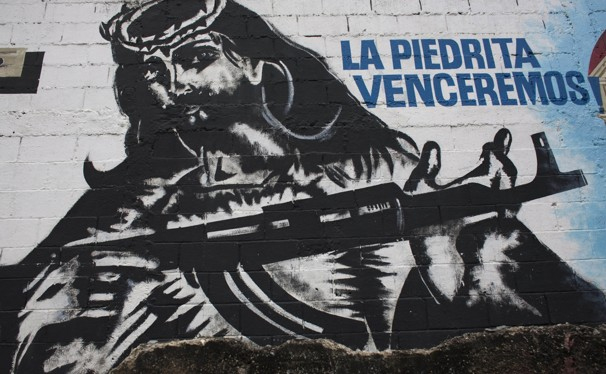
CARACAS (Reuters) — Sitting in front of a mural of Jesus and the Virgin Mary armed with AK-47s, three red-shirted children are clutching assault rifles and copies of Venezuela’s constitution.
The photo, taken in a poor Caracas neighborhood and posted online earlier this year by the militant left-wing group “La Piedrita” (The Little Stone), triggered outrage across the South American nation and beyond.
For many abroad, it was their first glimpse inside Venezuela’s “colectivos” – radical organizations that call themselves the guardians of Hugo Chavez’s socialist project and defenders of their local communities.
In the eyes of critics, the groups are bandana-clad killers and vigilantes, the shock troops of the president’s self-styled revolution. They have become more high-profile in the last four years, and some have been blamed for attacks on people they are said to perceive as enemies of Chavez.
With a presidential election looming on October 7, opposition members fear the colectivos will turn to violence if challenger Henrique Capriles defies the polls and wins.
Although the president denies it, some of his opponents have long worried Chavez could simply refuse to go should he lose.
In rare interviews with Reuters in the 23 de enero (January 23) slum, the colectivos’ heartland near the city center, some of their leaders said they were targets of right-wing propaganda.
“We’re the ones least interested in violence or instability, because our triumph (Chavez’s re-election) is assured,” Juan Contreras, co-founder of the Coordinadora Simon Bolivar group, said at its headquarters, a former police base now adorned with revolutionary paintings.
“We and many other colectivos are armed, but armed with consciousness, with education.”
This is an election unlike any before in Venezuela, with Chavez ostensibly recovering from cancer and a newly united opposition supporting a single candidate for the first time.
Against that tense backdrop, the colectivos’ very existence underlines the risk of street unrest in a divided society where guns proliferate, impunity reigns, and the murder rate is one of the highest in the world.
Despite their unstinting support for Venezuela’s colorful leader and his policies, the more radical groups are something of a public relations nightmare for him, often described as “even more Chavista than Chavez.”
Stung by the reaction to the picture of the armed children, two small girls and a boy, La Piedrita said it was taken during a kids’ theater production about Venezuelan guerrilla leaders of the past, and the guns were fakes.
Since then, security forces have stormed the slum and tried to arrest La Piedrita’s leader. Chavez himself has weighed into the debate, even suggesting that the CIA might be behind some of the recent drama in 23 de enero.
SOCIALIST EXPERIMENT
Overlooking the ornate Miraflores presidential palace, the hilly area draws its name from January 23, 1958, when military dictator Marcos Perez Jimenez fled the country amid widespread rioting and a coup by rebel soldiers.
One of the main scenes of the 1989 “Caracazo” – the Caracas riots over price rises when troops fired on demonstrators and killed hundreds – the slum’s monolithic tower blocks, jumbled stacks of modest houses and winding alleys are home to about 100,000 people.
Most residents are fiercely proud of their neighborhood’s long history of left-wing activism.
Today, the slum is something of a laboratory for Chavez’s socialist project: Stores sell milk and meat from nationalized producers at steep discounts, residents do volunteer work cleaning up streets, and some youth “pioneer” groups are modeled on similar ones in communist ally Cuba that fuse leftist ideology with kids’ activities such as sports and camping.
Residents – many suspicious of reporters, whom they associate with pro-opposition private media – say the Caracas police do not patrol in 23 de enero. Sometimes National Guard troops pass through, they say, but rarely.
In almost one square mile (about two-square-kilometers) of one of most dangerous cities in the Americas, security is almost entirely in the hands of the colectivos. Some set up armed roadblocks after dark, communicating by walkie-talkie, stopping cars and questioning passengers.
Though scattered around Venezuela and probably numbering a few thousand members, the dozen or so best-known colectivos are based in 23 de enero. In a report in June, the International Crisis Group think tank warned they could be used by politicians to stoke violence or could “take to the streets on their own.”
The Venezuelan government did not respond to requests for comment on the colectivos’ role or the opposition’s charges.
Chavez has a double-digit lead in most polls, but his opponent, 40-year-old state governor Capriles, has been campaigning across the country for months, drawing big crowds. An aide said 23 de enero is the only area he cannot go, out of fear for his safety. Someone shot at one opposition colleague when she visited the slum late last year.
“People in the barrio told our advance team: “Don’t even think about it,’” the Capriles aide said.
“These are violent groups that are supported by the government,” the opposition candidate said of the scandal over the La Piedrita photo. “Because of that, they feel cocky, and they put themselves beyond the law with absolute impunity.”
RIPOSTE TO CAPITALISM
Capriles may be deeply unpopular with the colectivos, but Contreras from the Coordinadora Simon Bolivar, named after South America’s 19th century independence hero, denied they meant him any harm.
“He represents the past, the repression and anguish this country lived through, the corruption,” Contreras said at the former police base, which has two hulking watchtowers and walls covered in murals of Bolivar, a masked Palestinian fighter, and Argentine revolutionary Ernesto “Che” Guevera.
“For us, Chavez represents education, health, dignified homes and jobs, and recreation.”
Though denounced as a dictator by his foes, Chavez is adored by many of the poor and portrays his rule as a riposte to four decades of capitalism by governments bent on enriching a small elite.
From the Coordinadora’s veterinarian clinic to its radio station, Internet cafe and left-wing bookshop, the group is staunchly ideological but does not on the surface have the look of a militant group posing a serious threat. It organizes a host of cultural and sports events, as well as activities for pensioners, dances and discussion groups.
As a DJ upstairs spun old salsa tunes, a tattooed volunteer from Spain’s Basque country painted a banner welcoming slum kids to a cut-price summer activities program, overlooked by posters of Chavez, Bolivar and late left-wing Colombian FARC rebel leader Raul Reyes.
“For 30 years this building was the greatest center of repression in western Caracas. They tortured people here, they fired into the blocks,” said Contreras, a courteous 50-year-old with a receding hairline, black T-shirt and black jeans.
Sticking his group’s new election poster to the wall (“The presidency is ours, and it’s staying that way, damn it!”), he said he was radicalized by police brutality against him and his friends during the 1970s, when he was a teenager sporting an Afro.
“If you asked me then, I wanted to be the best footballer in the world, but the circumstances brought me here instead … We didn’t begin with Chavez. We’ve been doing it our whole lives.”
CHAVEZ ACCUSES CIA
Taking a break from work at a small recycling project a few blocks up the hill at Jose Leonardo Pirela, another colectivo, Luis Estrella, a 47-year-old in a bright green polo shirt, also rejected the idea they were plotting violence.
“The opposition always looks badly at what we do in 23 de enero,” he said. “You don’t see any guns here, any cannons, because we don’t have any. We work with the community to solve problems … We’re doing activities that show the president’s message comes with results.”
The colectivos say the days are gone when the more radical groups would pose for videos with weapons. But no one doubts that in a city with as many guns as Caracas, there are lots of weapons in 23 de enero.
Die-hard members of the colectivos were at the forefront of the giant demonstrations that, along with allies in the military, helped sweep Chavez back to power after he was briefly toppled during a two-day coup a decade ago.
That saga, when about 20 people died as big marches by both sides clashed in the streets around Miraflores, has taken on almost religious overtones for some Chavez loyalists. “We saved the president in 2002,” is a common refrain in 23 de enero.
Near Estrella’s recycling project are the apartment blocks controlled by La Piedrita. Since the controversy over the photo of the children, the AK-47 brandished by Jesus in the mural has been repainted as a large blue Venezuelan constitution.
Though many of their members say they would die for Chavez, the groups’ autonomy and unpredictability make them a political liability for him.
The president has, at times, appeared exasperated.
“Are they real revolutionaries? I doubt it,” he sneered in February, a few days after La Piedrita published its picture. Even if it was of a kids’ theater group, Chavez said, it was “indefensible.”
“They want to be more Catholic than the Pope,” he added. “They damage the revolution … I tell you, that group has been infiltrated by the CIA.”
The U.S. embassy in Caracas did not immediately respond to a request for comment on Chavez’s allegation.
Nonetheless, reveling in his own humble roots growing up in a rural shack and much-vaunted love for leftist activist groups, especially in 23 de enero where he casts his vote each election day, he was careful not to condemn the whole neighborhood.
“The bourgeois say everyone in 23 de enero is armed, that there are lots of violent gangs, which is a lie. Get out of here! What a heroic district, the 23 de enero!” Chavez said in a televised speech.
Venezuelan attitudes to the colectivos are as deeply divided as on most subjects in this polarized nation. Some living in the area say they have brought better security, while others say they are gangsters ruling by fear.
“I’m 60, and I can say that these young men have done a lot for 23 de enero. Everyone makes mistakes, but it is false to say they’re bad guys … They fight the bad guys and drug dealers,” said one commenter in an online argument about La Piedrita.
“They’re a band of hoods. They all smoke drugs. To claim they’re doing good for the community is madness,” said another.
“A MONSTER’
La Piedrita’s name alludes to the saying “a pebble in the shoe,” or a nuisance. Founded in 1985 by Valentin Santana, a former head of security at Caracas’ Central University of Venezuela, it is thought to have about 50 members running an area where some 3,000 people live.
The group began life as a predominantly cultural group like many in the area but turned more militant after Santana’s son Diego was murdered in 2006. He blamed right-wing paramilitaries. Local media said one suspect in the case was later gunned down on the Caracas Metro; another was shot eight times but survived.
“Since they took my son away from me, part of me became a monster,” Santana told a reporter from Spain’s El Pais newspaper in early 2009.
Authorities have blamed La Piedrita for attacking people the group views as enemies of Chavez, including staff working at two opposition TV stations, and making death threats to print journalists.
In 2009 the group admitted it threw teargas into the Vatican’s diplomatic residence in Caracas after Chavez accused the Catholic Church of meddling in Venezuelan politics.
That year the president issued an arrest warrant for Santana in connection with those attacks, but he remains at large. The controversy over the photo put La Piedrita, and his freedom, back in the spotlight.
One night less than a week after Chavez publicly denounced the group and said it had been infiltrated by U.S. agents, police helicopters clattered above 23 de enero and SWAT teams closed roads before moving in to try to arrest Santana.
Local media said the La Piedrita boss addressed residents by loudspeakers set up on roofs, calling on other colectivos in the neighborhood to come to his defense.
He slipped away in the night, and hours later the group issued a statement that painted Santana as the injured party. It claimed the security forces had tried to assassinate him and blamed the raid on “counter-revolutionary” forces within Chavez’s government.
“Santana’s only crime is the defense of the REVOLUTION,” the statement read. “We categorically reject the new efforts to discredit La Piedrita and its leader … Long live Chavez! Long live the revolution! Long live Valentin Santana!”
Repeated attempts by Reuters to interview Santana were unsuccessful.
“PSYCHOLOGICAL WAR’
Tensions following the raid lasted several weeks. In March, La Piedrita parked hearses carrying the bodies of two members killed in 23 de enero at the gates of opposition TV station Globovision, holding a demonstration to accuse the channel of waging a “psychological war” and politicizing the violence.
Relative calm has returned to the neighborhood since then. Relaxing in the sun outside another colectivo, Radio23, in a white hoodie and wide Prada-labeled sunglasses, Glen Martinez is another well-known figure locally.
He said the area is safer than other poor parts of Caracas, which routinely records scores of murders each weekend, despite having seen almost no government security forces for nearly a decade.
“Of course there are always problems, like everywhere, but here we can resolve things by talking,” he told Reuters, sitting across from another giant mural portraying the late Libyan leader Muammar Gaddafi, Mexican rebel Subcomandante Marcos, and the slogan “Bloque Combativo 23.”
Two DJs from the radio station perched on a motorbike parked nearby, sharing a cigarette and flicking through a magazine about handguns.
“They say we’re armed, that we’re “the Guardians of Chavez,’ we’re ultra-violent, we’re killers,” Martinez, 41, said with a smile. “No. We’re the people who were excluded (by previous governments), who are now included, dignified and organized.”
His group also runs a newspaper, and during October’s election it plans to send members to polling stations across Venezuela to counter any “lies” told by the opposition media.
“We’re showing that we’re capable of doing valuable, high-quality things in the barrio,” Martinez said.
“We’d be an immense resource for the right, for the multinationals, for capitalism. But we do things from a more social point of view, more Bolivarian, more egalitarian, more humanist. That makes them scared, bro.”
(Additional reporting by Edwin Montilva; Editing by Andrew Cawthorne, Claudia Parsons and Prudence Crowther)
To read this article on the Chicago Tribune, please click here.