Sep
20
2012
Posted by
admin
Comments

ICYMI: Venezuela crime out of control, imperiling Chavez re-election

Venezuela crime out of control, imperiling Chavez re-election

USA Today
September 20, 2012
By Peter Wilson

violence in venezuela 300x203 ICYMI: Venezuela crime out of control, imperiling Chavez re election

Courtesy of: AP / Fernando Llano

EL JUNQUITO, Venezuela — Margarita Hernandez has been waiting more than a year for someone to pay for the murder of her 18-year-old son, killed by thugs a few blocks from his home.

“He was visiting friends when three men approached and shot him without warning,” said Hernandez, who works in a drug store. “The police know who the killers are as my son’s friends identified them — but one of the killers has an uncle in the police, so no arrests have been made,” she says.

Venezuela under President Hugo Chávez has the fourth-highest murder rate in the world and an abysmal crime-solving rate. Police in Venezuela make arrests for only eight of every 100 murders committed in the country of 28 million.

Crime is an issue that has enabled challenger Henrique Capriles Radonski to pull closer to upsetting Chávez in his attempt to win a third term Oct. 7. Some experts blame Chávez for allowing the country to become a transit point for the South American drug trade.

“Venezuela has become a criminalized state,” said Vanessa Neumann, a senior fellow at the Foreign Policy Research Institute. “You have drug traffickers and Colombian guerrillas operating in the country, and government officials have become involved with them. That makes it difficult to combat crime.”

Crime is common in Latin America. The Mexico-based Citizen Council for Public Safety and Criminal Justice, a non-government entity that compiles homicide statistics, found that 40 of the world’s 50 most dangerous cities last year were in Latin America.

Venezuela stands apart in two important areas, said Roberto Briceño León, who heads the Observatorio Venezolano de Violencia, a non-government group that monitors crime in the country.

“First, crime here is increasing unlike most Latin countries that are experiencing a decline,” he said. “And secondly, the government isn’t making it a priority or taking the right steps to combat it.”

Instead, Chávez has made it worse by arming groups who support his presidency and taking over state and city police forces, León said.

Murders and kidnappings have soared since Chávez took office in 1999. Last year, the Observatorio, estimates 18,850 people were murdered, up from 4,550 in 1998. There were almost 16,000 kidnappings, up from a few hundred in 1998.

Venezuela now has more murders annually than the U.S. and European Union combined, and that is despite 18 government anti-crime initiatives that Chávez has introduced.

More than 9,500 murders were committed in the first six months of this year, compared with 8,830 a year agoin the year-ago period, the Observatorio reported. Most of the victims are poor, male and between the ages of 18 and 30. More than 60% are shot five times or more.

Venezuelan newspapers are full of gruesome crimes that go unsolved. Criminals have committed armed robberies in hospital operating rooms and held hostage an entire movie theater audience.

Even high-ranking government officials have been targeted with relative impunity. The father of the pro-Chávez governor of the eastern state of Delta Amacuro was kidnapped earlier this month, while the governor of the eastern state of Monagas was assaulted in January.

Several diplomats assigned to Caracas, including the Mexican Ambassador, have been kidnapped or robbed. Caracas’ once thriving nightlife has gone quiet because many people are afraid to leave their homes after dusk.

Chávez has blamed the upsurge in crime on capitalism, poverty, the breakdown of families and American culture, which he says glorifies violence. His Interior and Justice minister, Tareck El Aissami, said earlier this month that the government has spent more than $500 million in the past few years on crime-fighting measures. A newly created police force, for example, has had marked success in zones where it has been deployed, he claimed.

Briceño disagrees, saying Chávez’s own revolutionary and socialist rhetoric has made things worse.

“The government is confused as to how to respond to the upswing in crime,” he said. “They view using the police as a bourgeois and repressive measure that was used by their predecessors. They want to use new solutions, but they just aren’t working.”

Capriles has capitalized on the crime issue, which surveys show is the voters’ most pressing issue this election.

Besides promising to fire corrupt police officials and deploy more than 20,000 more officers throughout the country, Capriles said he would launch an immediate campaign to disarm the country.

“Whoever has an illegal weapon will have to turn it in, or we will come for it,” he told cheering supporters at a recent rally. He also promised to clean up the country’s prisons, from which criminals direct kidnappings and robberies.

Hernandez voted for Chávez in each of his presidential campaigns. She said she will vote for Capriles this time.

“We deserve better than to live like this,” Hernandez said. “We deserve to live in peace. My son deserved better.”

To read this article on USA Today, please click here.
 
Apr
30
2012
Posted by
admin
Comments

ICYMI: In Venezuela, armed groups that pledge allegiance to Hugo Chavez rule over slum fiefdoms

The Washington Post
April 28, 2012

hugo chavez armed slums ICYMI: In Venezuela, armed groups that pledge allegiance to Hugo Chavez rule over slum fiefdoms

Closed-circuit cameras stare down from lampposts, allowing a heavily armed gang to keep watch over those who dare to enter one of Caracas’ most violent slums. At night, the gunmen cover their faces with ski masks and set up checkpoints, brandishing pistols and ordering residents to identify themselves as they enter the neighborhood.

Here in the 23 de Enero slum, several gangs that pledge allegiance to Venezuelan President Hugo Chavez are effectively the law, ruling over fiefdoms where police seldom venture.

Chavez has occasionally criticized the groups, but the authorities have largely left them alone, stoking accusations by critics that the government is tolerating an armed wing that could prove dangerous in a critical election year in Venezuela.

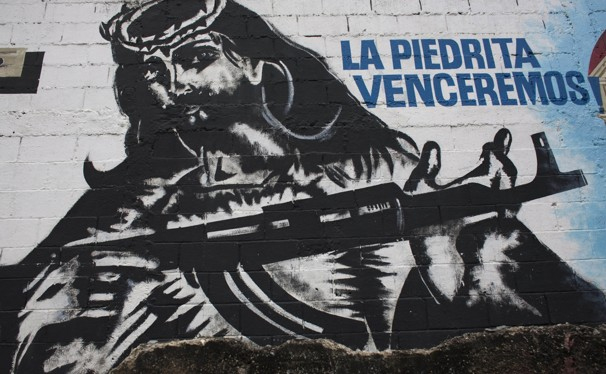
One of the biggest gangs calls itself “La Piedrita,” or “Little Rock.” In its neighborhood turf, murals are painted with slogans such as “For the defense of the revolution, vote for Chavez. La Piedrita.” One of the murals depicts Jesus and the Virgin Mary holding assault rifles.

Nearby, young men wearing olive green caps guard the barred gate of an apartment building that the gang uses as a command center. They don’t welcome visitors, especially journalists.

“Please leave peacefully,” one of the young men said cordially to a team of AP journalists. “From the high-ranking commanders to the low-ranking ones, no one is going to make any statements because you’re going to distort the information.”

As he spoke, another man pointed a 9-mm pistol at an AP photographer, ordering him and a driver to get off their motorcycle, and then demanding they get back on it and leave.

Some of Chavez’s opponents say the government tolerates such groups to use them when convenient to intimidate adversaries, and that it’s hard to predict how they would react if opposition presidential candidate Henrique Capriles were to defeat Chavez in the October presidential vote. Also unknown is how the gangs would react if Chavez were to succumb to his nearly yearlong fight with cancer.

What’s clear is that the gangs wield serious firepower, toting assault rifles that only security forces are legally permitted to carry in Venezuela.

“These illegally armed groups could at some point use those weapons to commit crimes or to destabilize any government,” said Luis Izquiel, who leads a security committee for the opposition. He said if Chavez is defeated and a new government takes over, “the authorities would have to go get those illegal weapons.”

Chavez, who is undergoing cancer treatment, is leading in the polls and has warned his opponents not to try to stir up violence. He has said previously that his socialist movement is “peaceful but armed.”

Chavez has also created a Bolivarian Militia, named after independence hero Simon Bolivar, with tens of thousands of civilian volunteers who participate in occasional boot camp training led by military officers.

Nearly a dozen armed gangs, however, appear to maintain looser ties to the government while controlling their neighborhoods in slums located less than a mile (1.5 kilometers) from the presidential palace.

Opposition politicians estimate about 300 people belong to armed pro-Chavez gangs, many of them young men. There is no evidence, however, that they have received weapons or training directly from the government as some Chavez opponents suspect.

Armed groups such as the “Tupamaros” and La Piedrita have existed for years in western Caracas, even before Chavez took office in 1999. But since then they have expanded, and new groups have emerged.

In rare public appearances, some leaders of the groups have vowed to zealously back Chavez’s socialist movement. Many of the groups call themselves “collectives,” and residents say some, such as La Piedrita, carry out service work including running a community kitchen for the poor. But in photos and videos posted on the Internet, gang members also show off weapons including pistols, AK-47s and R-15 rifles.

Members of La Piedrita have also held menacing protests at the offices of opposition newspapers and anti-Chavez television channel Globovision, hurling tear gas canisters at the buildings. Chavez has publicly disavowed the group in recent years, and in 2009 urged the authorities to detain La Piedrita’s leader, Valentin Santana.

Despite arrest warrants for homicide and other crimes, Santana remains free, and it’s unclear why he hasn’t been captured. Earlier this year, Santana even appeared on state television at a church event.

Wearing a camouflage cap with the bill turned up, he questioned the commitment of some government officials to socialist ideals and pledged “loyalty to our friend Chavez.”

Miguel Dao, a former police chief, criticized the authorities’ failure to act against such groups. “If you have the power and … you don’t do anything, you become an accomplice of these groups,” he said.

Dao said he doesn’t think the gangs would represent a major security risk if Chavez were to be forced from office either by illness or electoral defeat. But for now, he said, “I think these irregular groups are better armed than the police.”

The Justice Ministry did not respond to requests to ask Minister Tareck El Aissami about the government’s stance toward the pro-Chavez groups and the actions that authorities have taken in Santana’s case.

During the first half of his presidency, Chavez had publicly praised Lina Ron, a radical supporter with bleached blond hair who led one armed group.

When Chavez was briefly ousted in a 2002 coup, Ron and others took to the streets in protests that helped usher his return to the presidency. In subsequent years, armed gangs of “Chavistas” on motorcycles regularly circled opposition protests brandishing weapons and displaying the flags of their groups. Sometimes, they were spotted firing shots in the air for intimidation.

Such incidents had become less frequent in the past few years, and by the time Ron died in 2011, Chavez had distanced himself from her brash tactics, which included the protests outside opposition news media buildings.

But on March 4, gunfire erupted during an event where Chavez’s rival Capriles was visiting the traditionally pro-government neighborhood of Cotiza. Both political camps traded blame for the violence, in which one Capriles supporter was wounded. Members of the opposition said they saw some Chavez supporters with guns. No arrests have been made.

In January, La Piedrita found itself at the center of a national controversy when photos circulated on the Internet showing children posing with assault rifles at a ceremony organized by the group. After a public outcry, Chavez condemned the group and demanded the authorities take action.

“This hurts the revolution,” Chavez said.

Prosecutors responded by ordering two women to appear in court as suspects for posing the children with guns. Venezuelan law calls for prison terms of one to five years for adults who provide weapons to children.

The authorities also arrested three members of La Piedrita as suspects in the killing of a bodyguard who had been working for the Justice Ministry.

Criminologist Fermin Marmol Garcia said police and other security forces typically don’t enter 23 de Enero without notifying the armed groups. He said that shows the thugs effectively run a “micro-state” and operate like paramilitary groups, controlling their turf.

People who live in the slum have learned to cope with the pro-Chavez gunmen, some of whom claim to keep the neighborhoods safe from common criminals.

“After 10, 11 at night, you can’t be in the area of 23 de Enero because there are times when they put up checkpoints and stop cars,” said Manuel Mir, a community leader who has lived in the neighborhood all of his life. “They order anyone who isn’t from the area to get out. They’re masked and armed people. It’s unacceptable that groups of this sort are guaranteeing us security.”

To view this article on The Washington Post, please click here.

 
Mar
5
2012
Posted by
admin
Comments

ICYMI: Shooting injures 1 at Venezuela candidate’s event

The Associated Press
March 5, 2012

Gunshots were fired during an event where the leading opponent of President Hugo Chavez was visiting a traditionally pro-government neighborhood, wounding at least one person and prompting both political camps on Monday to trade blame for the violence.

Justice Minister Tareck El Aissami said that the authorities are investigating Sunday’s violence, in which the son of opposition lawmaker Ismael Garcia was lightly injured.

A group of government supporters clashed with backers of opposition presidential candidate Henrique Capriles as he visited the Cotiza neighborhood of Caracas.

In messages on his Twitter account, Capriles accused government supporters of starting the violence.

Garcia said his son, who is also named Ismael, was wounded in an arm.

“The government can’t say it isn’t responsible for this,” Garcia said by phone. He said government supporters from outside the area had come to cause problems, and that Capriles was well-received by many people in the area before the shots rang out.

El Aissami accused the opposition of provoking the violence.

“They went to generate this show,” El Aissami said on state television, according to the state-run Venezuelan News Agency.

He said there was no evidence to back Garcia’s claim that backers of Chavez’s socialist party had opened fire, and he encouraged Garcia to present any evidence to prosecutors.

A prosecutor was appointed to investigate along with the police.

Watch the video below: