Jul
19
2013
Posted by
admin
Comments

In Case You Missed It…Articles Roundup Week of 7/19/13

capriles denuncia en 16083903 In Case You Missed It…Articles Roundup Week of 7/19/13

Courtesy of: EFE

This week: Henrique Capriles arrives in Chile to meet with President Sebastián Piñera, as well as other ruling party leaders and the Venezuelan community in Santiago; Human Rights Watch says Venezuela should guarantee the right of free speech of its own citizens before offering to defend Edward Snowden; U.S. Secretary of State John Kerry tells Venezuelan Foreign Minister Elías Jaua that Washington will halt all refined-oil sales if Snowden takes refuge in Venezuela; and Nicolás Maduro fumes after U.S. envoy to the United Nations criticizes Venezuela’s regime as “repressive.” Annual inflation reaches 39.6 percent, far exceeding the government’s stated goal of 14 – 16 percent; purchasing power declines 10 percent as a result of rising inflation; and the Venezuelan government recognizes scarcity of dollars as a big problem, but only takes tepid steps to solve it. The devaluation of the bolívar is complete with the Central Bank’s auction of dollars, doubling the exchange rate; a new Fitch Ratings report confirms that the country’s foreign exchange policy continues to face challenges; and Maduro marries his longtime companion and prominent PSUV figure, Cilia Flores.

Capriles arrives in Chile; confirms appointment with Sebastián Piñera, El Universal

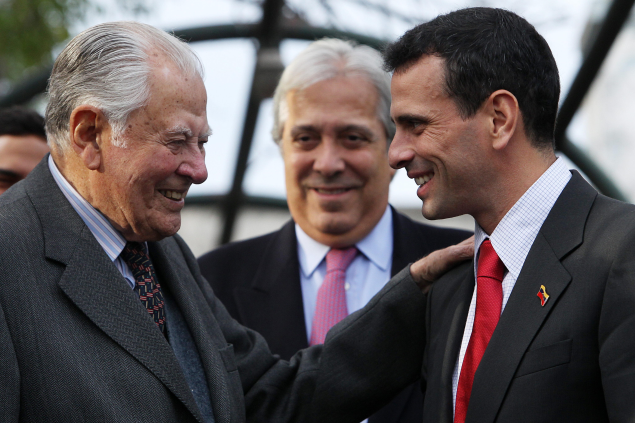
Venezuelan opposition leader Henrique Capriles arrived in Chile on Wednesday in the first leg of a tour that will also take him to Peru. He confirmed that he will meet with President Sebastián Piñera, without specifying the time or place. “It is not important whether we will talk at La Moneda Palace, the seat of the Chilean government, or elsewhere,” Capriles told reporters at the airport of Santiago.

Human Rights Watch: Snowden should steer clear of Venezuela, Salon

If US whistleblower Edward Snowden takes refuge in Venezuela he might quickly wish he hadn’t. At least that’s the verdict of Chilean lawyer Jose Miguel Vivanco, who heads the Americas division of Human Rights Watch, the New York-based advocacy group.

Kerry said to give stern warning to Caracas on Snowden, UPI

Washington is reported to have warned Caracas it would be barred from entering any NATO airspace if it flies U.S. secrets leaker Edward Snowden to Venezuela. Secretary of State John Kerry, who Spanish newspaper ABC said made the warning to Venezuelan Foreign Minister Elias Jaua, also said Washington would halt all sales of vital gasoline and other refined-oil products to Venezuela if Snowden gets refuge in that country, the newspaper said.

Venezuela slams U.S. over ‘repressive regimes’ remarks, Reuters

Venezuelan President Nicolas Maduro demanded the United States apologize on Thursday after the Obama administration’s nominee for envoy to the United Nations said there was a crackdown on civil society in the South American country.

Venezuela Inflation at 39.60%, Latin American Herald Tribune

The inflation rate for the month of June was at 4.7%, lower than that of May’s 6.1%, according to the Venezuelan Central Bank. This brings the rate of inflation for just the first half of 2013 to a total of 25% and the annualized rate at 39.6% — far from the Venezuelan government’s stated goal of keeping it between 14% and 16%.

Purchasing power down 10% due to inflation, El Universal

Venezuela’s minimum wage was increased by 20% on May 1 to USD 390, yet soaring prices have made such increase lose strength rapidly. In May-June this year, inflation shot up reducing purchasing power by 10%.Data from the Central Bank of Venezuela (BCV) indicates that since May 1, prices have swollen 17% in the case of food, 11.2% in transport, and 9% in clothing.

Venezuela: let there be dollars, Financial Times

The Venezuelan toilet paper shortage story says a lot about economic management in a country where the greenback fetches five times its official value on the parallel market. While Venezuelans have struggled to get their hands on everything from loo roll to toothpaste, authorities have been in denial about the grinding liquidity crunch that makes ordinary life – and business life – a daily struggle.

BCV sells US dollars at VEB 10.9 and VEB 11.7 in Sicad auction, El Universal

Devaluation of the bolivar was completed upon the auction sale of US dollars conducted by the Central Bank of Venezuela (BCV) through the Ancillary Foreign Currency Administration System (Sicad), where the exchange rate doubled that of VEB 5.30 per US dollar at its predecessor, the Transaction System for Foreign Currency Denominated Securities (Sitme).

Fitch: Venezuela’s Foreign Exchange Policy Faces Challenges, Reuters

Venezuela’s foreign exchange (FX) policy adjustments in 2013 could reduce fiscal imbalances and limit the need of continued external debt issuance. However, the room to stabilize creditworthiness could be constrained by weaker external buffers, limited upside for oil revenues and non-debt capital inflows, a rapidly decelerating economy, and political changes, according to a new Fitch Ratings report.

Venezuelan President Marries Longtime Companion, Wall Street Journal

Venezuela’s President Nicolás Maduro said on Tuesday that he had married his longtime companion, Cilia Flores, a prominent ruling party figure. Mr. Maduro, speaking during a cabinet meeting broadcast on state television, said the small ceremony was held Monday and was conducted by Jorge Rodríguez, a Caracas-area mayor.

 
Dec
9
2011
Posted by
admin
Comments

In Case You Missed It… Articles Roundup Week of 12/9/11

In this week’s roundup…After nearly 13 years of “21st Century socialism,” Hugo Chávez wants to remain in power for 30 more years; a new regional body, CELAC, is born in Caracas; the Venezuelan economy continues to weaken with prices rising, investments falling and a staggering inflation rate; Venezuela’s opposition candidates agree on need to reform country’s judicial and law enforcement systems; and Russian state-owned oil behemoth Rosneft strikes a $2.6 billion deal to refine Venezuelan oil reserves.

Chávez’s 40-Year Plan to Conquer Vice, The Wall Street Journal

Venezuela’s Hugo Chávez says his Bolivarian Revolution needs more time to produce its utopian fruits. “We barely have 10 years here,” he told a crowd of supporters in Caracas last week. “We will take it to 10 more and 10 more and 10 more to construct the new social virtues.” In that time, Mr. Chávez pledged, “we will deepen the socialist revolution: socialism, socialism and more socialism. We have to deepen the struggle and defeat the vices of the past that still persists among us: violence, insecurity, corruption, selfishness, individualism.”Considering that the human condition hasn’t changed much since we got kicked out of the garden, a 40-year plan to conquer vice seems pretty ambitious. But Mr. Chávez has never suffered a lack of self-confidence. Of course being an individual is hardly a vice. On the other hand, notably absent from his list was another perennial transgression that has yet to be defeated in Venezuela: the central bank’s sinful practice of printing money to finance the government.

Celac: “giant” born in another’s shadow, The Financial Times

“A giant has been born,” declared Hugo Chávez in his usual understated style at the founding of the latest Latin American regional body, Celac, which was formed over the weekend in Caracas. The 33 member body pointedly excludes the US and Canada – which raises the question: is it a non-American or anti-American alliance? (Conservative Latin countries such as Mexico, Colombia and Chile would probably suggest the former; the likes of Venezuela and Cuba the latter). More pointedly, if it is a giant as Chávez suggested, for the moment it looks like a blind and one-legged colossus, with one arm tied behind its back. As noted here and here the body lacks a secretariat, a building, a funding structure, or even rules on how to reach its anyway non-binding decisions. Rather than tackling such meat and potato issues, which are presumably central to any functioning multilateral body, the meeting ended instead with a fiesta and a bland communiqué about the desire for more regional cooperation. Still, the summit did give Chávez the chance to flaunt his “recovery” from cancer.

Venezuela: paying the Chávez price, The Financial Times

Christmas has come early for many Venezuelans this year. Around the country, state-subsidised “fairs” have been springing up where imported Chinese “white goods” are being sold at bargain basement prices. In a country where annual inflation is running at 27.6 per cent, people have been leaping at the opportunity to buy cheap Haier fridges at what Venezuela’s bountiful president has called “the Chávez price”. Massive queues have been appearing out of nowhere as consumers try to ease the deleterious effects of inflation – prices rose by 2.2 per cent in November alone according to central bank figures released on Tuesday. According to the government, the items on sale are going for as much as 55 per cent less than what they would cost in a privately-owned store. There’s one very good reason for that: the government can afford to charge much less as it has unlimited access to foreign currency at the cheap official exchange rate.

Venezuela central bank: Private investment down 43% in 2007-2010, El Universal

After two years of recession, soaring oil prices have created momentum for the Venezuelan economy to resume growth. However, economic imbalances, such as the collapse of private investments, represent a major stumbling block. The Central Bank of Venezuela (BCV) reported that between 2007 and 2010, the private sector’s investment in machines, equipments, and buildings that are used to increase production declined 43.6% to the lowest level in the last seven years. The BCV has not yet published specific data on private investment in 2011 and only releases the public sector’s statistics. Nevertheless, everything suggests that there has been no change in the mood of the business sector.

Venezuela November CPI Rises 2.2% Vs 1.8% In October, The Wall Street Journal

Venezuela’s chronically high inflation rate picked up last month, with the consumer price index climbing in November by 2.2% from the previous month and registering a 12-month rise of 27.6%, the central bank reported Tuesday. The figures show prices rising in key categories like housing services and food as President Hugo Chavez’s government aims to increase housing construction and embark on measures to regulate consumer prices in a bid to curb one of the world’s fastest inflation rates. Expectations for increased spending on social programs ahead of next year’s presidential elections are also seen exacerbating the jump in inflation. The oil-rich South American country had posted a 1.8% rise in the national consumer price index in October and a 1.5% jump in November of 2010.

Chavez: Venezuela willing to talk with Exxon Mobil, Bloomberg Businessweek via The Associated Press

Venezuelan President Hugo Chavez says his government would be open to negotiating with Exxon Mobil Corp. in a dispute over the nationalization of an oil project in the country. Venezuelan officials have previously said Exxon Mobil’s compensation demands are excessive. The Irving, Texas-based oil company turned to international arbitration after refusing to accept the terms of the nationalization in 2007. Chavez says he would be willing to “sit down with them and seek a friendly settlement, but that’s up to them and not to us.” Exxon Mobil declined to comment. Chavez said during a news conference Tuesday that his government has always sought agreements in such cases when possible.

Opposition pre-candidates: Impunity needs to be uprooted, El Universal

When asked about personal insecurity, the five opposition presidential pre-candidates agreed on the need to end impunity, and to make in-depth changes in the Judiciary, the Attorney General Office, and police corps in order to secure law enforcement. Presidential hopeful Henrique Capriles Radonski that said more than 100,000 Venezuelans have been killed over the last decade. He added that dignified employment and quality education are of the essence to break the vicious circle of violence.

Putin continues to court Venezuela, The Financial Times

It’s not hard to see why Vladimir Putin saw fit to take precious time out today in the aftermath of Russia’s controversial parliamentary elections last Sunday to meet with Venezuela’s vice-president, Elias Jaua. Much to the discomfort of Washington, the two countries are developing an ever cosier bilateral relationship and Russia’s state-run oil giant Rosneft announced a $2.6bn deal today to develop Venezuela’s extra-heavy crude oil reserves in the Orinoco. The idea is for Rosneft to have a 40 per cent stake in the Carabobo 2 block in a joint venture with Venezuela’s state oil company, PDVSA, which will control the remaining 60 per cent. Carabobo 2 has estimated reserves of 40bn barrels of oil, and potential production capacity of more than 400,000 barrels per day. For the privilege, Rosneft must pay an initial $440m on approval of the project by the Venezuelan authorities, and a further $660m after the final investment decision. Rosneft has also agreed to lend $1.5bn to PDVSA, though no more than $300m a year.


Aug
24
2010
Posted by
admin
Comments

Chavez’s socialist populism perpetuates inequality

Getty Images 300x168 Chavez’s socialist populism perpetuates inequality This article was originally posted by The Globe and Mail

Venezuela’s escalating crime rate reflects the failure of President Hugo Chavez to address the glaring disparities between the rich and the poor.

When “el Comandante” came to power in 1998, he promised to use the country’s oil wealth to benefit the poor. But his Bolivarian socialist model has not alleviated the long-term problem of income inequality, and the attendant social ills it perpetuates.

Ironically, this runs counter to the overall trend in the region. Latin America used to be known for its acute and persistent income inequalities. But 12 of the largest economies in the Americas – including Brazil, Chile, Argentina and Mexico – actually saw a reversal of this pattern in the past decade. A new study shows that the average decline in the Gini coefficient – a measure of income inequality – was 1.1 per cent a year from 2000 to 2007. Venezuela improved the least of the 12 countries, conclude the authors, the economists Luis Lopez-Calva, of the United Nations Development Program, and Nora Lustig, of Tulane University.

Read More