Sep
19
2012
Posted by
admin
Comments

Venezuelan Band Claims Hugo Chavez Expropriated Song for Campaign Ad

Fox News Latino
September 19, 2012

Chavez Band BT Venezuelan Band Claims Hugo Chavez Expropriated Song for Campaign Ad

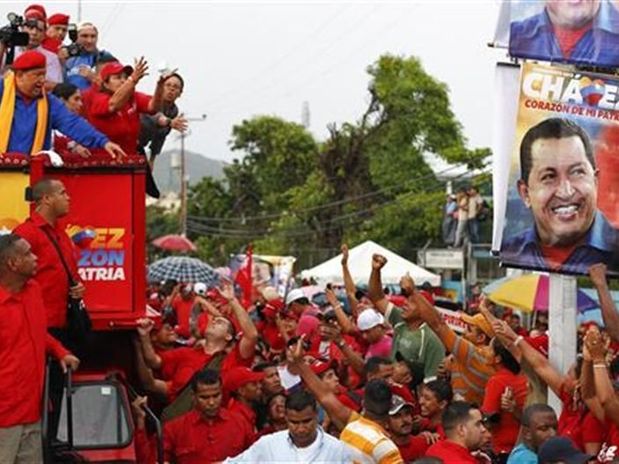
Courtesy of: AP / Ariana Cubillos

A Venezuelan pop group claims that their music is the latest prey of President Hugo Chávez’s campaign of expropriations.

Los Amigos Invisibles, a band that plays a blend of disco, acid jazz and funk mixed with Latin rhythms, claims that a state-owned radio station did not ask permission to run a remixed version of its song “Majunche” as part of a re-election campaign plug for Chávez, Reuters reported.

“They’ve expropriated Majunche, just what we needed,” tweeted bass player José Rafael Torres.

Released in 2004, “Majunche” – which roughly translated to the word “loser” – is an instrumental song which is occasionally broken up when the band shouts the song’s title. Venezuela’s state-owned radio station YVKE Mundial ran the song behind a speech by Chávez in which he says: “The loser won’t win elections in Venezuela … this year, or even in 2,000 years!”

Chávez is up for reelection this year against opposition candidate Henrique Capriles. The Venezuelan leader, who has been in power since 1998, faces his toughest reelection campaign since taking office.

Economic issues – much like the upcoming elections in the U.S. – are key factors in Venezuelan voter’s minds.

“A victory by Henrique Capriles would produce a very strong Venezuelan bond rally that would allow the country in the future to sell debt at substantially lower yields than it can today,” said Alejandro Grisanti, Latin America economist at Barclays, according to Bloomberg.

Besides dealing with a troubled economy, a major debt crisis and a turbulent oil industry, Venezuela’s voters are also concerned with Chávez’s health. The Venezuelan leader was diagnosed with an unknown form of cancer 15 months ago and has since made frequent trips to Cuba to have tumors removed from his pelvic region.

Despite declaring that he was cancer free back in July, doubts still exist about his health and ability to run the OPEC-nation.

“I love Chávez and I want him to remain in power for many more years, but I must confess that some people like me have suspicions that he hasn’t told us the whole truth about his cancer,” said Maria Lovera, a street vendor in the Venezuelan capital of Caracas. “The possibility of him getting sick again and having to step down exists.”

With the election less than three months away, Chávez’s rival Capriles maintains a slight lead in the polls over the current Venezuelan leader, according to Consultores 21, a Caracas- based polling company.

Capriles had 48.1 percent against 46.2 percent for Chavez in a poll taken at the end of August. The poll surveyed 1,000 people, was taken in the final two weeks of August and has a margin of error of 3.2 percentage points.

“If we were to make a linear projection for the election, it would be that Capriles will maintain an advantage of 2.5 percent over Chávez,” said Consultores 21 President Luís Christiansen, according to Bloomberg.

Other polls, however, favor Chávez. According to a Datanalisis poll of 1,288 people taken between July 16 and Aug. 9, Chávez would take 46.8 percent of the vote compared with 34.2 percent for Capriles.

To read this article on Fox News Latino, please click here.

 
Aug
17
2012
Posted by
admin
Comments

On Expropriations, the Proof is in Actions, Not Words

By Petardo de Petare

pic11 150x150 On Expropriations, the Proof is in Actions, Not Words

Petardo de Petare

Actions, it is said, speak louder than words. A cliché, to be sure, but it is instructive when evaluating events in Venezuela during recent months.

For example, no matter how high-minded Hugo Chávez’s rhetoric may at times sound, the president’s actions are drawing a marked contradiction. It is an indisputable fact that he and the PSUV have co-opted the government’s cadena authority to expand the candidate’s reach while battling cancer. They have tilted the playing field against Henrique Capriles and the opposition through their control over many facets of the government, such as the judiciary and the electoral commission, known as the Consejo Nacional Electoral (CNE). Chávez’s party has used its control over the Supreme Court to threaten Globovision, one of the last remaining television stations bold enough to air criticism of the president. The tightly controlled CNE told Capriles he was not permitted to wear a Venezuelan-themed baseball cap, even as every element of Chávez’s stage, bus, and piece of clothing bears the very same colors. The PSUV may try to convince us that their sole concern is the future of Venezuela; their actions, however, reveal a rapacious cartel devoted to maintaining its own power.

The PSUV’s abuses are indeed regrettable, but they are not surprising to most. More curious is how one might apply the “actions speak louder than words” test to Chávez’s economic policies.

For years, Chávez has heralded his expropriations policy as beneficial to Venezuela’s economy. Every time Chávez expropriated a company, utility or tract of land, he assured Venezuelans that his government would manage it better than the wasteful, profiteering private owners. The election is but months away, and Venezuela’s economy is in dire need of a jolt; indeed voters in Venezuela, as elsewhere, largely base their votes on economic factors. One would think, then, that Chávez would have increased his much-touted expropriations in order to foster economic growth ahead of October.

You would, however, be wrong. Chávez has barely expropriated anything at all in months.

Why, with economic performance so crucial to his re-election hopes, would Chávez cease one of his principal economic policies? If expropriations are as beneficial to Venezuelans as he boasts, why wouldn’t he go on an expropriation binge ahead of the election?

Perhaps he secretly acknowledges what so many already believe: that expropriations do not help the economy. In fact, his suspension of the policy suggests that he realizes that expropriations actively damage the economy.

Consider the following examples, which have already been amply documented by many prominent sources, including this website. Chávez seized farmland because he thought Venezuela’s agricultural industry needed a boost, but, even as Venezuelans suffer from dire shortages at the grocery store, hectare upon hectare of the expropriated land remains untilled. In the years following such expropriations, importation of basic foods traditionally grown in Venezuela, such as rice and coffee, has skyrocketed. He seized factories because he declared their private owners were not producing enough, yet today many expropriated companies remain in such shambles they are not even open for business. And all the while, Venezuela’s infrastructure – which Chávez’s government has controlled the entire time – continues to crumble, at times turning reliable electricity into a privilege and a simple commute into a treacherous endeavor.

Add to this the desperate (and temporary) ramping up of government support for the poor and homeless ahead of the election – financed through borrowed money – and it seems that, despite the rhetoric, Chávez is fully aware his policies have failed the very people he pledged to help.

Venezuela’s lower-class has long been Chávez’s largest political constituency; they have also been hardest hit by the struggles of recent years. And with reports out today of new polls showing Capriles surging into the lead, it appears he is losing ground with this constituency. In October, they will render their final judgment on whether Chávez has delivered positive results, not on how much progress has been made towards Chávez’s “Bolivarian Revolution.” And, if recent months are any indication, it seems that even an avowed socialist like Chávez will reject his own ideology if he thinks it will get him votes.

 
Jun
27
2012
Posted by
admin
Comments

Venezuela poll shows tight race for Chavez

Reuters
June 27, 2012
By Brian Ellsworth

chavez 300x200 Venezuela poll shows tight race for Chavez

Courtesy of: Reuters / Carlos Garcia Rawlins

A new poll shows Venezuelan President Hugo Chavez only slightly ahead of challenger Henrique Capriles in the October 7 presidential election, welcome news for the opposition following numerous surveys showing Chavez with a wide lead.

The leftist former soldier is seeking re-election for a third term to extend his self-styled socialist revolution, and he has boosted his public appearances as his health seems to be recovering from a cancer diagnosed last year.

Capriles is seeking to tap into pent-up frustration among the OPEC nation’s voters who are weary of high crime, soaring prices and a continuing wave of nationalizations.

Respected pollster Consultores 21 said its most recent survey shows Chavez holding a 3.4 percentage point lead over Capriles in contrast to the double-digit lead that other public opinion groups have given Chavez in recent surveys.

The news highlights the frequent disparities among the polls in Venezuela, where public opinion researchers are often thrust to the center of the country’s polarized politics and face constant accusations of favoring one side or the other.

Consultores 21 President Luis Christiansen told Reuters the firm’s June survey showed 47.9 percent of voters intend to vote for Chavez compared with 44.5 percent for Capriles.

The poll has a margin of error of 2.4 percentage points and was carried out between June 2 and June 12, he said.

Reuters did not have access to the full poll, which was released only to Consultores 21 clients.

The results were largely in line with the firm’s March poll, which showed Chavez with 46.3 percent and Capriles at 44.8 percent. Though Chavez edged up slightly from that poll, the increase is within the margin of error.

Chavez is set to officially launch his candidacy on Sunday with rallies around the country. Earlier this month he brought hundreds of thousands of supporters into the center of Caracas to officially register his candidacy.

DIVERGENT POLLS

Capriles, who is also boosting his public appearances after a months-long “house-by-house tour” through Venezuela meant to win over supporters, has shrugged off negative poll readings and mocked pollsters as government lackeys.

“If you want to get into a booming business right now, do a poll, say the government is ahead, and you’ll see the money flowing in,” Capriles said during a press conference this week.

He has burnished his image of physical fitness during Chavez’s months of convalescence. He walked and jogged 10 km (6.2 miles) to register his own candidacy in the company of hundreds of thousands of supporters.

The last survey by pollster Datanalisis, which is also widely respected, showed Chavez with a 15.9 percentage point lead over Capriles.

Analysts have said part of the reason for the discrepancy between the Datanalisis and Consultores 21 figures is that the former indicates 28.7 percent of voters are undecided – a surprisingly high figure given the country’s polarized politics.

The Consultores 21 poll numbers suggest that a maximum of only 7.5 percent of the country’s voters are undecided.

Government leaders were quick to interpret the poll as beneficial to Chavez.

“It’s significant that that particular pollster, which is so linked to (the opposition), has joined other pollsters that consistently show the patriotic candidate as the favorite,” said Information Minister Andres Izarra, referring to Chavez by a catch-phrase frequently used by party members.

Polls are historically controversial in Venezuela. One opposition exit poll in a 2004 recall referendum showed Chavez losing by around 20 percentage points – almost the exact opposite of the result later certified by electoral authorities.

(Additional reporting by Andrew Cawthorne; Editing by Anthony Boadle)

To read this article on Reuters, please click here.