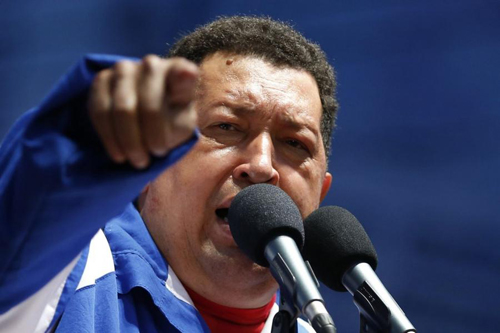
Courtesy of: Reuters
Having secured reelection, Hugo Chávez has signaled his intention to pivot back to his most extreme socialist policies. After presenting a more moderate face as a candidate, Chávez has pledged to deepen his socialist revolution as president. The pace of expropriations slowed in the politically crucial months before Oct. 7, but now the administration promises to begin nationalizing private companies with renewed vigor. Just weeks after his victory, even the remaining trace of Venezuela’s independent media, already one of the most harassed, has been put on notice.
The Chávez-friendly National Assembly appears set to approve legislation that extends the government’s strictest information-control requirements to cable TV. Previously the most severe restrictions – enshrined in the Ley Resorte law – applied only to broadcast television stations. These entities were required to abide by content requirements and to air Chávez’s “cadena” addresses at a moment’s notice. The Assembly’s proposed law would extend these restrictions to Venezuela’s private cable stations as well.
This legislation, which includes the Orwellian proposal to ensure “the enforcement of cultural information,” could deal a blow to Venezuela’s scant remaining free media. In addition to forcing stations to broadcast cadenas, the law would also limit the amount of “foreign” content aired on Venezuelan cable stations, infringing on Venezuelan TV viewers’ ability to get news or commentary from sources outside the country. Carabobo state Rep. Miguel Cocchiola, a member of the opposition, calls the law “a tool [for the government] to enhance communication hegemony.”
During the election, Chávez’s abuse of his cadena power was well documented, as it allowed him to saturate Venezuela with campaign propaganda and interrupt coverage of Capriles campaign events. Meanwhile, the Capriles campaign was forced to pay for airtime, while many noted that compiling the resources needed to match the reach of the state media would have been an impossible task. According to the watchdog group Transparency International, Chávez used cadenas for more than 87 hours during the campaign.
Such attacks on free media are nothing new for Chávez’s “21st Century Socialism,” which militates against the free economy and free media alike. From the closure of the popular network RCTV to the constant fines and sanctions levied against Globovision, Chávez has systematically censored, harassed or otherwise silenced privately-owned media outlets he deems critical of his persona or government.
Multiple watchdog groups have affirmed that independent media remain an endangered species in the country. Since 2005, defamation of the president has been punishable by six to 30 months in prison. Mr. Chávez has revoked the broadcast license of at least 240 radio stations – nearly 50 percent of all radio stations in the country – perceived as critical of the government. Today, Chávez controls at least two national radio networks, six television channels, 72 regional television stations, four newspapers and over 600 radio stations across the country.
As expected, news coverage on government-owned television is far from balanced. According to a report from the Wall Street Journal, during the last week of September – just days before the Oct. 7 election – government news channel VTV dedicated 18 hours of coverage to Chávez. Its tally for Mr. Capriles was 30 minutes.

