Mar
14
2013
Posted by
admin
Comments

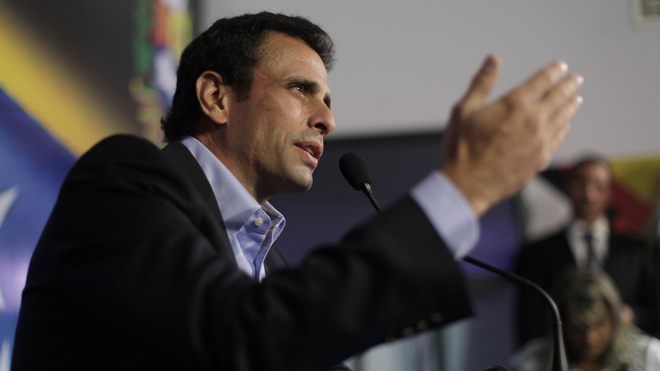
Capriles Prepares for a Tough Fight Against the Memory of Chávez

31013 capriles1 e1363269277543 Capriles Prepares for a Tough Fight Against the Memory of Chávez

Courtesy of: Associated Press

On Monday, interim president Nicolás Maduro and opposition leader Governor Henrique Capriles formally registered as candidates for Venezuela’s special presidential election, to determine who will succeed the late Hugo Chávez. The former vice president Maduro was sworn in just three days earlier – merely three days after the government announced Chávez’s death.

Even by the standards of an electoral system already skewed to the PSUV’s benefit, April’s special election is hardly a fair fight. The candidates are only permitted to campaign during an official 10-day campaign period from April 2-11, but the timing of the April 14 election already sets the opposition at a distinct disadvantage. While both candidates are prohibited from campaigning until April 2, Maduro has been riding the wave of grief over Chávez’s death to bolster his own image. Currently, state-run TV is saturated with 24/7 coverage of Chávez’s life and legacy, and the government has bused in thousands of supporters to wait in hour-long lines to view his casket. In addition, like Chávez, Maduro has not been timid about using his “cadena” powers, which require mandatory national broadcasts at the discretion of the president. Similar to Chávez, Maduro has made these a daily occurrence; even using one to take the oath of office in front of Chávez’s casket. While the official campaign will not begin for weeks, Maduro’s presence on the airwaves is virtually ubiquitous.

Although the campaign period officially ends on April 11, the days in between are fraught with symbolism that is sure to benefit Maduro. April 13 – the day before the election – is the anniversary of Chávez’s return to power after the April 11, 2002 coup that briefly ousted him from power. In the years following, the anniversary has been marked with widespread celebration by Chavistas – led by Chávez himself. This year will likely see that celebration further intensified – allowing Maduro to carry out de facto campaign events through official government celebrations of Chávez’s memory.

Capriles has spent much of his political career criticizing the Chávez administration for its expropriations, centralization of power, and corruption. He is currently serving as the Governor of Miranda, one of the largest states in Venezuela—the latest stage in his fast political rise. At the age of 26, he became the youngest elected member of the National Congress before winning two consecutive mayoral elections in Baruta, a division of the Greater Caracas municipality. Last year, he became the first candidate in 14 years to unite the opposition parties and seriously challenge Chávez in the October presidential election. Capriles traversed Venezuela for months, seeking to rally Venezuelan’s behind his vision for the country’s future. Although he lost the election, his quest was hardly unsuccessful: Capriles won an unprecedented 44 percent of the vote (over 6 million people).

Meanwhile, Maduro has risen far from his origins as a bus driver, becoming Chávez’s Vice President and handpicked successor. As a former Foreign Minister, he strengthened the Venezuelan government’s ties with Cuba and with the Castros. During Chávez’s absence in June 2011 and last winter, he worked to shore up his power as acting president and his political clout within the PSUV. Maduro lacks Chávez’s charisma and popularity, a weakness he has sought to counteract by currying favor with the late president and the Cuban government through a fierce commitment to PSUV’s principles of socialism.

The presidential campaign has not even officially begun, but Capriles has already been subjected by his rival to a malicious smear campaign. In a speech responding to Capriles’ candidacy, Maduro called him a “fascist” and used racist and homophobic slurs against the governor, a descendant of Polish Jews who escaped the Holocaust. The Venezuelan government is also threatening the opposition candidate with legal action for the defamation of Chávez and his family after Capriles raised questions about the government’s lack of transparency regarding the circumstances of the former president’s death.

Capriles has taken a tougher tone against Maduro than he did against Chávez in last year’s presidential election. Capriles has accused Maduro of exploiting Chávez’s memory for political gain. Indeed, Capriles’ chance at victory will likely hinge on his ability to demonstrate to Venezuelans that Maduro is not Chávez’s “second coming,” but is instead a lifelong political operative and puppet of the Castros, wholly complicit in the PSUV government’s economic mismanagement.

With only 10 days to campaign, Capriles will be fighting an uphill battle. Maduro will leverage every facet of Chávez’s finely-tuned political machine to secure a victory: at his disposal are a formidable (and corrupt) voter turnout program, unobstructed access to government resources, and the hysterical grief of Chávez’s devoted followers. It is little surprise that Maduro has already christened his campaign the “Comando de Campaña Hugo Chávez Frías” (Hugo Chávez Campaign Command). The month ahead will combine elements of a political rally and funeral march, as Maduro looks to ride a wave of Chávez sympathy and nostalgia into power.

Nevertheless, Capriles has defeated Chávez’s top deputies before. Just two months after his strong showing against Chávez in the presidential elections, Capriles held on to his Miranda governorship against Chávez’s close friend and former Vice President, Elías Jaua. He originally defeated Diosdado Cabello, the current head of the National Assembly, to first assume the governorship of Miranda in 2008. Capriles will capitalize on his youthful energy and the strong support of his base to do everything possible to obtain a victory.
 
Oct
25
2012
Posted by
admin
Comments

Venezuelan Assembly Considers New Media-Control Law

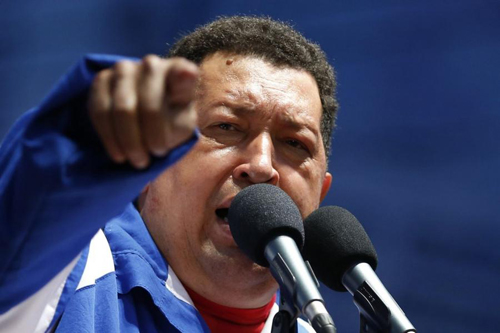
hugo chavez Venezuelan Assembly Considers New Media Control Law

Courtesy of: Reuters

Having secured reelection, Hugo Chávez has signaled his intention to pivot back to his most extreme socialist policies. After presenting a more moderate face as a candidate, Chávez has pledged to deepen his socialist revolution as president. The pace of expropriations slowed in the politically crucial months before Oct. 7, but now the administration promises to begin nationalizing private companies with renewed vigor. Just weeks after his victory, even the remaining trace of Venezuela’s independent media, already one of the most harassed, has been put on notice.

The Chávez-friendly National Assembly appears set to approve legislation that extends the government’s strictest information-control requirements to cable TV. Previously the most severe restrictions – enshrined in the Ley Resorte law – applied only to broadcast television stations. These entities were required to abide by content requirements and to air Chávez’s “cadena” addresses at a moment’s notice. The Assembly’s proposed law would extend these restrictions to Venezuela’s private cable stations as well.

This legislation, which includes the Orwellian proposal to ensure “the enforcement of cultural information,” could deal a blow to Venezuela’s scant remaining free media. In addition to forcing stations to broadcast cadenas, the law would also limit the amount of “foreign” content aired on Venezuelan cable stations, infringing on Venezuelan TV viewers’ ability to get news or commentary from sources outside the country. Carabobo state Rep. Miguel Cocchiola, a member of the opposition, calls the law “a tool [for the government] to enhance communication hegemony.”

During the election, Chávez’s abuse of his cadena power was well documented, as it allowed him to saturate Venezuela with campaign propaganda and interrupt coverage of Capriles campaign events. Meanwhile, the Capriles campaign was forced to pay for airtime, while many noted that compiling the resources needed to match the reach of the state media would have been an impossible task. According to the watchdog group Transparency International, Chávez used cadenas for more than 87 hours during the campaign.

Such attacks on free media are nothing new for Chávez’s “21st Century Socialism,” which militates against the free economy and free media alike. From the closure of the popular network RCTV to the constant fines and sanctions levied against Globovision, Chávez has systematically censored, harassed or otherwise silenced privately-owned media outlets he deems critical of his persona or government.

Multiple watchdog groups have affirmed that independent media remain an endangered species in the country. Since 2005, defamation of the president has been punishable by six to 30 months in prison. Mr. Chávez has revoked the broadcast license of at least 240 radio stations – nearly 50 percent of all radio stations in the country – perceived as critical of the government. Today, Chávez controls at least two national radio networks, six television channels, 72 regional television stations, four newspapers and over 600 radio stations across the country.

As expected, news coverage on government-owned television is far from balanced. According to a report from the Wall Street Journal, during the last week of September – just days before the Oct. 7 election – government news channel VTV dedicated 18 hours of coverage to Chávez. Its tally for Mr. Capriles was 30 minutes.

 
Sep
21
2012
Posted by
admin
Comments

In Case You Missed It… Articles Roundup Week of 9/21/12

presidencial venezolana Henrique Capriles Radonski 300x204 In Case You Missed It… Articles Roundup Week of 9/21/12

Foto: AFP

As the elections approach it appears that the bold and well-executed campaign of opposition candidate Henrique Capriles is making this the closest election President Hugo Chávez has ever faced. Many observers expect the election to have serious consequences for global oil markets. Others, meanwhile, worry about the possibility of electoral fraud or violence should Chávez be defeated. The president’s health is also a growing concern, as he still refuses to divulge details about his cancer or name a successor in the case that he falls seriously ill after the election. The dirty tactics of Chávez’s campaign continue, this time when he interrupted the broadcast of an opposition event with a government cadena. Meanwhile, the country’s crime problem, a major election issue, continues unabated and Chávez’s government continues its borrowing and spending to prop up the country’s weak economy, setting up the country for a possible default.

An Emboldened Opposition Challenges One of Latin America’s Most Skilled Politicians, The Huffington Post

There is no doubt that the Oct. 7 presidential vote will be Hugo Chávez’s most difficult election to date.

The Venezuelan Election Deserves Our Attention, Forbes

There is a crucial election about to take place in Venezuela. Basic issues of freedom and economic liberty are at stake for the Venezuelan people.

Investors Turn Gaze to Venezuela Election, The Wall Street Journal

The approach of next month’s national elections has created a fervor among investors in the country’s bonds but is ringing alarm bells for some.

Venezuela Opposition Concerned About Armed Groups, ABC News

The campaign of Venezuelan presidential candidate Henrique Capriles said Tuesday that it has detected risks of trouble at dozens of polling centers in areas where Colombian rebels or other armed groups are known to operate.

Cancer or no Cancer, Venezuela President Hugo Chavez Won’t Pick Running Mate, Fox News

Even with his deteriorating health, Hugo Chavez is not afraid to stand alone. While it is normal in Venezuela’s election system for presidential candidates to not choose a running mate, this year’s situation has voters concerned.

Venezuela’s Capriles slams Chavez for blocking broadcast, Reuters

Shortly after Capriles began speaking to thousands of supporters in a Caracas park, Chavez launched a “chain broadcast” across all public access television in which he celebrated his government’s achievements and extolled the virtues of socialism.

Venezuela crime out of control, imperiling Chavez re-election, USA Today

Margarita Hernandez has been waiting more than a year for someone to pay for the murder of her 18-year-old son, killed by thugs a few blocks from his home.

Venezuela’s Reserves Fall to Five-Year Low Before Vote, Bloomberg Businessweek

Venezuela’s international reserves last week fell to their lowest level in more than five years as the government boosts spending ahead of next month’s presidential election.

Venezuela Risks Default If Chavez Wins, Morgan Stanley, Bloomberg

Venezuela could default on its debt as early as the second half of 2013 if President Hugo Chavez wins re-election next month and fails to shore up the oil- producing nation’s “increasingly fragile” balance sheet, Morgan Stanley said.

Venezuela ranks last in economic freedom worldwide, El Universal

According to a report on economic freedom worldwide released on Tuesday in Washington, Hong Kong, Singapore, New Zealand, Switzerland, and Australia are among the countries with the highest levels of economic freedom worldwide, whereas Angola, Congo, Zimbabwe, and Burma are at the bottom of the ranking, and Venezuela ranked last.