Oct
25
2012
Posted by
admin
Comments

Venezuelan Assembly Considers New Media-Control Law

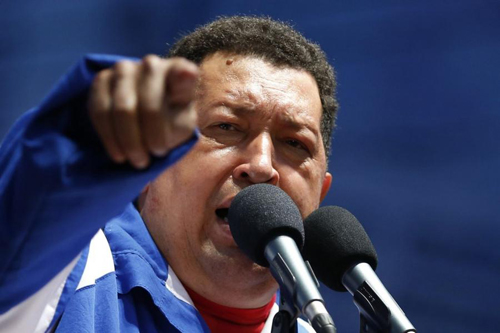
hugo chavez Venezuelan Assembly Considers New Media Control Law

Courtesy of: Reuters

Having secured reelection, Hugo Chávez has signaled his intention to pivot back to his most extreme socialist policies. After presenting a more moderate face as a candidate, Chávez has pledged to deepen his socialist revolution as president. The pace of expropriations slowed in the politically crucial months before Oct. 7, but now the administration promises to begin nationalizing private companies with renewed vigor. Just weeks after his victory, even the remaining trace of Venezuela’s independent media, already one of the most harassed, has been put on notice.

The Chávez-friendly National Assembly appears set to approve legislation that extends the government’s strictest information-control requirements to cable TV. Previously the most severe restrictions – enshrined in the Ley Resorte law – applied only to broadcast television stations. These entities were required to abide by content requirements and to air Chávez’s “cadena” addresses at a moment’s notice. The Assembly’s proposed law would extend these restrictions to Venezuela’s private cable stations as well.

This legislation, which includes the Orwellian proposal to ensure “the enforcement of cultural information,” could deal a blow to Venezuela’s scant remaining free media. In addition to forcing stations to broadcast cadenas, the law would also limit the amount of “foreign” content aired on Venezuelan cable stations, infringing on Venezuelan TV viewers’ ability to get news or commentary from sources outside the country. Carabobo state Rep. Miguel Cocchiola, a member of the opposition, calls the law “a tool [for the government] to enhance communication hegemony.”

During the election, Chávez’s abuse of his cadena power was well documented, as it allowed him to saturate Venezuela with campaign propaganda and interrupt coverage of Capriles campaign events. Meanwhile, the Capriles campaign was forced to pay for airtime, while many noted that compiling the resources needed to match the reach of the state media would have been an impossible task. According to the watchdog group Transparency International, Chávez used cadenas for more than 87 hours during the campaign.

Such attacks on free media are nothing new for Chávez’s “21st Century Socialism,” which militates against the free economy and free media alike. From the closure of the popular network RCTV to the constant fines and sanctions levied against Globovision, Chávez has systematically censored, harassed or otherwise silenced privately-owned media outlets he deems critical of his persona or government.

Multiple watchdog groups have affirmed that independent media remain an endangered species in the country. Since 2005, defamation of the president has been punishable by six to 30 months in prison. Mr. Chávez has revoked the broadcast license of at least 240 radio stations – nearly 50 percent of all radio stations in the country – perceived as critical of the government. Today, Chávez controls at least two national radio networks, six television channels, 72 regional television stations, four newspapers and over 600 radio stations across the country.

As expected, news coverage on government-owned television is far from balanced. According to a report from the Wall Street Journal, during the last week of September – just days before the Oct. 7 election – government news channel VTV dedicated 18 hours of coverage to Chávez. Its tally for Mr. Capriles was 30 minutes.

 
Jul
25
2012
Posted by
admin
Comments

Chavez opponent takes new campaign approach in Venezuela with online forum on Facebook

By Associated Press via The Washington Post
July 25, 2012

Venezuela Opposition.JPEG 00309 Chavez opponent takes new campaign approach in Venezuela with online forum on Facebook

Courtesy of: Associated Press

CARACAS, Venezuela — Venezuelan opposition presidential candidate Henrique Capriles tried a new campaign tool on Wednesday with a live question-and-answer session on Facebook.

The candidate, who is running against President Hugo Chavez in the country’s Oct. 7 election, used the 45-minute video appearance to field questions sent via Facebook and Twitter.

Answering one of the questions, Capriles criticized Chavez’s decision this week to pull out of the Inter-American Court of Human Rights, calling it “irresponsible.”

“He doesn’t like them to put limits on him,” Capriles said, referring to Chavez. “This affects those Venezuelans who are left without justice in their country.”

Capriles said that if he’s elected, he would restore Venezuela’s membership in any such international bodies.

He spoke on Wednesday night before an audience in a studio at the Venezuelan television channel RCTV, which Chavez’s government forced off the airwaves in 2007. The government had refused to renew the channel’s license, accusing it of violating broadcast laws and backing a failed 2002 coup against Chavez.

Capriles said if he wins the vote, he would allow RCTV to go back on the air.

Both Capriles and Chavez are active on Twitter, but the live video talk on Facebook was a first for a Venezuelan politician.

Andreina Marquez, who leads online efforts for Capriles’ campaign, said the online forum was a way to “open another channel of participation.”

A poll last month by the Caracas-based polling firm Datanalisis found that Chavez had a 15-point lead over Capriles. The survey, which had a margin of error of 3 percentage points, also found that 23 percent of those polled didn’t express an opinion as to which candidate they would support.

To read this article on The Washington Post, please click here.

 
Jul
23
2012
Posted by
admin
Comments

Chavez says he won’t stop taking over airwaves

Associated Press
July 23, 2012
By Christopher Toothaker

hugo chavez frias Chavez says he wont stop taking over airwaves

Courtesy of: Reuters

CARACAS, Venezuela (AP) — President Hugo Chavez said Sunday that he will not stop seizing control of Venezuela’s airwaves to give his trademark marathon television and radio addresses despite complaints from his challenger that it gives him an unfair advantage during the country’s presidential election campaign.

Opposition candidate Henrique Capriles has demanded that election officials prevent Chavez from taking political advantage of the special broadcasts, which all networks are required by law to air, ahead of Venezuela’s Oct. 7 election.

Directors of the National Electoral Council have approved campaign regulations that prohibit TV and radio messages that favor a presidential candidate to run longer than three minutes. But it’s unclear whether the president’s frequent and lengthy special broadcasts, known as “cadenas,” will be affected.

“The cadenas are part of the national government’s information strategy,” said Chavez, speaking during one of the special broadcasts. “The bourgeoisie wants me to give up something that’s the faculty of the president of the republic. I’m not going to do it.”

Chavez, a former paratroop commander, argued that most of Venezuela’s privately owned TV channels, radio stations and newspapers are biased in favor of Capriles and he accuses the independent media of ignoring his government’s achievements.

“The major part of the radios, television channels and newspapers are in the hands of the bourgeoisie,” said Chavez, who is seeking re-election to a fresh six-year term.

When Chavez took office in 1999, he referred to four major TV channels — RCTV, Venevision, Globovision and Televen — as the “Four Horsemen of the Apocalypse.” He accused the channels supporting a short-lived 2002 coup by broadcasting cartoons and movies instead of the protests that aided his return to power.

But the government refused to renew RCTV’s broadcast license in 2007, and Venevision and Televen have since curbed their criticism of the government, while Globovision has remained sharply critical of Chavez.

Chavez has been making more frequent use of his ability to take over the airwaves since he completed cancer treatment and started rehabilitation, talking on TV and radio for several hours a couple times a week.

He often lambasts Capriles and vows to win the looming election during the broadcasts.

Over the past 13 months, Chavez has undergone two surgeries that removed tumors from his pelvic region, most recently in February. That’s meant Chavez has appeared in public less frequently than in the past, a dramatic shift for his 13-year-old presidency.

Earlier this month, Chavez announced that he’s completely free of cancer and assured Venezuelans that physical limitations stemming from his recuperation will not affect his re-election bid.

The socialist leader has not disclosed key details about his illness including the type of cancer that had been diagnosed.

To read this article on the Associated Press, please click here.