Jun
5
2013
Posted by
admin
Comments

Nicolas Maduro’s Embarrassing Week

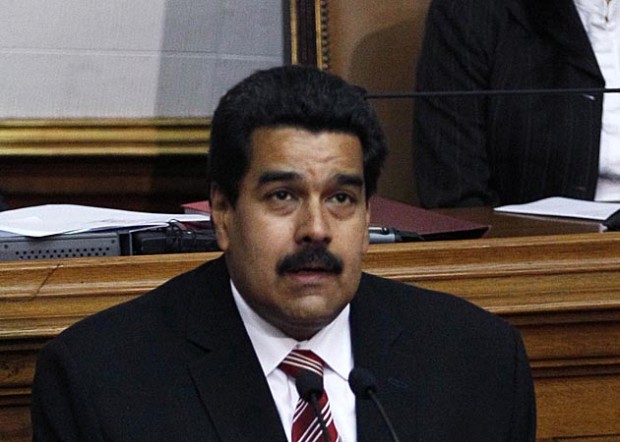
Nicolas Maduro1 620x442 e1370466156876 Nicolas Maduro’s Embarrassing Week

Courtesy of: Associated Prses

The presidency of former bus driver Nicolás Maduro began inauspiciously, his government using intimidation and threats to consolidate power.  Now, two months after he claimed victory in an election fraught by irregularities, things have only gotten worse for Maduro. The aftermath of Venezuela’s election controversy have caused Maduro to lose support and popularity among his own people. And as violence and a sinking economy continue to take their toll on Venezuelans, Maduro is now coming face-to-face with the consequences of years of Chávez’s failed socialist policies.

Maduro reacted like a spurned child when news emerged that opposition leader Henrique Capriles had traveled to Colombia and had been received there by President Juan Manuel Santos. As Venezuela’s socialist policies have kept the country in economic squalor, Colombia is one of Latin America’s success stories, and a strong U.S. ally in the region. Capriles met with President Santos, along with members of the Colombian parliament, where the leaders discussed Venezuela’s narrow presidential election along with the country’s dire economic situation.

“We are taking the voice of millions of Venezuelans beyond our borders,” Capriles said in Colombia. “The fight for democracy has to be everyone’s fight.” Indeed, news emerged this week that voter rolls indicate that deceased Venezuelans had “voted” in recent elections – the latest in a series of disturbing revelations about the state of democracy in Venezuela.

Economically, the situation is perilous and getting worse. With inflation near 30 percent and Venezuelans struggling to find basic goods like toilet paper, the country’s economy is heading for a recession sure to make matters worse. The Venezuelan government plans to institute restrictions on the sale of 20 basic items subject to price controls in Zulia, the country’s most populous state. Starting next week, the state will issue computer chip cards that will limit consumer purchases of certain products. Though the government has spun the move as a fight against contraband on the Colombian border, it is another clear sign that Venezuela’s shortages are worsening.

Meanwhile Venezuela’s bonds have bottomed out; Moody’s now rates them as junk status, a sign that the financial community has lost faith in Maduro’s government.

Indeed, criticism from the international community and from watchdogs continues to ratchet up. The meeting between President Santos and Capriles embarrassed Maduro on the world stage; the shootings of two U.S. embassy officials only further underscored the dreadful violence that plagues Venezuela. Desperate to quell the concerns of the international community, Venezuela has requested a meeting with top U.S. Diplomat John Kerry. Kerry will meet with Foreign Minster Elías Jaua at the ongoing Organization of American States General Assembly session in Guatemala. The meeting – the first at the cabinet level between the nations in several years – will explore ways to improve fractured relations between the two nations.

The only hope for Venezuela’s economy and her people lies in moderation, yet the signs often point in the opposite direction. Maduro has grasped for scapegoats, blaming Venezuela’s scant remaining private industry for the problems caused by the government. Venezuela’s last independent television station, Globovisión, was recently purchased by a group of businessmen with ties to the country’s ruling party. Now, as if on cue, the station has pledged to curb criticism of the government on its airwaves.

With Venezuela’s media already almost entirely controlled by the government, Globivision represented the last semblance of free media in the country. Its sale “appears to represent a new extension of the Venezuelan government’s control over broadcast media,” write Latin America experts Hugo Pérez Hernáiz and David Smilde.

All in all: it paints an embarrassing picture for Venezuela’s new president. Lacking in legitimacy before the international community and his own people, his government unable to reverse the economic calamity it caused, Nicolas Maduro’s first months in office started poorly, and have only gotten worse. And the Venezuelan people are feeling the consequences.

 
Jul
30
2012
Posted by
admin
Comments

ICYMI: Cocaine’s Flow Is Unchecked in Venezuela

The New York Times
July 26, 2012
By William Neuman

LA MACANILLA, Venezuela — The Venezuelan government has trumpeted one major blow after another against drug traffickers, showing off barrels of liquid cocaine seized, drug planes recovered, cocaine labs raided and airstrips destroyed.

But a visit this month to a remote region of Venezuela’s vast western plains, which a Colombian guerrilla group has turned into one of the world’s busiest transit hubs for the movement of cocaine to the United States, has shown that the government’s triumphant claims are vastly overstated.

Deep in the broad savanna, one remote airstrip the government said it had disabled in a recent army raid appeared to be back in business. The remains of two small aircraft set on fire by the army had been cleared away. Traffickers working with the Revolutionary Armed Forces of Colombia, which operates with surprising latitude on this side of the border, appeared to have reclaimed the strip to continue their secret drug flights shuttling Colombian cocaine toward users in the United States.

There were no signs that soldiers had blasted holes in the runway or taken other steps to prevent it from being used again.

For years, the United States has been working with friendly governments in Colombia, Mexico, Honduras, Guatemala and other countries in Latin America, spending billions of dollars to disrupt the flow of drugs northward. But because of antagonistic relations with President Hugo Chávez of Venezuela, the reach of American drug agents, and the aid that comes with them, does not extend here.

“Our airspace has been taken over,” said Luis Lippa, a former governor of Apure State who plans to run again as an opposition candidate in elections in December. Referring to the grip of traffickers on the border region, he said, “Our national territory has been reduced.”

venezuela drug trafficking routes ICYMI: Cocaine’s Flow Is Unchecked in Venezuela

Radar data collected by the United States government shows what are believed to be illicit drug flights, mostly between Venezuela and Central America. Country names have been added. (Courtesy of: Joint Interagency Task Force South)

A map of flight tracks made by a United States government task force using data from long-range radar makes the point vividly: a thick tangle of squiggly lines, representing drug flights, originates in Apure, on Venezuela’s border with Colombia; heads north to the Caribbean; and then takes a sharp left toward Central America. From there, the drugs are moved north by Mexico’s well-established traffickers.

President Obama signed a memorandum in September that designated Venezuela, for the seventh time, as a country that failed to meet international obligations to fight drug trafficking. He cited a federal report that concluded that the country was “one of the preferred trafficking routes out of South America” and had a “generally permissive and corrupt environment.”

Venezuela says that it is caught in the middle — Colombia produces the drugs and the United States consumes them — and that it is doing all it can to fight back. In May, the government announced that the number of illicit flights it detected had been cut in half this year, although it declined to provide data to back up the claim.

“We are hitting drug trafficking hard all the time,” said Ramón Carrizalez, the governor of Apure, the border state where the drug flights originate, speaking in May at a news conference to announce the destruction of 36 hidden airfields. “Very few countries are carrying out a policy like ours.”

But the United States says Venezuela’s efforts are deeply hobbled by corruption, particularly by ties between the government and the Revolutionary Armed Forces of Colombia, known as the FARC, which controls much of the cocaine traffic in the region.

Since 2008, the Treasury Department has accused at least seven high-level military officers and current and former officials in Mr. Chávez’s government of aiding the FARC, and sometimes exchanging weapons for drugs. Defense Minister Henry Rangel Silva was one of those singled out by Treasury officials. Venezuela dismissed the accusations as imperialist meddling.

The White House Office of National Drug Control Policy estimates that as much as 24 percent of the cocaine shipped out of South America in 2010 passed through Venezuela, accounting for more than 200 tons.

More than half of that left from the hidden airfields in Apure, analysts say. They say that Venezuela’s central role as a transit point for drug shipments began after Mr. Chávez halted cooperation with the United States Drug Enforcement Administration in 2005, accusing its agents of spying.

Around the same time, Colombia, with assistance from the United States, began to tighten control of its airspace.

As a result, the traffickers jumped across the border to Apure, where an airstrip can be fashioned on the flat prairie in a few hours by dragging a log behind a pickup truck to smooth the ground.

“You can blow up an airfield here and it doesn’t matter,” said one resident, standing beside an eight-foot-deep hole that soldiers had blown in a runway near the Cinaruco River, the plains stretching out for miles. “They can make another one right next to it.”

But perhaps the main attraction for traffickers is that the federal government’s hold on large parts of Apure, the poorest state in the country, is tentative at best.

In many areas, residents say, the real power is held by the FARC, which they describe as moving around the state with alarming impunity.

One resident living in Santos Luzardo National Park, a picturesque preserve abounding in wildlife, said that last month two FARC members patrolled the remote area on motorcycles, asking farmers if they had heard any airplanes, apparently concerned that traffickers were using a nearby airstrip without paying.

The guerrillas also collect protection money from local businesses, ranchers and fishing camps along some parts of Venezuela’s long border with Colombia. One resident said that a small group of FARC members showed up at a homestead in December and set up camp for a week, using it as a base to patrol the area and possibly protecting drug flights. He said the owner had no choice about whether to accept, although the guerrillas brought their own food.

The residents also expressed fear and mistrust of government authorities. Most said they believed that local officials and soldiers were in league with the traffickers and that passing along information about the traffickers’ activities would result in reprisals. Residents said they had learned to coexist with the traffickers just as they had gotten used to the frequent sound of low-flying aircraft at night. But many said they were fearful and felt intimidated.

“We all knew what was going on, but no one said anything,” a man said of the smugglers who used a local airstrip. “What were we going to do about it? The one that should be doing something is the government. They should be constantly patrolling the area.”

Meridith Kohut contributed reporting from La Macanilla; María Eugenia Díaz from Caracas, Venezuela; and Jenny Carolina González from Bogotá, Colombia.

To read this article on The New York Times, please click here.

 
Jul
6
2010
Posted by
admin
Comments

Chávez “terrorist” was kidnapped in Guatelama

According to El Universal, the man that Chávez is accusing of a plot to kill him, was actually kidnapped in Guatemala before being transported to Caracas. Is this “terrorist plot” even real???

Additionally, the newspaper El Mundo is reporting the kidnapping of Francisco Chávez Abarca.

The wife of the Salvadoran citizen Francisco Chávez Abarca, who is currently arrested in Venezuela where he has been accused of “terrorism,” did not rule out that he was “abducted” in Guatemala by a group of Venezuelans and taken to the South American country.

“He was in Guatemala; in fact, he told me that his telephone card was running out of balance and that he would call me later. How is it possible that he appears overnight in Venezuela?” said his wife Karla Guadalupe Trigueros, a Salvadoran online newspaper reported on Monday.

According to the Venezuelan government, Francisco Chávez Abarca was a “close associate” to anti-Castro activist Luis Posada Carriles, convicted in Venezuela for the bombing of a Cuban airplane in 1976.