Jul
6
2012
Posted by
admin
Comments

ICYMI: Tilting the pitch

The opposition faces some extraordinary obstacles

The Economist
July 7, 2012

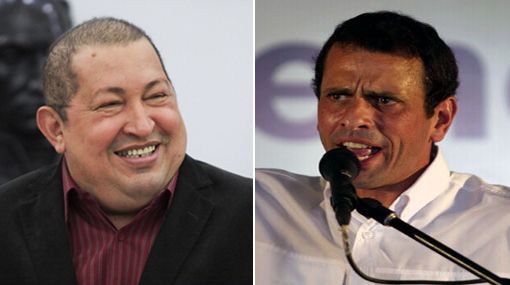
TO CHEERS from red-shirted supporters, on July 1st Hugo Chávez officially launched his campaign for Venezuela’s presidential election with a rally in Maracay, just west of the capital, Caracas, where he promised to “pulverise” the opposition. Mr Chávez is seeking a third consecutive six-year term, despite undergoing three operations for cancer in the past year. His centrist opponent, Henrique Capriles of the Democratic Unity coalition (MUD), spent the day flitting from the Brazilian border to the semi-desert of the Guajira in the north-west. His message was that the “most forgotten” communities can count on him to improve their lives.

That seemed calculated to underline how Mr Chávez’s uncertain health may prevent him from campaigning as actively as in the past. But in other ways, Mr Capriles is the one who faces unusual obstacles. Although almost all anti-Chávez forces are united under the umbrella of the MUD, the president can use the apparatus of the Venezuelan state to put roadblocks in his way. And he is taking full advantage.

On June 28th the supreme court (TSJ) struck against the only surviving anti-government television channel, Globovisión. As the 24-hour news channel sought to overturn in a lower court a $2.1m fine imposed by a government regulator, the TSJ ordered the seizure of assets worth $5.7m from the channel. Globovisión managers rushed to pay the original fine (imposed for its coverage of a prison siege last year) in order to avoid the seizure. Frank La Rue, the United Nations special rapporteur on freedom of expression, accused the government of using legal subterfuge to provoke the closure of critical media.

Although constitutionally independent of the executive, the TSJ has a history of obeying the president’s wishes. The former head of its criminal division, Eladio Aponte, who fled the country in April, has said the government issued instructions to the judiciary at weekly meetings.

After a 2002 coup attempt against Mr Chávez, which he accused private television channels of orchestrating, his government swore to establish its own “media hegemony”. It closed down dozens of radio and television stations, neutered others by intimidation, and created a vast state-media network which offers saturation coverage of the president’s campaign. Mr Chávez also claims the right to interrupt all terrestrial broadcast channels without notice, to speak for as long as he likes. Broadcasters are obliged by law to carry ten minutes of free government propaganda every day. Mr Capriles is mentioned in the state media only as the butt of insults.

In theory, under rules announced by the electoral authority (CNE), candidates will be entitled to just one three-minute television slot a day (and four minutes on radio) during the campaign. But the CNE has said it is powerless to prevent the president using his media prerogatives to transmit campaign speeches. It has nothing to say about the bias of state television, for whom Mr Chávez is the “candidate of the motherland”, while Mr Capriles is backed by “the bourgeoisie”.

The CNE has also ruled that 23,000 Venezuelans registered to vote in Miami, nearly all of them opposition supporters, must cast their ballots at the consulate in New Orleans, over 1,000km away by road. The excuse is that the government closed the Miami consulate after the United States expelled the consul last year. And just before the deadline for registering candidacies, the TSJ handed back to factions supporting Mr Chávez control over two formerly chavista political parties that had switched to the opposition.

None of these decisions on their own is likely to swing the result on October 7th. Most opinion polls show the president leading by a wide margin—though pollsters Consultores 21 recently put the two candidates neck-and-neck. And many voters are still undecided. But they reveal the lengths to which Mr Chávez is prepared to go to crush his opponent.

To see this article on The Economist, please click here.

 
Jul
6
2012
Posted by
admin
Comments

Tilting the pitch

The opposition faces some extraordinary obstacles

The Economist
July 7, 2012

chavez 2129761b Tilting the pitch

Courtesy of: AP / Ariana Cubillos

TO CHEERS from red-shirted supporters, on July 1st Hugo Chávez officially launched his campaign for Venezuela’s presidential election with a rally in Maracay, just west of the capital, Caracas, where he promised to “pulverise” the opposition. Mr Chávez is seeking a third consecutive six-year term, despite undergoing three operations for cancer in the past year. His centrist opponent, Henrique Capriles of the Democratic Unity coalition (MUD), spent the day flitting from the Brazilian border to the semi-desert of the Guajira in the north-west. His message was that the “most forgotten” communities can count on him to improve their lives.

That seemed calculated to underline how Mr Chávez’s uncertain health may prevent him from campaigning as actively as in the past. But in other ways, Mr Capriles is the one who faces unusual obstacles. Although almost all anti-Chávez forces are united under the umbrella of the MUD, the president can use the apparatus of the Venezuelan state to put roadblocks in his way. And he is taking full advantage.

On June 28th the supreme court (TSJ) struck against the only surviving anti-government television channel, Globovisión. As the 24-hour news channel sought to overturn in a lower court a $2.1m fine imposed by a government regulator, the TSJ ordered the seizure of assets worth $5.7m from the channel. Globovisión managers rushed to pay the original fine (imposed for its coverage of a prison siege last year) in order to avoid the seizure. Frank La Rue, the United Nations special rapporteur on freedom of expression, accused the government of using legal subterfuge to provoke the closure of critical media.

Although constitutionally independent of the executive, the TSJ has a history of obeying the president’s wishes. The former head of its criminal division, Eladio Aponte, who fled the country in April, has said the government issued instructions to the judiciary at weekly meetings.

After a 2002 coup attempt against Mr Chávez, which he accused private television channels of orchestrating, his government swore to establish its own “media hegemony”. It closed down dozens of radio and television stations, neutered others by intimidation, and created a vast state-media network which offers saturation coverage of the president’s campaign. Mr Chávez also claims the right to interrupt all terrestrial broadcast channels without notice, to speak for as long as he likes. Broadcasters are obliged by law to carry ten minutes of free government propaganda every day. Mr Capriles is mentioned in the state media only as the butt of insults.

In theory, under rules announced by the electoral authority (CNE), candidates will be entitled to just one three-minute television slot a day (and four minutes on radio) during the campaign. But the CNE has said it is powerless to prevent the president using his media prerogatives to transmit campaign speeches. It has nothing to say about the bias of state television, for whom Mr Chávez is the “candidate of the motherland”, while Mr Capriles is backed by “the bourgeoisie”.

The CNE has also ruled that 23,000 Venezuelans registered to vote in Miami, nearly all of them opposition supporters, must cast their ballots at the consulate in New Orleans, over 1,000km away by road. The excuse is that the government closed the Miami consulate after the United States expelled the consul last year. And just before the deadline for registering candidacies, the TSJ handed back to factions supporting Mr Chávez control over two formerly chavista political parties that had switched to the opposition.

None of these decisions on their own is likely to swing the result on October 7th. Most opinion polls show the president leading by a wide margin—though pollsters Consultores 21 recently put the two candidates neck-and-neck. And many voters are still undecided. But they reveal the lengths to which Mr Chávez is prepared to go to crush his opponent.

To see this article on The Economist, please click here.
 
Jun
29
2012
Posted by
admin
Comments

Tilting the playing field

The Economist
June 29, 2012
By P.G.

capriles chavez 20532 20120404 56 Tilting the playing field

Courtesy of: Reuters / Jamil Bittar

WHEN Hugo Chávez was re-elected as Venezuela’s president in 2000 and 2006, most polls indicated he would have won comfortably even if he had not used his control of Venezuela’s state institutions to his advantage. This year, as he stands for a third consecutive term, he faces a credible threat from his challenger for the first time: a recent poll by Consultores 21 gave him just a 3.4 percentage-point lead over Henrique Capriles of the Democratic Unity coalition (though other surveys suggest the president has a much bigger edge). The campaign for the election to be held on October 7th starts officially on July 1st. But even before it begins, Mr Chávez has made abundantly clear that he is willing to dispense with any remaining pretence of differentiation between himself, his United Socialist party and supposedly autonomous organs of the Venezuelan state in order to secure a victory.

On June 28th Venezuela’s supreme court (TSJ) struck a potentially fatal blow against Globovisión, the only surviving television station critical of the president. A state regulator had previously fined the 24-hour news channel over $2m for its coverage of the government’s siege of a jail where prisoners staged a mutiny last year. Globovisión was seeking to have the penalty overturned in a lower court. But with no advance warning, the TSJ ordered the seizure of assets belonging to the channel worth almost three times as much as the fine. The company then rushed to pay the original penalty in an effort to avoid the much bigger confiscation ordered by the court.

The TSJ is constitutionally independent of the executive. However, it has a history of strict obedience to Mr Chávez’s wishes. According to the former head of its criminal division, Eladio Aponte, who fled the country in April, the government regularly gave orders to the judiciary at weekly meetings.

Mr Chávez’s information minister has spoken openly of his desire to establish “media hegemony” for the government. The president has had dozens of broadcast outlets closed, neutered others by administrative intimidation, and created a vast state media network offering undiluted propaganda. He also claims the right to interrupt all terrestrial broadcast channels without notice and speak for as long as he likes, and introduced a law requiring them to carry ten minutes of free government propaganda every day. State media only mention Mr Capriles as the butt of insults. Outside observers were quick to condemn the TSJ’s move: Frank LaRue, the UN’s special rapporteur on freedom of expression, accused the government of using legal subterfuge to provoke the closure of critical media.

Mr Chávez has also used the TSJ to weaken his rivals more directly. Just before the June 11th deadline for registering candidacies, the court put his allies in control of two political parties that had previously opposed him. Citing alleged irregularities in internal voting procedures, the TSJ handed the reins of the social-democratic Podemos to Didalco Bolívar, a former state governor who has made up with Mr Chávez after fleeing the country when he was accused of corruption in 2009. The leftist Fatherland for All was similarly snatched from its anti-chavista leadership just in time to appear on the ballot in support of the president’s re-election.

Another nominally independent state agency is the national electoral authority, the CNE. It has also taken decisions beneficial to the president of late, ruling that voters living in Miami—home to the world’s biggest Venezuelan expatriate community—must vote at the consulate in New Orleans, over 1,000km (660 miles) away by road. The vast majority of the 23,000 registered voters in Miami oppose Mr Chávez. The CNE justified the policy by arguing that the government closed the consulate in Miami after the United States expelled the consul in January.

Individually, none of these decisions is likely to tip the balance in the president’s favour in October. But taken together, they demonstrate that Mr Chávez is both willing and able to deploy the entire weight of the state to crush his opponent.

To view this article on The Economist, please click here.