The Wall Street Journal
October 2, 2012
By José De Córdoba and Kejal Vyas
Courtesy of: European Pressphoto Agency
CARACAS—Henrique Capriles is a skinny marathon runner and opposition governor who has done something no Venezuelan politician has managed in the past 14 years: pose a serious threat to President Hugo Chávez.
This Sunday, Venezuelans vote in presidential elections that will be the first time since Mr. Chávez won power in 1998 that the outcome isn’t a foregone conclusion.
Opinion polls vary widely, partly because Venezuelans mistrust pollsters. Some surveys show Mr. Chávez with a 10- or even 20-point lead. Others show the race neck-and-neck. Respected local pollster Consultores 21 said Tuesday its last pre-election survey shows Mr. Capriles ahead by 48.9% to 45.7%.
In all polls, however, Mr. Capriles has been gaining ground. And while the president remains the favorite, Mr. Capriles seems poised for the best showing for an opposition politician against Mr. Chávez to date—an outcome likely to position him as the leader of the opposition for years to come.
A close election in this highly polarized country could reverberate far beyond Caracas. Venezuela holds the world’s largest oil reserves. Political turmoil could send oil prices soaring.
No one is sure whether Mr. Chávez would accept a narrow defeat. The opposition plans to have at least two witnesses at every polling station to make sure the vote is counted correctly.
Defeat for Mr. Chávez would transform the political landscape in Latin America. For the past decade, he has been a beacon for anti-American sentiment and symbolic leader of a populist left that governs in Bolivia, Ecuador, Nicaragua and Argentina.
Mr. Capriles, a 40-year-old known as “El Flaco,” or “The Skinny One,” says he would normalize relations with Washington and multinational companies, which have been hit hard by nationalizations under Mr. Chávez.
But the governor’s surge in the polls has little to do with promises to play nice with Uncle Sam or private companies. Rather, he has hit on a formula for challenging the populist president: veer to the left on economic issues and play up the populism. The state governor has vowed to keep Mr. Chávez’s emphasis on the poor as well as the president’s spending programs, some 30 so-called missions that provide everything from subsidized food and housing to free basic medical care.
“We have to improve, strengthen and legalize the Missions,” Mr. Capriles, the grandson of a Holocaust survivors, said in an interview. A devout Catholic, he describes himself as center-left.
Mr. Capriles’s economic team pledges to launch a $100 billion infrastructure spending program and start a cash transfer program for the poor modeled on Mexico and Brazil. It wants to raise the minimum wage and index it to prices—a move that worries economists in Venezuela, which has among the world’s highest inflation rates.
The head of Mr. Capriles’s Justice First Party, Julio Borges, said a Capriles administration would try to make social spending more efficient, but makes no bones about what sells politically in this oil-rich nation of 29 million: “Our movement is called Justice First, not Markets First.”
Mr. Chávez tells supporters that Mr. Capriles is lying about keeping the social programs. In a televised interview Sunday morning, the president complained that his rival is hiding his true colors. “The right wing has had to disguise itself as the left,” he said. Mr. Chávez’s message may be working: Some 44% of Venezuelans believe a Capriles victory would end their social handouts, according to Consultores 21.
And even in the face of Mr. Capriles’ surge, the charismatic president remains the favorite for the vote on Sunday thanks to a mixture of carrots and sticks. Last year, state oil monopoly Petroleos de Venezuela alone spent $30 billion on social programs at Mr. Chávez’s command, including new high-rise apartment towers for the poor that dot the Caracas skyline, according to company data. His government also controls most television and radio.
In the past, opposition candidates have run against a Chávez they have demonized, convinced that most Venezuelans disliked the president as much as they did. But they offered little to Venezuelans who sympathized with the president.
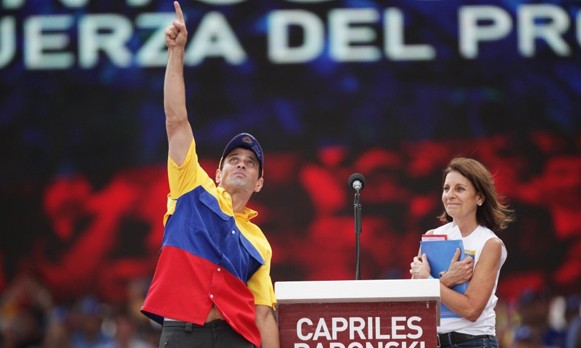
Mr. Capriles seems determined to win Chávez supporters. During the campaign, he has visited more than 300 towns, dashing through hard-bitten hillside slums. He tells crowds that Mr. Chávez did the right thing by putting the poor first, but that his government has been disorganized and corrupt.
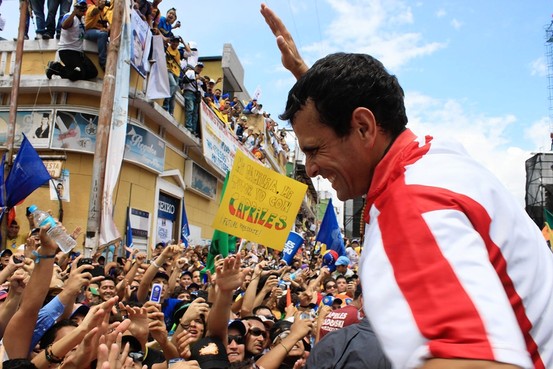
Increasingly, he is getting a rock-star reception even in Chávista strongholds, with women throwing themselves at him to touch or kiss him. One fan, saying she wanted to see what he tasted like, bit the candidate in the hand.
Everywhere he goes, Mr. Capriles focuses on the daily ills that plague Venezuelans like electricity and food shortages, drawing a contrast to Mr. Chávez’s often grandiose goals. The president’s campaign platform calls for the development of a new geopolitical balance that “permits the equilibrium of the universe and guarantees peace on the planet.”
“The people have told us their problems with public services, blackouts, with highways, and with the lack of high schools and housing which the government keeps promising,” Mr. Capriles said during a recent stop in Mr. Chávez’s home state of Barinas.
Even if Mr. Capriles loses, he may get another shot. The president, who has battled cancer for much of the past two years, may be seriously ill. His health is a state secret in Venezuela. If Mr. Chávez dies within the first four years of his term, Venezuela’s constitution calls for holding new presidential elections.
Mr. Capriles plays down his background as the son of wealthy entrepreneurs. Instead, he talks about his grandparents on his mother’s side, Polish and Russian Jews who survived the Warsaw Ghetto before emigrating to Venezuela with a suitcase of clothes and a movie reel that Mr. Capriles’s grandfather used to begin what eventually became Venezuela’s most important movie house chain.
Now a marathon runner, Mr. Capriles was a chubby, shy kid, says one of his best school friends, Alejandro Barrios. Mr. Barrios says that when they were both teens in high school, Mr. Capriles told him he wanted to be president. “I laughed out loud,” said Mr. Barrios. “He was just a normal guy.”
After law school, Mr. Capriles got an early jump on his political career, becoming the youngest ever member of Venezuela’s congress by winning a seat in 1998 elections, the same vote that brought Mr. Chávez to power.
Within two years, he became mayor of Baruta, a key municipality in the capital. In 2004, as mayor, he was imprisoned on charges that he had led a mob against the Cuban embassy during a 2002 coup, which briefly ousted Mr. Chávez from power. He spent four months in jail before being eventually absolved of all charges.
At the time, the jailing was widely seen as a government attempt to sideline Mr. Capriles as an up-and-coming opposition figure. But if so, it backfired. That same year, he won re-election as mayor with 79% of the vote.
He went on to defeat a key Chávez ally, Diosdado Cabello, to become governor of Miranda state. During his tenure, he expanded social programs like free food and housing. He also overcame efforts to undermine him from the federal government, including a move to disarm his state police.
Write to José de Córdoba at [email protected] and Kejal Vyas at [email protected]
To read this article on The Wall Street Journal, please click here.