Jan
3
2013
Posted by
admin
Comments

An Ailing Chávez Hides From View As A Constitutional Crisis Looms

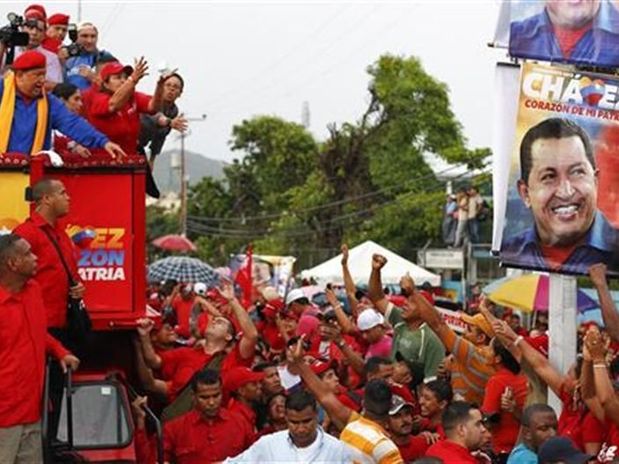
hugo chavez campaign stump An Ailing Chávez Hides From View As A Constitutional Crisis Looms

Courtesy of: Reuters

In Venezuela, the significance of events during the last several weeks cannot be overstated. After promising the Venezuelan people that he was “totally free” of the abdominal cancer that plagued him for more than a year, Hugo Chávez won re-election on October 7. Two months later, however, a visibly weak Chávez announced that his cancer had returned. He was rushed to Cuba for surgery on December 11; reports later surfaced that he had suffered serious “complications” after his fourth operation in 18 months.

Before leaving the country, Chávez designated newly-named Vice President Nicolas Maduro as his successor. According to Venezuela’s constitution, if a president dies or is unable to serve, a new election must be called within 30 days. A pallid Chávez, speaking on December 8th at the presidential palace, asked Venezuela to “elect Nicolás Maduro” if a special election occurs.

Though the special election requirement seems unambiguous, any transition of power is likely to be protracted and – because to several confusing provisions in Venezuela’s constitution – perhaps quite contentious. Chávez is due to be re-inaugurated on January 10th. As Foreign Policy explained this week, Chávez’s inability to be sworn in will pose significant problems for his party and thereby, the future of his self-styled socialist revolution:

“The problem for Maduro is that his term as vice president expires January 10th, when the current presidential term ends and a new one begins. Chávez, who is also president-elect, may not be healthy enough to be sworn in and appoint him vice president again. If that doesn’t happen, Maduro will be out of a job, even though he would remain the ruling party candidate in any follow-up election.”

If Chávez misses his inauguration, National Assembly president Diosdado Cabello would then assume control of the government until the President is finally sworn in or declared by the Assembly to be “totally absent.” Such a declaration, however, is unlikely to occur unless the President actually dies. Indeed, some of his socialist allies have suggested postponing the inauguration to accommodate Chávez’s health – a constitutionally dubious step that has drawn criticism from opposition leaders.

Even within the ruling socialist party there are divisions. Maduro and Cabello have emerged as the figureheads in a behind-the-scenes battle over the future of the party. Already faced with a slumping economy, a much-needed currency devaluation and a cancer-stricken president, Venezuelans may well have a full-blown constitutional crisis on their hands to start 2013.

If recent reports are to be believed, the country draws ever closer to such a scenario. Multiple outlets report that Chávez, his immune system ravaged by the cancer, suffered a severe respiratory infection following his most recent surgery. News also emerged that the infection was so serious it prevented Chávez from breathing, requiring doctors to perform a tracheotomy. Last month, Maduro sped to Havana to speak with the ailing president, sparking rumors that Chávez was on his deathbed.

For their part, members of the Venezuelan opposition have demanded the government tell ‘the whole truth’ about the president’s health. So far, the information released has lacked much needed specifics to determine the likelihood of Chávez’s survival.

For Venezuelans seeking clarification from the president himself, it may be a long wait. Chávez has not been seen or heard from since his statement nearly a month ago on December 8th. And this week, a source inside the Cuban hospital claimed that Chávez has been put in an induced coma, is “only kept alive by life support,” or may have even died. Chávez’s end may indeed be near, but we can be sure this is only the first chapter of a critical period for the future of Venezuelan’s government.
 
Dec
17
2012
Posted by
admin
Comments

ICYMI: Venezuela’s Capriles Solidifies Threat to Chávez

Wall Street Journal
December 17, 2012
By Kejal Vyas

OB VS154 velect G 20121217024727 ICYMI: Venezuelas Capriles Solidifies Threat to Chávez

Courtesy of: Associated Press

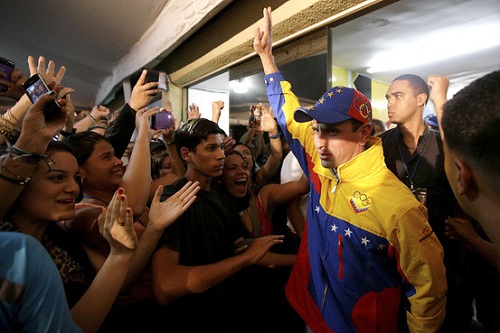
CARACAS—Henrique Capriles held on to his governorship in state elections Sunday, solidifying his place as the opposition’s most likely candidate if President Hugo Chávez’s illness forces a new race for Venezuela’s presidency.

The center-left Mr. Capriles, who lost to Mr. Chávez in a presidential race in October, has pledged to maintain nearly all of the current president’s social programs, but says he wants to run them more efficiently.

The opposition suffered a blow in the state polls Sunday, winning only three of the country’s 23 governor seats and losing four they had held before the vote.

“This has been a total victory” for Mr. Chávez’s ruling party, Miguel Perez Pirela, host of a pro-government political program, said on state television as the president’s supporters celebrated.

Despite its strong performance, the ruling party remains at a crossroads because of the health problems facing Mr. Chávez, the charismatic leftist leader who has dominated Venezuelan politics for 14 years.

The 58-year-old former army officer was re-elected in early October and announced a recurrence of his cancer a week ago, raising uncertainty about his future at the helm of the oil-rich South American country of 29 million people. Venezuela’s constitution requires new elections to be called within 30 days if a president dies or is incapacitated.

With his victory Sunday, Mr. Capriles has emerged as the strongest likely opposition candidate in a possible presidential vote. Analysts had said a loss in the Miranda state governor’s race would have been a devastating blow to his political future after his unsuccessful run against Mr. Chávez in October.

The 40-year-old governor won just over 50% of the votes in the state race Sunday, fighting off a challenge from former Vice President Elias Jaua—whom Mr. Chávez had handpicked to run against Mr. Capriles. Mr. Jaua took 46% of the vote.

“I feel happy for the people of Miranda, but in the rest of the country we didn’t achieve what we set out for,” Mr. Capriles said late Sunday at his campaign headquarters in Caracas.

A week ago Mr. Chávez tapped his longtime ally and vice president, Nicolas Maduro, as his preferred successor to lead his self-styled “socialist revolution.” Analysts are at odds over how Mr. Maduro, who has never been tested in an election, would fare against the opposition.

Mr. Capriles lost to Mr. Chávez by about 11 percentage points in the Oct. 7 presidential vote—but polls show Mr. Capriles winning if he were to face off against the president’s top allies. The governor has run a hectic door-to-door campaign during much of this year in a bid to attract voters from Mr. Chávez’s traditional strongholds in slums and the countryside.

Still, Sunday’s election results are “overall a negative for the opposition’s chances in any potential presidential election that could occur in the months ahead,” said Bret Rosen, a Latin America strategist at Standard Chartered. He said the ruling United Socialist Party of Venezuela, or PSUV, won more states than analysts had expected.

Venezuelan authorities said Mr. Chávez continued recovering from his operation in Cuba over the weekend. Few details about his condition have been released.

The president was “of full mental capacity” and was already “giving instructions and governing,” Science Minister Jorge Arreaza, who is also Mr. Chávez’s son-in-law, said from Havana in a phone call aired on state television.

However, government officials said throughout the week that Mr. Chávez’s recovery could take time, and asked Venezuelans to understand if he were unable to return before Jan. 10, when he is scheduled to be sworn in for his next six-year term.

Mr. Chávez has never said what kind of cancer he faces. He said on Dec. 8 that there had been a recurrence of malignant cells that required him to undergo surgery in Havana last week, his fourth operation for the illness since June 2011. He has also received several rounds of chemotherapy and radiation treatment.

 
Nov
12
2012
Posted by
admin
Comments

Having Secured a Third Term, Chávez pushes Commune System

chavez Having Secured a Third Term, Chávez pushes Commune System

Courtesy of: Reuters

On the night of his reelection, Hugo Chávez said in his acceptance speech that he planned to advance his vision of “21st century socialism” in the next term of his presidency. Now, just one month later, it has become clear that the plan involves the massive expansion of the “commune” system, which experts say is a plot to diminish the power of the opposition.

Communes are a standard feature of the socialist model of government. Chávez touts them as essential to his agenda, as he claims they will give people the power to manage their own resources. But many believe that his renewed interest in them – following an election in which he was victorious by a narrower margin than ever before – is not as ideological as he claims. Instead, many characterize the push for communes as motivated by a desire to reclaim power for his own party on the state and local levels.

To date, Chávez has attempted to weaken the power of state and municipal authorities merely by withholding the share of the national budget they are guaranteed by the constitution. He’s effectively accomplished this by significantly underreporting oil revenue, which limits the amount paid to municipal leaders, many of which are his political foes. But the commune proposal now on the table has been criticized as an offensive to further destabilize the country’s pluralist constitution and decimate any remaining shreds of capitalism.

The implementation of communes could prove disastrous for the opposition by absorbing and ultimately diminishing much of the power of mayors and governors. Already, as part of its most recent budget proposal, Chávez’s party proposed a far greater increase (37 percent) in the amount of funding going to the communes than to either the state or municipal governments (22 and 23 percent, respectively). A logical next step could potentially involve the assignment of the few remaining political responsibilities from local authorities to the communes.

In 2007, the people of Venezuela rejected an amendment to the constitution that would have provided for the legal establishment of the communes. However, in December of 2010 the National Assembly passed the Enabling Law, which granted the president broad authority to mandate by decree following the flooding that left approximately 100,000 Venezuelans homeless. The law gave Chávez unchecked power for eighteen months, through which he created a ministry charged with setting up the communes. However, creation of communes had stalled until October 20 – just 13 days after his reelection – when he urged the National Assembly to implement of the Communes Law.

But implementation has been slow because the act is unconstitutional. It illegally changes the very nature of Venezuela’s government by shifting responsibilities from democratically-elected local officials to a central authority. According to the constitution, the deadline has passed for making such dramatic changes this year.

If realized, millions of Venezuelans would be affected by these changes. By the numbers, Chávez is looking to grow the communes at a record-breaking pace: 3,000 between 2013 and 2019 at the rate of 450 per year. Ultimately this will incorporate more than 21 million citizens – nearly 68 percent of the country’s population. By consolidating local power into the communes, the president is ensuring that these Venezuelans are largely controlled by the central government – not their locally elected officials.