Nov
28
2012
Posted by
admin
Comments

ICYMI: Chavez’s return to Cuba for treatment rattles Venezuela

Reuters
November 28, 2012
By Andrew Cawthorne and Jeff Franks
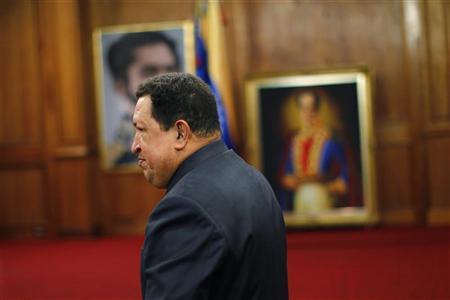
chavez returns to cuba 300x200 ICYMI: Chavezs return to Cuba for treatment rattles Venezuela

Courtesy of: Reuters / Jorge Silva

Venezuelan President Hugo Chavez flew into Cuba on Wednesday for cancer-linked medical treatment that revived questions about the viability of his socialist rule and left Venezuelans again guessing about his exact condition.

After weeks of scarce public appearances, Chavez, 58, announced in a letter on Tuesday that he was going to Havana for therapy known as “hyperbaric oxygenation” – a method used to reduce bone decay caused by radiation therapy.

Communist Party daily Granma confirmed his arrival in Cuba.

In Havana, Chavez enjoys the friendship of past and present Cuban leaders Fidel and Raul Castro, plus guaranteed privacy on the tightly controlled Caribbean island.

Venezuelans, who have been endlessly speculating about Chavez’s cancer since it was discovered in mid-2011, were not sure what to make of the latest twist – debating whether it was normal post-radiation treatment or a serious downturn.

“I really don’t know what he has,” Chavez’s cousin, Guillermo Frias, told Reuters from the president’s rural hometown state Barinas. “But anyway, I always pray for him every night. I stop at a shrine on the corner and always remember him.

“I hope he recovers fine. I’m sure he will. The election campaign was tough for him. He went too far.”

Though he had declared himself cured, Chavez appeared exhausted at the end of his successful presidential re-election bid in October. He later admitted radiation had taken its toll.

“INVISIBLE MAN”

The normally garrulous and omnipresent leader has made only a few, relatively short public appearances, mainly on state TV, at his presidential palace since his October 7 win. One opposition newspaper dubbed him “The Invisible Man”.

Unlike multiple past trips to Cuba, during treatment for three operations on two tumors in his pelvic area, state TV did not show images of Chavez departing or arriving this time.

Chavez has an open-ended authorization from Congress to travel, but aims to be back at least for the January 10 start of his new term, if not for a couple of regional summits before.

His absence leaves newly appointed Vice President Nicolas Maduro, 49 – a former bus driver and union leader – in a prominent position amid speculation among Venezuelans over who could replace Chavez should he leave power.

Congress head Diosdado Cabello, a former military comrade of Chavez’s, also is frequently touted as a possible successor to lead the ruling Socialist Party. Under the constitution, an election would have to be held if Chavez leaves office within the first four years of his new six-year term.

Chavez’s return to Cuba overshadowed the buildup to state elections on December 16, where the opposition aims to overcome disappointment at the presidential loss to make inroads.

A prolonged absence could potentially postpone major policy decisions, such as a widely expected devaluation of the bolivar currency after heavy pre-election state spending.

After removal of a first cancerous tumor, Chavez wrongly declared himself cured in late 2011. He again pronounced himself cancer-free in mid-2012 after removal of a second tumor.

BONDS RISE

The hyperbaric oxygenation therapy, or HBOT, he was due to receive involves breathing pure oxygen in a pressurized chamber.

In addition to the bone-weakening side effects of radiation on cancer sufferers, experts say HBOT is used to treat conditions including infections, abscesses and decompression sickness – or the “bends” – that can afflict deep sea divers.

Nelson Bocaranda, a prominent pro-opposition journalist, said Chavez had been suffering intense pain in his bones and waist area of late, forcing him to rest and take pain-killers.

In his widely read “Rumors” column on Wednesday, Bocaranda published a supposed medical report from Havana’s Cimeq hospital, with a relatively uninflammatory diagnosis.

“It’s a matter of giving him therapy for pain and stabilization so he has a better quality of life,” said the report, which could not be confirmed.

“His physical state is normal; loss of weight reasonable; high tension constant; abdominal nausea and pains; good emotional state but with variable depression; tolerable pain thresholds and reaction to treatment applied. He’s rested in recent days and had little pressure from government functions.”

Venezuelan officials, who frequently decry Bocaranda as a gossip and liar, gave no details of Chavez’s health. One medical source with knowledge of Chavez’s treatment said the HBOT may last several months and was a common “palliative treatment.”

An opposition leader, Henry Ramos Allup, demanded transparency from the government. “The president’s illness is a matter of state. The country has the right to know how exactly how serious it is,” he said.

Given investor hopes for a more market-friendly government, Venezuela’s widely traded bonds not surprisingly have risen.

On the streets, there was both solidarity and skepticism concerning Chavez.

“He exploited this thing of going to Cuba during the election campaign,” motorbike taxi driver Omar Rivas, 55, said, noting the wave of sympathy Chavez received in the past.

“That man doesn’t have anything. He was never sick.”

Teacher Ana Maria Garcia, 26, had a kinder reading.

“I don’t understand what he has, but I hope he recovers quickly. He’s a winner,” she said.

(Additional reporting by Mario Naranjo and Diego Ore; Editing by Bill Trott)

To read this article on Reuters, please click here.
 
Apr
11
2012
Posted by
admin
Comments

A Minimum Wage Increase Likely Not to Last Long

download A Minimum Wage Increase Likely Not to Last Long

On Saturday, during a televised cabinet meeting, Chávez announced that the minimum wage in Venezuela would be raised by almost a third. The statement came mere hours before Chávez boarded a late-night plane back to Cuba for more radiation treatments.

The 32.25 percent pay increase is scheduled to take place in two stages – 15 percent on May 1 and the remainder on September 1. However, the timing of this announcement – and of the pay increases themselves – is hardly incidental.

The May 1 increase may give Chávez a much sought-after bump in popularity in the short-term, and the second increase, on September 1, will come just weeks before the October 7 election. Not to mention the announcement had the added effect of changing the media’s focus, albeit briefly, away from the continuing saga of Chávez’s health.

While Chávez has a practice of instituting a pay increase to coincide with International Workers’ Day on May 1, inflation consistently outpaces any increase in wages. Case in point: Chávez increased the minimum wage by 26.5 percent in 2011, but the inflation rate was 27.6 percent that year. Luis Vicente León, president of polling firm Datanálisis, said the actual increase in workers’ buying power will be minimal because of inflation. While the 32.25 percent wage adjustment this year actually exceeds the 25 percent inflation rate forecast for 2012, León said this was politically motivated: “It was clear that the government was going to be more aggressive in increasing the minimum wage in an election year.” He also noted that the impact on production costs will be considerable and the hike in labor costs will hit investment.

Jorge Roig, Vice President of the Venezuelan Federation of Chambers of Commerce (Fedecámaras), expressed the same concerns in an interview with Radio Union News, noting “the salary increase will be diluted … with inflation” and “the government’s strategy has been thoughtless.” Back in May 2011, the last time the Venezuelan government increased the minimum wage, Washington Post blogger William J. Dobson commented:

“[Chávez’s real goal] is to inject enough short-term cash into people’s wallets to raise his chances for reelection in 2012. Never mind that that cash will disappear from their wallets as the minimum wage hikes fail to keep pace with inflation. Indeed, Chávez’s newly announced measures will make inflation worse. But he isn’t concerned with that. As he told a crowd this week, ‘I have a year and a half more in this government, then six more in the next one.’ That is Chávez’s main consideration.

 
Apr
6
2012
Posted by
admin
Comments

In Case You Missed It… Articles Roundup Week of 4/6/12

In this week’s roundup… Hugo Chávez travels to Cuba to undergo radiation treatment, and returns Thursday to his home state of Barinas on Thursday; MUD candidate Henrique Capriles embarks on a three-month, “house-by-house” tour of the country; a poll shows Chávez and Capriles in a statistical tie ahead of the presidential election; the European Union bans Venezuelan airline Conviasa from flying in the EU due to “numerous safety concerns”; poor maintenance at the refineries of state-run oil company PDVSA raise safety concerns; cables released by Wikileaks show that Cuban spies with direct access to Chávez are playing a key role in supporting his regime; and the construction of a 170 feet tall mausoleum to hold the remains of Simón Bolívar causes confusion and outrage.

120404085229 chavez castro story top In Case You Missed It… Articles Roundup Week of 4/6/12
Courtesy of: CNN

Venezuelan leader returns to Cuba for treatment, Associated Press

Venezuelan President Hugo Chávez traveled to Cuba on Saturday for another round of cancer treatment, saying he will be in Havana for several days and then return home. Chávez boarded the presidential jet on Saturday night accompanied by one of his daughters. His aides and military chiefs saw him off at the airport.

Insight: The man who would beat Hugo Chávez, Reuters

In an uphill battle to end President Hugo Chávez’s 13-year grip on the South American nation at an election in October, Capriles has an ace card – youth – and he knows how to play it. The sinuous, 39-year-old governor of Miranda state has embarked on a three-month, “house-by-house” tour of the country designed as much to show off his energy as his ideas. Still trailing Chávez in all polls, he certainly needs it.

Venezuelan Leader Tied With Rival in One Poll, but Other Results Differ, Wall Street Journal

CARACAS—A recent slate of public-opinion surveys show widely varying assessments of the presidential election for Venezuela’s polarized electorate. Most of the polls have President Hugo Chávez in the lead, but one set of results shows him with a 30-percentage point advantage over opposition candidate Henrique Capriles, while another had the rivals running neck-in-neck ahead of the Oct. 7 vote.

Venezuela Carrier Conviasa Banned by EU in New Blacklist Update, Bloomberg

The European Union banned Venezuelan airline Conviasa from flying in the 27-nation bloc under the latest changes to a list of unsafe carriers. The EU said “numerous safety concerns” resulting from accidents and European ramp checks justified the prohibition on Venezuela’s state airline.

Venezuelan refineries only receive 19% of maintenance, El Universal

The poor condition of oil facilities is among the criticisms made of the current management of state-run oil company Petróleos de Venezuela (Pdvsa). Frequent events in oil refineries have been attributed to their employees’ incompetence or lack of maintenance. Maintenance works were affected in 2011 by the shortage of inputs and materials.

WikiLeaks: Cuban spies support Chávez’s regime, El Universal

Cuban spies with direct access to President Hugo Chávez play a key role in supporting his regime. These spies constantly inform the president on the opposition’s moves, any rumors in the barracks and any sign of potential treason within revolutionary lines, say reports from WikiLeaks quoted by the New Herald. These reports include information from the United States Department of State and analysis from the private intelligence firm Stratfor.

Chavez returns to Venezuela after radiation treatment, CNN

President Hugo Chavez returned to Venezuela early Thursday morning after a second round of radiation treatment in Cuba. Appearing healthy and walking unaided, Chavez held court on the tarmac of the airport in Barinas, telling well-wishers who had gathered to welcome him that his treatment went well. “So far there has been no adverse reaction to the treatment; the body has assimilated it well,” Chavez said. He was greeted by members of his family, government officials and supporters.

Ramp? Mall? Ship? No, a Titan’s New Tomb, The New York Times

The 17-story-tall white-tiled mausoleum being built to hold the remains of the national hero Simón Bolívar looks to many people here like the world’s biggest skateboard ramp. To others, it evokes a parking garage, a shopping mall, a bridal veil, a sailing ship or a drive-in movie screen. Some simply call it an outrage. But to its creators, it is an eloquent tribute to the father of the nation, the quasi-mythical inspiration for President Hugo Chávez’s socialist revolution.