Nov
28
2012
Posted by
admin
Comments

ICYMI: Chavez’s return to Cuba for treatment rattles Venezuela

Reuters
November 28, 2012
By Andrew Cawthorne and Jeff Franks
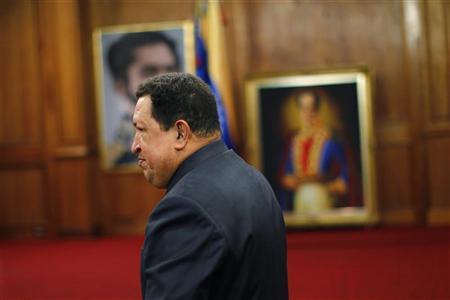
chavez returns to cuba 300x200 ICYMI: Chavezs return to Cuba for treatment rattles Venezuela

Courtesy of: Reuters / Jorge Silva

Venezuelan President Hugo Chavez flew into Cuba on Wednesday for cancer-linked medical treatment that revived questions about the viability of his socialist rule and left Venezuelans again guessing about his exact condition.

After weeks of scarce public appearances, Chavez, 58, announced in a letter on Tuesday that he was going to Havana for therapy known as “hyperbaric oxygenation” – a method used to reduce bone decay caused by radiation therapy.

Communist Party daily Granma confirmed his arrival in Cuba.

In Havana, Chavez enjoys the friendship of past and present Cuban leaders Fidel and Raul Castro, plus guaranteed privacy on the tightly controlled Caribbean island.

Venezuelans, who have been endlessly speculating about Chavez’s cancer since it was discovered in mid-2011, were not sure what to make of the latest twist – debating whether it was normal post-radiation treatment or a serious downturn.

“I really don’t know what he has,” Chavez’s cousin, Guillermo Frias, told Reuters from the president’s rural hometown state Barinas. “But anyway, I always pray for him every night. I stop at a shrine on the corner and always remember him.

“I hope he recovers fine. I’m sure he will. The election campaign was tough for him. He went too far.”

Though he had declared himself cured, Chavez appeared exhausted at the end of his successful presidential re-election bid in October. He later admitted radiation had taken its toll.

“INVISIBLE MAN”

The normally garrulous and omnipresent leader has made only a few, relatively short public appearances, mainly on state TV, at his presidential palace since his October 7 win. One opposition newspaper dubbed him “The Invisible Man”.

Unlike multiple past trips to Cuba, during treatment for three operations on two tumors in his pelvic area, state TV did not show images of Chavez departing or arriving this time.

Chavez has an open-ended authorization from Congress to travel, but aims to be back at least for the January 10 start of his new term, if not for a couple of regional summits before.

His absence leaves newly appointed Vice President Nicolas Maduro, 49 – a former bus driver and union leader – in a prominent position amid speculation among Venezuelans over who could replace Chavez should he leave power.

Congress head Diosdado Cabello, a former military comrade of Chavez’s, also is frequently touted as a possible successor to lead the ruling Socialist Party. Under the constitution, an election would have to be held if Chavez leaves office within the first four years of his new six-year term.

Chavez’s return to Cuba overshadowed the buildup to state elections on December 16, where the opposition aims to overcome disappointment at the presidential loss to make inroads.

A prolonged absence could potentially postpone major policy decisions, such as a widely expected devaluation of the bolivar currency after heavy pre-election state spending.

After removal of a first cancerous tumor, Chavez wrongly declared himself cured in late 2011. He again pronounced himself cancer-free in mid-2012 after removal of a second tumor.

BONDS RISE

The hyperbaric oxygenation therapy, or HBOT, he was due to receive involves breathing pure oxygen in a pressurized chamber.

In addition to the bone-weakening side effects of radiation on cancer sufferers, experts say HBOT is used to treat conditions including infections, abscesses and decompression sickness – or the “bends” – that can afflict deep sea divers.

Nelson Bocaranda, a prominent pro-opposition journalist, said Chavez had been suffering intense pain in his bones and waist area of late, forcing him to rest and take pain-killers.

In his widely read “Rumors” column on Wednesday, Bocaranda published a supposed medical report from Havana’s Cimeq hospital, with a relatively uninflammatory diagnosis.

“It’s a matter of giving him therapy for pain and stabilization so he has a better quality of life,” said the report, which could not be confirmed.

“His physical state is normal; loss of weight reasonable; high tension constant; abdominal nausea and pains; good emotional state but with variable depression; tolerable pain thresholds and reaction to treatment applied. He’s rested in recent days and had little pressure from government functions.”

Venezuelan officials, who frequently decry Bocaranda as a gossip and liar, gave no details of Chavez’s health. One medical source with knowledge of Chavez’s treatment said the HBOT may last several months and was a common “palliative treatment.”

An opposition leader, Henry Ramos Allup, demanded transparency from the government. “The president’s illness is a matter of state. The country has the right to know how exactly how serious it is,” he said.

Given investor hopes for a more market-friendly government, Venezuela’s widely traded bonds not surprisingly have risen.

On the streets, there was both solidarity and skepticism concerning Chavez.

“He exploited this thing of going to Cuba during the election campaign,” motorbike taxi driver Omar Rivas, 55, said, noting the wave of sympathy Chavez received in the past.

“That man doesn’t have anything. He was never sick.”

Teacher Ana Maria Garcia, 26, had a kinder reading.

“I don’t understand what he has, but I hope he recovers quickly. He’s a winner,” she said.

(Additional reporting by Mario Naranjo and Diego Ore; Editing by Bill Trott)

To read this article on Reuters, please click here.

 
Jun
5
2012
Posted by
admin
Comments

“Virtual” Chavez campaigns for re-election in Venezuela

* Cancer prevents president from hitting the streets

* Allies lack his charisma and rhetoric at rallies

* Chavez symbols omnipresent in election campaign 

Reuters
June 5, 2012
By Andrew Cawthorne

El presidente de Venezuela Hugo Chavez 300x198 Virtual Chavez campaigns for re election in Venezuela

Courtesy of: AFP / Juan Barreto

CARACAS, June 5 (Reuters) – Hugo Chavez’s voice booms out from loudspeakers singing the Venezuelan national anthem. A life-sized puppet of the socialist president dances on stage. His face looms from hundreds of shirts and hats on euphoric red-clad followers.

Yet at the latest government election rally, in a renovated colonial square at the heart of the largest slum in Caracas, the man himself is nowhere to be seen.

Chavez’s battle with cancer has kept him off the street during the tumultuous run-up to Venezuela’s Oct. 7 presidential vote, but his larger-than-life personality is stamped on every gathering of his supporters.

“Without his physical presence, we are simply re-doubling our efforts,” said Armando Marenco, a militant Chavez supporter who helped organize two buses to take about 100 people to the Petare slum for the swearing-in of a regional campaign team.

“We believe he will survive. Even if he does not, ‘chavismo’ will live without him. We, the people, are Chavez. He is no longer one man,” Marenco added, summing up the quasi-religious sentiment toward Chavez among his most passionate supporters.

In the square, government figures took to the stage invoking the words of Chavez. Earlier, a rapper warmed up the crowd with a newly-tailored chant: “Es sano, es sano, levantame la mano!” (“He’s healthy, he’s healthy, lift your hand!”)

The charismatic 57-year-old Chavez has for many years been one of Latin America’s greatest election campaigners.

After being pardoned following a coup attempt and freed from jail in 1994, he tramped Venezuela’s streets for four years, his unique popular touch and revolutionary message eventually sweeping him to an unlikely 1998 presidential poll win.

In power, Chavez’s remarkable energy has seen him crisscross the country, deliver marathon speech-after-speech and work crowds into a frenzy to help win almost a dozen votes.

This time, though, Chavez has so far been reliant on “virtual” campaigning – a stream of Twitter messages, some TV and radio appearances, and the occasional short appearance – while seemingly following his doctors’ orders to rest.

‘LIKE CHRIST’

Chavez’s lower profile has put the onus on allies such as Vice President Elias Jaua, Congress chief Diosdado Cabello and Foreign Minister Nicolas Maduro to front rallies in the big man’s absence.

Lacking Chavez’s popularity and rhetorical gifts – and fearing any overt protagonism that could imply that they themselves have an eye on the top job – they generally fall back on repeating his catch phrases and ideas.

“It’s like Jesus Christ and the apostles,” said Leonardo Agualimpias, a 46-year-old painter, watching Jaua perform a tepid jig with a rapper that was a pale imitation of Chavez’s famous all-singing, all-dancing appearances at such rallies.

“Obviously, the passion and fervor that Christ would produce in person is greater than that of his apostles. But don’t misinterpret this. The opposition think that without Chavez’s presence on the campaign, the election is going to be easy. No way. Anyway, Chavez will be back soon, you’ll see.”

Will he, though? Chavez said he finished radiotherapy last month but has given few more details, and nobody knows his full condition beyond a small group of doctors and confidants.

While he and government stalwarts say he is recovering well, rumors persist that he is close to death after three operations to remove two malignant tumors in the last year.

U.S. journalist Dan Rather lent his name to that end of the spectrum of speculation last week, saying a source close to Chavez had told him he has only a couple of months left to live.

“This reporter has been told … Chavez has metastatic rhabdomyosarcoma, an aggressive cancer that has ‘entered the end stage’,” he wrote, enraging Chavez supporters who said the veteran media man was echoing the wishful thinking of U.S. intelligence services.

ON HIS FEET

Ironically, Chavez gave his longest appearance since the recurrence of his cancer in February – chairing a Cabinet meeting live on TV for almost four hours – just hours before Rather’s report appeared.

In fact, he has been on something of a roll lately, phoning in to state media more often and standing in public, albeit gingerly, with a delegation from Belarus last weekend.

Supporters hail that as evidence of his recovery and are predicting he will soon hit the campaign trail in person – but the rumors and leaks persist.

Spain’s ABC newspaper and Nelson Bocaranda, an influential Venezuelan pro-opposition journalist, said at the weekend that the president was taking powerful opiates to ease the pain of what they said was cancer that had spread to his bones.

One source close to Chavez’s medical team told Reuters his condition was “delicate” and he had started to experience strong pain in one leg last month due to the illness’s progression.

Despite that, opinion polls show that two-thirds of Venezuelans believe Chavez will recover.

“He has not had one day of rest in 12 years. He has given his all for this country. It’s hardly surprising he’s feeling tired. He’ll be fine soon, of course he will,” said pensioner Luz Marina Rodriguez, 65, a regular at government rallies.

Chavez’s cancer has given an extraordinary backdrop to the election and is eclipsing all other major factors in the campaign – such as an unprecedented push by the opposition who have rallied behind a single candidate.

Miranda state governor Henrique Capriles’ “house by house” campaigning across Venezuela in the last few months has raised his national profile and cemented an image of youth, energy and on-the-street presence contrasting with Chavez’s absence.

Capriles is planning a march to the election board’s headquarters to formalize his candidacy this weekend, while there is widespread speculation about how Chavez will sign his registration papers without risking an impression of frailty.

Despite the contrasting physical images, most polls show Chavez with a two-digit lead in voter intentions. Analysts attribute that to sympathy over his condition, enduring personal popularity and the success of socialist welfare policies.

Perhaps symbolizing the populist touch that has served Chavez so well, the 3 millionth person to sign up to follow the president’s Twitter feed was recently awarded a free house.

Capriles’ camp insists some prominent polls are manipulated by the government, and say their surveys show the opposition candidate is neck-and-neck with Chavez.

They say some voters are scared to answer pollsters truthfully, and that the opposition’s grassroots campaigning will take a while to show up in surveys.

That view drew mockery at the Petare rally.

“It’s like a boxing fight. Capriles has come out too early, he’s given his all and not done much damage,” said the painter, Agualimpias. “Chavez is about to come out strong in the ring. This fight is only just starting.”

(Additional reporting by Mario Naranjo and Marianna Parraga; Editing by Daniel Wallis and Kieran Murray)

To read the original article from Retuers, please click here.

 
May
9
2012
Posted by
admin
Comments

For Venezuela’s president, a year of health struggles

CNN
By Catherine E. Shoichet

cr mega 998 hugo chavez 300x225 For Venezuelas president, a year of health struggles

Courtesy of: Reuters

It started with an unscheduled phone call to an evening TV show.

The voice of Venezuelan President Hugo Chavez crackled over the state television speakers.

“I have some news that is not very good,” he said on May 9, 2011, describing what he said was debilitating pain in his left knee that forced him to abruptly cancel a trip to Brazil and go on doctor-ordered bed rest.

“Surgery could be necessary,” he continued. “They’re evaluating that, but anyway, it is my responsibility to inform the country. Here I am, in battle.”

A year later, the battle hasn’t stopped.

Significant dates in Chavez health battle

Over a span of weeks, what started with announcements about a knee injury became something much more serious. First, an emergency surgery in Cuba for what government officials described as a pelvic abscess.

Then, days of silence from a leader known for lengthy speeches and rapid-fire Twitter posts.

Venezuelan officials went on the offensive when media reports suggested Chavez had cancer, describing the reports as vicious rumors that were part of a conspiracy by the president’s political opponents.

Government reports summed up the situation with the same phrase, saying Chavez was “recuperating satisfactorily” in Cuba.

After weeks of speculation, the Venezuelan president broke his silence in a somber speech from Havana on June 30, revealing that doctors had removed a cancerous tumor.

He ended with a phrase that would become a constant refrain in his speeches in the coming months: “We shall overcome.”

But the Venezuelan president did not disclose the type of cancer he was battling or how long he would be in Cuba for treatment.

After months of treatment, Chavez declared that he was cancer-free in October.

“There are no malignant cells in this body. They don’t exist,” he said on a visit to a religious site near Venezuela’s border with Colombia.

In mid-January, he delivered a State of the Union speech that lasted more than nine hours.

On February 20, rumors swirled on social media after Venezuelan columnist Nelson Bocaranda, without naming sources, wrote that Chavez was in serious condition and doctors were treating him in Cuba.

The report drew ire from Venezuelan officials.

“Regarding the rumors, dirty war of swine,” Information Minister Andres Izarra writes in a Twitter post.

The next day, while touring a tractor factory in Venezuela’s Barinas state, Chavez announced that he would undergo surgery to remove a lesion from the same area where doctors removed a cancerous tumor from his body last year.

Soon afterward, he announced that tumor was also cancerous, and he has been regularly undergoing radiation treatment in Cuba since then.

Now, 10 months after Chavez first announced his cancer diagnosis, officials have released few details about his treatment. Neither Chavez nor anyone in his government have publicly discussed what kind of cancer he has or provided a detailed prognosis for the 57-year-old leader.

This year alone, Chavez has spent more than 50 days undergoing treatment in Havana, according to a CNN tally. Last year, he spent 45 days there.

Speaking to Venezuelan state TV in a phone interview from Cuba on Monday, Chavez said that he is governing his country even as he undergoes treatment in Havana.

“I am governing, fulfilling my duties as head of state and of the government, but in this special situation, which I will come out of in the coming days,” he said. “Soon I will be there.”

For answers on Chavez’s health, many have turned to detailed media accounts, which, citing unnamed sources, paint a far more dire picture.

Among those reporting on Chavez’s condition are Bocaranda and Venezuelan doctor Jose Rafael Marquina, who practices in Florida and has no direct connection with the case but says he has colleagues who know what is happening. Reporters from the Spanish ABC newspaper and the Brazilian O Globo daily publication also have filed reports on Chavez’s condition.

According to these reports, thought to be reliable but which CNN has been unable to verify, Chavez’s illness — initially diagnosed as prostate cancer in January 2011 — has spread to his colon and other internal organs and to some bones.

Top Venezuelan officials maintain Chavez is beating the disease, and Chavez has repeatedly said he plans to run for re-election on October 7.

But the Venezuelan president further fueled speculation last month when he teared up during a Holy Thursday Mass as he discussed his struggle with cancer.

“Christ … give me life, because I still have things to do for the people and this country. Do not take me yet,” the Chavez said.

Chavez announced in January that it was time to constitute a Council of State, stipulated in the Venezuelan Constitution as the highest circle of advisers to the president.

Last week, as speculation continued to surge over who would succeed if Chavez becomes to ill to govern or dies, he named 10 Venezuelans to the council.

CNN’s Mariano Castillo and Arthur Brice contributed to this report.

To read the original article from CNN, please click here.