By Petardo de Petare

Petardo de Petare
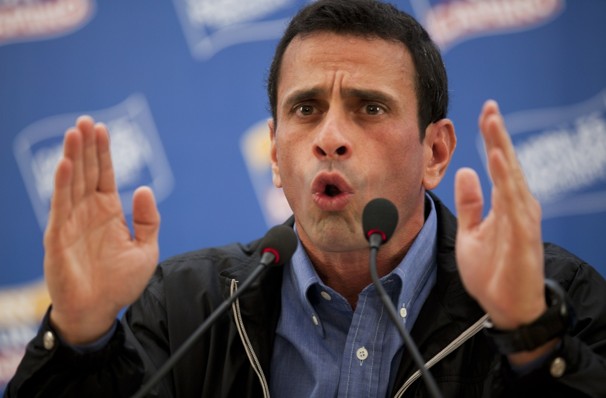
Two weeks ago, Venezuelans witnessed two remarkable occurrences. First, on June 10, MUD nominee Henrique Capriles jogged more than 6 miles to Venezuela’s electoral headquarters (as we call it, the CNE) to formally register his candidacy for president. He was followed by thousands of supporters, marching alone the avenues of Caracas as they chatted avidly about brighter days ahead for Venezuela—it was the picture of an opposition movement that genuinely believes they can win. His speech soared with idealistic rhetoric about a Venezuela with less violence, a more vibrant economy, and a political culture that respects, not demonizes, those who disagree. “On October 7th,” said Capriles, “I’ll be the next president of all Venezuelans.”
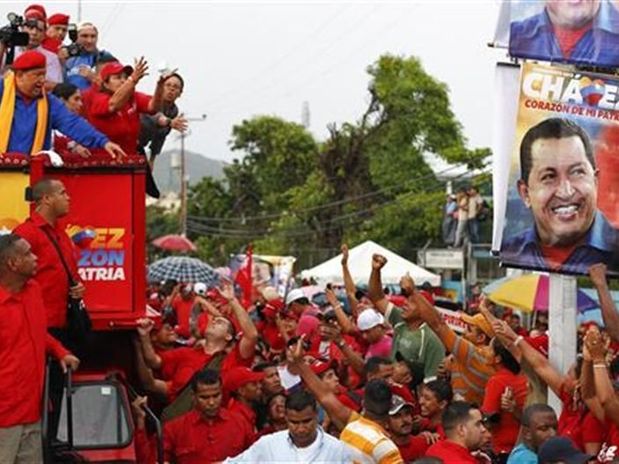
The very next day, a weakened but still feisty Hugo Chávez arrived at the electoral headquarters himself. Chávez had his supporters as well—to claim otherwise would be a lie—but the difference between his and Capriles’ entrance could not have been starker. While Capriles strode proudly at the head of a throng of supports, Chávez was deposited at the CNE by truck. Cameras were not permitted to witness the manner of his ascent to the podium, leading many to question whether the president, currently battling from an undisclosed type of cancer, could even make it to the stage under his own strength. He did his best to rouse the crowd with his speech. And while he delivered flashes of his old, charismatic self, any adult Venezuelan could see that this was not the same Chávez who rose to power on a wave of idealism more than a decade. The words of his oration were familiar, rife with obsolete rhetoric, promises to take care of the poor and his characteristic ad hominem insults of the opposition. However, for many, the speech itself fell flat.
The two appearances give us a metaphor worth considering. Some of the more free-thinking commentators in my country – along with many in the international media – have claimed that Capriles, represents Venezuela’s future, and Chávez the weight of her past. Of course, the tricky thing about the future is that it hasn’t happened yet…
13 years of Hugo Chávez has made many Venezuelans weary and distrustful of the promises of politicians. Make no mistake: the ideals Chávez espouses at times sound beautiful. Who doesn’t wish to see Venezuela produce enough food for its entire populace? Who doesn’t support Chávez’s stated “mission” to build millions of houses for the people who need it? Who wouldn’t want to see an oil-rich nation like Venezuela use its abundant resources to provide for its citizens?
However, the past 13 years have often taught us that there is a difference between priorities and reality. Chávez promised Venezuela food sovereignty; yet today our shortages are worse than ever. Chávez often says that “capitalists” and “the bourgeois” were the reason for our country’s ills, but his constant expropriations and currency manipulation have done nothing but drag our economy down by the waist. Chávez has often bellowed about his “Great Housing Mission;” yet these promises offer little comfort to the millions of Venezuelans who remain homeless. Indeed, within eyeshot of the CNE stood an office building-turned-refugee camp, where many Venezuelans who lost their homes in floods continue to wait for Chávez’s aid.
I do not doubt that Chávez’s supporters ardently believe in the president. But the sad fact is that so many of these Venezuelans have never really been given a choice. For more than a decade Venezuelans have been inundated by PSUV propaganda. Barely two weeks ago I turned on VTV (our largest television network) and saw an hour-long PSUV infomercial proclaiming the glory of the government. And now Chávez has refused to debate Capriles, depriving Venezuelans of their one true opportunity to compare the candidates on a level playing field. Indeed, if I did not seek and find truths about Venezuela through independent media and conversations with my neighbors, I might be volunteering for Chávez’s campaign myself!
So I return to my original point. Capriles may represent Venezuela’s future, but in a nation whose president has held power for more than a decade and whose government controls nearly all mainstream media, the “future” is a much more speculative proposition than in most countries. Many sheltered Venezuelans do not understand just how poorly their countrymen have fared in recent years. Others remain true Bolivarian believers, and genuinely trust Chávez and the PSUV to rescue Venezuela from problems of their own making. And still others are part of the large segment of the electorate employed by the government, as it continues to expand its list of state-owned industries. These individuals, essentially employed by the PSUV, are required to march with and support Chavez, or risk retaliation in the form of their own firing.
But for the growing number of Venezuelans who feel in our bones that the time has come for a change, voting for the opposition this fall means waging an uphill fight.
Let us be clear: if Henrique Capriles wins this fall, it will be with the Venezuelan media stifling him every step of the way. I am not naïve enough to wish for the Venezuelan media to cover this election evenly. I simply hope that the energetic Capriles—already renowned for the stamina exhibited on his “house to house” campaign across the country—can reach enough Venezuelans in person to make up the difference.