 |
Chávez and his closest advisors appear to be taking the first steps in arranging for a successor should the president lose his battle with cancer or become unable to seek re-election.
On April 30, Chávez announced the creation of the “Council of State,” declaring that its first task should be to present recommendations on Venezuela’s withdrawal from the Inter-American Commission on Human rights. The six-member council should be formally sworn in sometime in the coming weeks.
Under the 1999 Constitution, the president may convene such a body “to recommend policies of domestic interest regarding those issues that the president of the Republic recognizes to be of special transcendence and that require its opinion.” Chávez’s decision to convene this body only now — 13 years following the enactment of the constitution and after months of cancer treatments — indicates that the president’s illness is likely the event that has qualified as a matter of “special transcendence.”
The timing of this move, concurrent with news of Chávez’s failing health, has led experts and analysts to believe that the Council of State’s true purpose is to serve as a transitional body to lead Venezuela into the post-Chávez era — and possibly choose a successor. Following reports of infighting within Chávez’s own party, the Council will likely mediate between rival political factions and attempt to quash dissention within the PSUV in the event of Chávez’s death or incapacitation.
Other prognostications are bleaker: as What’s Next Venezuela guest blogger José Cardenas put it, “many see [the Council] as the first step toward the establishment of a junta to govern in Chávez’s absence or name a successor if Chávez is forced to step down.”
Chávez’s spokespeople have long maintained that the president is in good health and will stand for re-election. But the sudden formation of this council — made public as Chávez traveled back and forth to Cuba for cancer treatments — casts doubt on those rosy claims.
The members, meanwhile, claim the body serves only an advisory function.
“I don’t think this has anything to do with a transition government, it’s not been conceived that way at all … We don’t have power to take administrative decisions or pass laws,” council member Luis Britto said in an interview with Reuters.
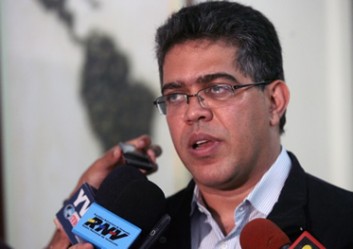 |
The Council is led by Elías Jaua, the vice-president. The other members of the Council are all close Chávez allies and mainly former government officials: Germán Mundaraín, former Ombudsman; Jorge García Carneiro, former Minister of Defense; José Vicente Rangel, former Vice-President; Luis Britto García, writer; Earle Herrera, Deputy for PSUV-Anzoátegui state; Roy Chaderton, former Minister of Foreign Affairs; Admiral Carlos Giacoppini Martínez and Luisa Estella Morales, President of the Supreme Tribunal of Justice (TSJ).
The makeup of the group — which includes several plausible successors — suggests that Chávez has drawn close his closest confidants in an attempt to ensure that his socialist project will carry on, with or without him.