Jun
13
2013
Posted by
admin
Comments

ICYMI: Venezuela gets a lifeline from the United States

The Washington Post
June 11, 2013
By Editorial Board
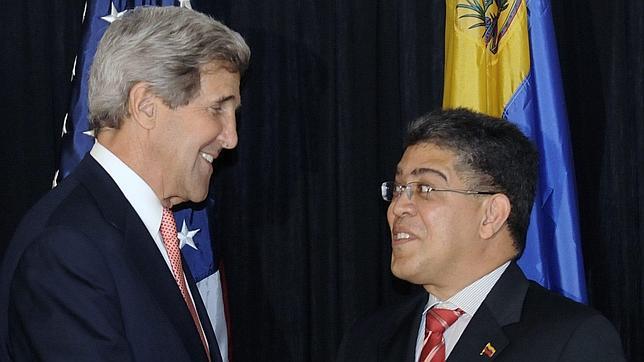
kerry jaua 644x362 e1371130314425 ICYMI: Venezuela gets a lifeline from the United States

Courtesy of: Agence France Presse

Nicolás Maduro, the former bus driver chosen by Hugo Chávez to lead Venezuela after his death, has been struggling to consolidate his position since being declared the victor in a questionable presidential election in April. With the economy stalling, inflation spiking and shortages spreading, the new president appears at a loss about how to respond, other than to blame domestic and foreign enemies. Nor has he been able to overcome a serious split in the Chavista movement between his own, Cuba-backed clique and another based in the military.

Perhaps most alarming for Mr. Maduro, an energized opposition has refused to accept the election outcome; its capable leader, Henrique Capriles, has been gaining sympathy around the region. The president of neighboring Colombia, Juan Manuel Santos, met with Mr. Capriles on May 29, prompting paroxysms of rage from Mr. Maduro and his aides. Other Latin American governments, while avoiding a confrontation with Caracas, have made it clear they regard the new leader’s legitimacy as questionable; the regional group Unasur called for an audit of the election results.

One government, however, has chosen to toss Mr. Maduro a lifeline: the United States. Last week Secretary of State John F. Kerry took time to meet Venezuelan Foreign Minister Elias Jaua on the sidelines of an Organization of American States meeting, then announced that the Obama administration would like to “find a new way forward” with the Maduro administration and “quickly move to the appointment of ambassadors.” Mr. Kerry even thanked Mr. Maduro for “taking steps toward this encounter” — words that the state-run media trumpeted.

What did Mr. Maduro do to earn this assistance from Mr. Kerry? Since Mr. Chávez’s death in March, the Venezuelan leader has repeatedly used the United States as a foil. He expelled two U.S. military attaches posted at the embassy in Caracas, claiming that they were trying to destabilize the country; he claimed the CIA was provoking violence in order to justify an invasion; and he called President Obama “the big boss of the devils.” A U.S. filmmaker, Timothy Tracy, was arrested and charged with plotting against the government — a ludicrous allegation that was backed with no evidence. Though Mr. Tracy was put on a plane to Miami on the day of the Kerry-Jaua encounter, Mr. Kerry agreed to the meeting before that gesture.

There’s nothing wrong, in principle, with diplomatic meetings or even in dispatching an ambassador to a country such as Venezuela. The State Department has also been meeting with senior opposition leaders and has yet to say it recognizes the presidential election results. But Mr. Kerry’s words amounted to a precious endorsement for Mr. Maduro — and the Obama administration appears bent on cultivating him regardless of his actions. Perhaps the increasingly desperate new leader has secretly promised concessions to Washington on matters such as drug trafficking. But with senior government and military officials involved in the transhipment of cocaine to the United States and Europe, he is unlikely to deliver.

In short, this looks like a reset for the sake of reset, launched without regard for good timing or the cause of Venezuelan democracy.

To read this article at The Washington Post, please click here.

 
Aug
22
2012
Posted by
admin
Comments

Venezuela invites Unasur to accompany elections

El Universal
August 22, 2012

11904599 copia.jpg.520.360 Venezuela invites Unasur to accompany elections

Courtesy of: V. Alcázares

Rafael Roncagliolo, Peru Foreign Minister and Pro Tempore President of the Union of South American Nations (Unasur), landed in Venezuela on Wednesday to sign an agreement on electoral accompaniment with the National Electoral Council (CNE).

Nicolas Maduro, Venezuela’s Foreign Minister, confirmed the information to the news agency Andina. He also indicated that he would take advantage of his counterpart visit to tackle issues linked with Peru-Venezuela relationship.

“Foreign Minister Rafael Roncagliolo will come on August 22, acting as Unasur Pro Tempore President to sign an agreement with the Venezuelan Electoral Power for the establishment of an Unasur accompaniment mission for the election on October 7,” stated Maduro.

Peru’s Ambassador to Venezuela Luis Raygade said that an immunity and privilege agreement for the Peruvian government officers that will come to Venezuela as part of  the accompaniment mission will be signed.

Peru- Venezuela link

Maduro declared that he will take advantage of Roncagliolo presence “to work on bilateral topics and to make important announcements related to the protection of our fellow Peruvian brothers who live here; topics that have already being treated,” he stated.

Translated by Karina Salas

To read this article on El Universal, please click here.

 
Jul
12
2012
Posted by
admin
Comments

Hugo Chávez, golpista

jose r cardenas Hugo Chávez, golpista

José R. Cárdenas

José R. Cárdenas served in several foreign policy positions during the George W. Bush administration (2004-2009), including on the National Security Council staff. He is a consultant with Vision Americas in Washington, DC.

Hugo Chávez’s penchant for labeling anyone who disagrees with him a “golpista” (coup-mongerer) is well-established. This, despite his own history of leading an ill-fated military coup in 1992 against former Venezuelan President Carlos Andres Pérez. But it seems the years since haven’t diminished his ardor for military coups when it suits his purposes — a fact affirmed by recent events in Paraguay.

Paraguay recently saw the sudden impeachment of President Fernando Lugo for “poor performance.” Whatever one thinks of that drastic action, it happened to be consistent with the country’s constitution.

Yet events in Paraguay apparently didn’t pass muster with Hugo Chávez, who ordered his foreign minister, Nicolas Maduro to meet with Paraguay’s military leadership to try and convince them to intervene and forcibly restore President Lugo to office. (In this effort, Maduro, who was in the country as part of a Unasur delegation monitoring the impeachment, was accompanied by Ecuador’s ambassador to Paraguay, who represents another government that routinely identifies opposition as golpistas.)

Infuriated by the meeting, the Paraguayan government withdrew its ambassador from Caracas, citing “the grave evidence of intervention by Venezuelan officials in the internal affairs of Paraguay.” It also ordered a shake-up of the military brass, with new President Federico Franco stating, “We will not tolerate military officers who want to become insubordinate or accept the recommendations of foreign countries.”

On a continent with a long, tortuous history of military involvement in politics, Paraguay stands out. It was not until 1989 that the 35-year reign of General Alfredo Stroessner ended. As a result, there is great sensitivity towards the matter in the country and is why a senior foreign official meeting with the military to encourage their intervention in Paraguayan politics constitutes an outrageously reckless act that threatens not only the internal stability of the country, but has wider regional implications as well.

Yet not only has the regional silence been deafening on Maduro’s meeting, but countries like Brazil and Argentina turned around and effectively rewarded Chávez by granting Venezuela full-membership in Mercosur, the political and economic pact among Argentina, Brazil, Paraguay and Uruguay. This fulfilled a key foreign policy objective of Chávez for years that had previously been blocked, ironically, by the Paraguayan Congress. But with Paraguay suspended from the customs union because of the Lugo impeachment, Brazil and Argentina moved instantly to grant Chávez membership. It’s not that Mercosur will bring Venezuela any measurable economic benefits, but to Chávez it is one more key symbol of the legitimacy of his political project and one more instance of Venezuela’s integration with Latin American countries in a union that excludes the United States.

As Brazilian diplomat and former Mercosur representative José Botafogo Goncalves told the Brazilian newspaper O Globo, “Venezuela doesn’t meet the basic requirements to enter Mercosur. Venezuela’s problem is Chávez, who doesn’t like free trade and wants to transform the bloc into a political platform.”

But degrading their own multilateral institutions is one thing; Chávez’s encouraging a military coup in Paraguay is quite another. Lamentably, the continued regional indulgence of Hugo Chávez’s provocations appears to know no bounds. Apparently, there is no action he can take, no matter how reckless or interventionist, that will bring rebuke. Instead, he is rewarded. It is indeed a sad commentary on the current state of Latin American regional leadership.