Jun
13
2013
Posted by
admin
Comments

ICYMI: Venezuela gets a lifeline from the United States

The Washington Post
June 11, 2013
By Editorial Board
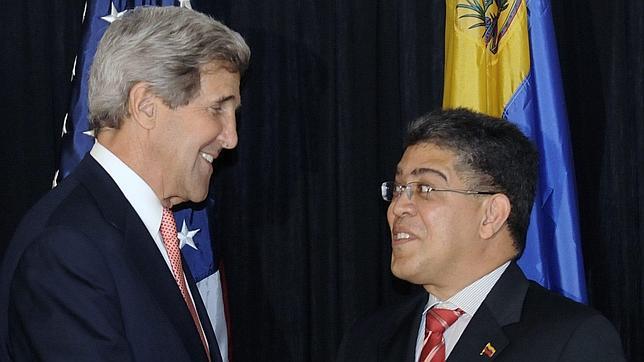
kerry jaua 644x362 e1371130314425 ICYMI: Venezuela gets a lifeline from the United States

Courtesy of: Agence France Presse

Nicolás Maduro, the former bus driver chosen by Hugo Chávez to lead Venezuela after his death, has been struggling to consolidate his position since being declared the victor in a questionable presidential election in April. With the economy stalling, inflation spiking and shortages spreading, the new president appears at a loss about how to respond, other than to blame domestic and foreign enemies. Nor has he been able to overcome a serious split in the Chavista movement between his own, Cuba-backed clique and another based in the military.

Perhaps most alarming for Mr. Maduro, an energized opposition has refused to accept the election outcome; its capable leader, Henrique Capriles, has been gaining sympathy around the region. The president of neighboring Colombia, Juan Manuel Santos, met with Mr. Capriles on May 29, prompting paroxysms of rage from Mr. Maduro and his aides. Other Latin American governments, while avoiding a confrontation with Caracas, have made it clear they regard the new leader’s legitimacy as questionable; the regional group Unasur called for an audit of the election results.

One government, however, has chosen to toss Mr. Maduro a lifeline: the United States. Last week Secretary of State John F. Kerry took time to meet Venezuelan Foreign Minister Elias Jaua on the sidelines of an Organization of American States meeting, then announced that the Obama administration would like to “find a new way forward” with the Maduro administration and “quickly move to the appointment of ambassadors.” Mr. Kerry even thanked Mr. Maduro for “taking steps toward this encounter” — words that the state-run media trumpeted.

What did Mr. Maduro do to earn this assistance from Mr. Kerry? Since Mr. Chávez’s death in March, the Venezuelan leader has repeatedly used the United States as a foil. He expelled two U.S. military attaches posted at the embassy in Caracas, claiming that they were trying to destabilize the country; he claimed the CIA was provoking violence in order to justify an invasion; and he called President Obama “the big boss of the devils.” A U.S. filmmaker, Timothy Tracy, was arrested and charged with plotting against the government — a ludicrous allegation that was backed with no evidence. Though Mr. Tracy was put on a plane to Miami on the day of the Kerry-Jaua encounter, Mr. Kerry agreed to the meeting before that gesture.

There’s nothing wrong, in principle, with diplomatic meetings or even in dispatching an ambassador to a country such as Venezuela. The State Department has also been meeting with senior opposition leaders and has yet to say it recognizes the presidential election results. But Mr. Kerry’s words amounted to a precious endorsement for Mr. Maduro — and the Obama administration appears bent on cultivating him regardless of his actions. Perhaps the increasingly desperate new leader has secretly promised concessions to Washington on matters such as drug trafficking. But with senior government and military officials involved in the transhipment of cocaine to the United States and Europe, he is unlikely to deliver.

In short, this looks like a reset for the sake of reset, launched without regard for good timing or the cause of Venezuelan democracy.

To read this article at The Washington Post, please click here.

 
May
1
2012
Posted by
admin
Comments

New Leaks Tie Chávez to Drug Trafficking

57598112 013366780 1 New Leaks Tie Chávez to Drug Trafficking
Giant portraits of the mothers of victims have highlighted the problem of violence in Caracas

With the October elections approaching, Hugo Chávez is no doubt hoping that Venezuelans’ faith in his government and its social programs will carry him to victory. But as we’ve reported before, former Venezuelan Supreme Court judge Eladio Aponte Aponte’s allegations of corruption and ties to drug traffickers are adding to what were already serious concerns about increasing violence and crime in Venezuela.

The former judge has been turning over proof of narco-trafficking to the DEA, some of which has leaked to the press. And while Aponte has implicated senior government leaders in the past, new evidence indicates that these actions were known by the highest levels of Venezuela’s government. According to Aponte, Chávez received weekly briefs on the drug operations carried out by Venezuela’s military. Aponte has revealed a letter to Chávez from a military leader requesting an investigation into the involvement of Henry Rangel Silva, now the Minister of Defense, in the transportation of 2.2 tons of cocaine by a military convoy. The cocaine was kept at an army barrack on the border of Colombia, an area rife with drug gangs. After hearing the allegations, Chávez chose not to launch the investigation, instead, according to Aponte, he did his best to keep the story under wraps.

Aponte has also said that he was told to “turn a blind eye” to members of the FARC, a guerilla group with ties to drug smuggling that the Colombian government has fought for decades. The problems along the porous Colombia-Venezuela border are well documented, which has allowed cocaine grown and produced in Colombia to pass to Venezuela, the main port of transit for the cocaine heading to the U.S. and Europe. Just last week, former Colombian president Álvaro Uribe criticized Chávez and his government for permitting Colombian terrorists and narco-traffickers to operate in Venezuela.

Previous reports said the operations were handled by Silva; General Cliver Alcalá, commander of the Fourth Armored Division of the Army; and Diosdado Cabello, president of the National Assembly and one of President Hugo Chávez’s closest allies, but these are the first allegations that Chávez himself was involved.

This comes on top of Aponte’s earlier claims that the Chávez administration controls the court system. Aponte has said Chávez and other government officials contacted judges with instructions on sensitive cases, while vice president Elias Jaua held weekly meetings with members of the judiciary. Chávez’s control over the Venezuelan courts is a concern that has been voiced by a number of human rights groups, such as Human Rights Watch, for many years.

Venezuelans have already identified crime and insecurity as a top issue in the upcoming elections. As the allegations continue to pour out, Chávez and the PSUV will have to do serious damage control to convince Venezuelans that they are part of the solution and not, as many are saying, part of the problem.

 
Apr
19
2012
Posted by
admin
Comments

Former Venezuelan Judge Suggests Drug Trafficking By Government Officials

Typically, when international experts, foreign governments and Venezuelan citizens talk about the rising crime in Venezuela, it’s in regard to the rampant violence that has made the country as dangerous as some conflict zones. Even the U.S. State Department has warned citizens traveling to Venezuela of the purported dangers. However, more and more, the governments in both the U.S. and Venezuela are turning their attention to the “worrying trends” emerging in Venezuela’s illegal narcotics trade.

Now, a former Venezuelan judge has suggested to U.S. investigators that prominent figures in Venezuela’s government are involved in drug trafficking operations.

In testimony given before the Drug Enforcement Administration (DEA) on Tuesday, Eladio Aponte Aponte, a former judge of the Supreme Court of Venezuela, has implied that senior officers of the armed forces and even leaders of the Chávez government are complicit in drug trafficking operations.

According to one source, Aponte said the drug trafficking operations are run directly by Henry Rangel Silva, the Venezuelan Minister of Defense; General Cliver Alcalá, commander of the Fourth Armored Division of the Army; and Diosdado Cabello, president of the National Assembly and one of President Hugo Chávez’s closest allies.

The Office of Foreign Assets Control (OFAC) of Treasury Department was already aware of Alcalá’s and Silva’s alleged links to drug trafficking and terrorist organizations.

aponte Former Venezuelan Judge Suggests Drug Trafficking By Government Officials

Aponte arrived in the U.S. from Costa Rica, where he had been since Apr. 2. He was himself implicated in the drug conspiracy, and was dismissed as a judge on March 20 for alleged ties to accused trafficker Walid Makled. His whereabouts between his dismissal from the Supreme Court and his appearance in Costa Rica remain unknown.

The National Assembly removed Aponte from office after documents found in Makled’s apartment showed ties to the judge. Aponte gave Makled credentials that gave him access to court offices and the freedom to move around the country without restriction.

Makled is currently on trial in Caracas. He was extradited to Venezuela from Columbia after a series of diplomatic negotiations.

According to reports released by WikiLeaks, the Venezuelan military exerted pressure on Chávez to prevent Makled from being tried in the U.S. Senior army officers reportedly fear that Makled — who has already told media that senior army officers were directly involved in drug transport — might testify that the Venezuelan military aided his drug trafficking operation.

Economic issues often garner the most attention during an election season. But in this election year in Venezuela, crime is an equally important issue for most Venezuelans. If proven true, these alleged connections between the government’s top officials and narcotics trafficking could adversely impact the PSUV, who very well could lose the high ground in the debate about crime.