May
16
2013
Posted by
admin
Comments

ICYMI: Venezuela is Running Out of Toilet Paper

Associated Press
May 16, 2013
By Fabiola Sanchez and Karl Ritter
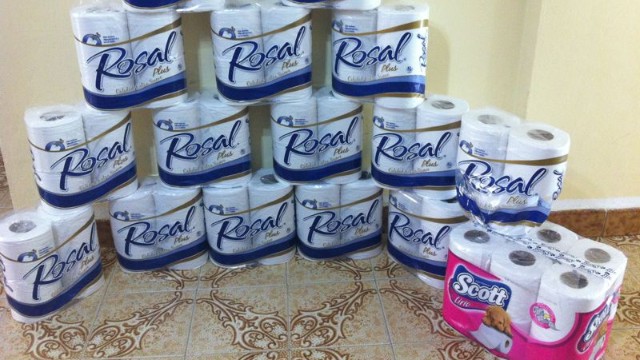
130515171546 toilet paper caracas story top e1368722217422 ICYMI: Venezuela is Running Out of Toilet Paper

Courtesy of: CNN

CARACAS, Venezuela (AP) — First milk, butter, coffee and cornmeal ran short. Now Venezuela is running out of the most basic of necessities — toilet paper.

Blaming political opponents for the shortfall, as it does for other shortages, the embattled socialist government says it will import 50 million rolls to boost supplies.

That was little comfort to consumers struggling to find toilet paper on Wednesday.

“This is the last straw,” said Manuel Fagundes, a shopper hunting for tissue in downtown Caracas. “I’m 71 years old and this is the first time I’ve seen this.”

One supermarket visited by The Associated Press in the capital on Wednesday was out of toilet paper. Another had just received a fresh batch, and it quickly filled up with shoppers as the word spread.

“I’ve been looking for it for two weeks,” said Cristina Ramos. “I was told that they had some here and now I’m in line.”

Economists say Venezuela’s shortages stem from price controls meant to make basic goods available to the poorest parts of society and the government’s controls on foreign currency.

“State-controlled prices — prices that are set below market-clearing price — always result in shortages. The shortage problem will only get worse, as it did over the years in the Soviet Union,” said Steve Hanke, professor of economics at Johns Hopkins University.

President Nicolas Maduro, who was selected by the dying Hugo Chavez to carry on his “Bolivarian revolution,” claims that anti-government forces, including the private sector, are causing the shortages in an effort to destabilize the country.

The government this week announced it would import 760,000 tons of food and 50 million rolls of toilet paper.

Commerce Minister Alejandro Fleming blamed the shortage of toilet tissue on “excessive demand” built up as a result of “a media campaign that has been generated to disrupt the country.”

“The revolution will bring the country the equivalent of 50 million rolls of toilet paper,” he was quoted as saying Tuesday by state news agency AVN. “We are going to saturate the market so that our people calm down.”

Finance Minister Nelson Merentes said the government was also addressing the lack of foreign currency, which has resulted in the suspension of foreign supplies of raw materials, equipment and spare parts to Venezuelan companies, disrupting their production.

“We are making progress … we have to work very hard,” Merentes told reporters Wednesday.

Many factories operate at half capacity because the currency controls make it hard for them to pay for imported parts and materials. Business leaders say some companies verge on bankruptcy because they cannot extend lines of credit with foreign suppliers.

Merentes said the government had met the U.S. dollar requests of some 1,500 small- and medium-sized companies facing supply problems, and was reviewing requests from a similar number of larger companies.

Chavez imposed currency controls a decade ago trying to stem capital flight as his government expropriated large land parcels and dozens of businesses.

Anointed by Chavez as his successor before the president died from cancer, Maduro won a close presidential election April 14 against opposition candidate Henrique Capriles, who refused to accept the result, claiming Maduro won through fraud and voter intimidation. He filed a complaint to the Supreme Court, asking for the vote to be annulled, though that’s highly unlikely to happen since the court is packed with government-friendly justices.

Patience is wearing thin among consumers who face shortages and long lines at supermarkets and pharmacies. Last month, Venezuela’s scarcity index reached its highest level since 2009, while the 12-month inflation rate has risen to nearly 30 percent. Shoppers often spend several days looking for basic items, and stock up when they find them.

Fleming, the commerce minister, said monthly consumption of toilet paper was normally 125 million rolls, but that current demand “leads us to think that 40 million more are required.”

“We will bring in 50 million to show those groups that they won’t make us bow down,” he said.

To read this article at Associated Press, please click here.
 
May
13
2013
Posted by
admin
Comments

With the Economy in Dire Straits, Maduro Scapegoats a Beloved Venezuelan Company

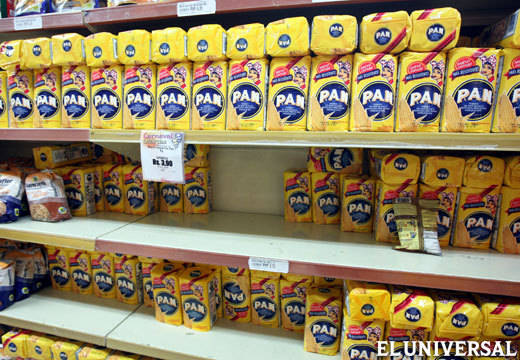
pan0.jpg.520.360.thumb  e1368469039817 With the Economy in Dire Straits, Maduro Scapegoats a Beloved Venezuelan Company

Courtesy of: El Universal

Nicolás Maduro and his socialist government cannot claim that they were not warned. Economists have long predicted that a Venezuelan economy propped up by excessive borrowing and an unsustainably high oil market would collapse spectacularly. Hugo Chávez, his cancer kept at bay just long enough to secure reelection, spent enough borrowed money in his final months to postpone the crash until Maduro had taken control. But the reckoning was inevitable. Now Maduro, eager for a scapegoat, is intensifying his attacks on the private sector, taking aim at Venezuelans’ most beloved company: Empresas Polar.

Polar is a pillar of the Venezuelan economy, producing staple goods from cornflour to household supplies and the nation’s most popular beer. Maduro issued his latest threat against the company on Saturday, when he accused the company of economic “sabotage” and demanded company President Lorenzo Mendoza to appear before the government to “explain the situation.” It was the latest in a series of escalating rhetoric against Polar, and a disturbing sign that Maduro refuses to learn the lessons inflicted on Venezuelans by years of failed socialist policies. Mendoza is scheduled meet with Vice-president Jorge Arreaza on Monday and with Maduro on Tuesday.

In a press conference held on Monday before the scheduled meetings, Mendoza addressed Maduro’s statements. He noted that Polar’s cornflour brand, PAN, operates at 100 percent capacity, but has only a 48 percent stake in the Venezuelan market, making it impossible to meet the country’s full demand. Thus far this year, Polar has produced 10 percent – 15,000 tons – more than last year. The remaining 52 percent of the market is comprised primarily of government-owned businesses, which are producing at less than 40 percent of their capacity. In response to Maduro’s accusation of “hoarding,” Mendoza stressed that Polar simply cannot hoard products to begin with since every step of the production and distribution process is regulated by government overseers.

As economists have noted, the shortages and inflation Maduro blames on the private sector are in fact caused by the government’s own policies. Rampant expropriations, price controls and other heavy-handed policies have harmed business and left farmland idle, sapping more than 11 percent from the country’s gross domestic product between 2005 and 2010.

Inflation is soaring, the nation’s debt continues to mount, and a currency devaluation has crippled Venezuelan’s purchasing power. As What’s Next contributor Joel Hirst observed, the economic crisis has left Maduro in the “awkward position of blaming Venezuela’s hobbled private sector for the failure of his own socialist policies.” The Central Bank’s scarcity index for Venezuela, which measures the percentage of goods unavailable in the market, rose to its highest number since it began tracking in April, 2009.

The facts, of course, could not be clearer. The company persevered under the yoke of Chávez’s policies, and continues to provide the goods Venezuelans need even as government controls force Polar and other companies to operate at a loss. These private companies are Venezuela’s best hope for brighter economic days; Maduro, in a desperate bid to save his own political skin, has chosen to marginalize them even further. It is ordinary Venezuelans, however, who will suffer the consequences.

 
May
10
2013
Posted by
admin
Comments

In Case You Missed It… Articles Roundup Week of 5/10/13

Maduro In Case You Missed It… Articles Roundup Week of 5/10/13

Courtesy of Reuters

This week: The Venezuelan government starts an expanded audit of the disputed April 14 presidential election as Henrique Capriles files a legal challenge of the results; the Obama administration continues to monitor Venezuela’s crackdown on political opposition; Nicolás Maduro reacts angrily to Barack Obama’s comments about the political crisis in Venezuela; the family of Timothy Tracy, the American filmmaker held in Venezuela on charges of alleged espionage, calls the situation a “nightmare”; and U.S. diplomats are finally granted access to Tracy in Venezuela. Senior Venezuelan banking official is held on charges of accepting at least $5 million in bribes to funnel business to two Miami broker-dealers; the U.S. Treasury punishes Iran-Venezuela Binational Bank for helping the Iran government evade international sanctions; the Venezuelan government scrambles for answers to the country’s homicide rate, creating concerns about possible human rights abuses; and representatives of 130 countries believe Venezuela fails to meet the minimum democratic requirements. Venezuelan inflation soars toward 30 percent, the highest since August 2010, as the central bank’s scarcity index reaches a record high; according to mathematicians, the tally in Venezuela’s disputed election presents logical and numerical inconsistencies; Venezuela falls to seventh place in scientific research in Latin America, ranking below Cuba; and Venezuela’s only opposition TV station announces management changes after being taken over by the government.

Venezuela Starts Election Audit, The Wall Street Journal

Authorities on Monday began an expanded audit of the disputed April 14 presidential election even though the opposition candidate who called for the review has since withdrawn his support and instead filed a legal challenge of the results.

U.S. Monitoring Venezuela’s Political Crackdown On Opposition, Obama Says, Reuters

The United States is watching “crackdowns on the opposition” in Venezuela, President Barack Obama said in a television interview aired on Friday when asked if he considered newly elected Nicolas Maduro to be the country’s legitimate president.

Venezuela’s Government Condemns Obama’s Comments, The Associated Press

Venezuela’s government on Saturday angrily rejected comments made by U.S. President Barack Obama about the South American country’s political crisis and accused Washington of being behind violence that has followed its recent presidential election.

Family of American held in Venezuela says experience ‘a nightmare;’ embassy has had no access, The Associated Press

U.S. diplomats have been given no access to a California man held in Venezuela for nearly two weeks in what his family on Monday called a “nightmare” that unfolded after he was accused of being a spy fomenting postelection unrest.

US officials are granted access to American detained in Venezuela, Associated Press

Venezuela’s government has granted U.S. diplomats access to a California man who is being held while he awaits trial on charges of espionage and fomenting unrest.

Venezuelan banking official and 2 Miami broker dealers charged in $5 million NY bribery case, The Associated Press

A senior Venezuelan banking official is being held in Miami on charges that she accepted at least $5 million in bribes to funnel business to two Miami broker-dealers, federal authorities in Manhattan announced Tuesday.

US punishes Venezuelan-Iranian bank for helping Tehran, El Universal

The US Department of the Treasury punished on Thursday the Iran-Venezuela Binational Bank (IVBB) for helping the Iranian government to “sort out” international sanctions because of its controversial nuclear program.

Justice minister says Venezuela’s military to form part of anti-crime initiative, The Associated Press

Venezuela’s top security official announced Sunday the government of President Nicolas Maduro will use the military to fight rampant violent crime, raising concerns among activists who warned the initiative could lead to human rights violations.

No democracy in Venezuela, according to 130 countries, El Universal

Representatives of 130 Foreign Offices of countries viewed as democratic met last week in Mongolia, at the Summit of the Community of Democracies.

Venezuela Inflation Soars Toward 30% as Maduro Cuts Dollar Sales, Bloomberg

Venezuelan consumer prices soared the most in three years last month as President Nicolas Maduro’s government reduced dollar sales to importers and the central bank’s scarcity index reached the highest on record.

Mathematicians claim that election numbers in Venezuela do not match, El Universal

The results released by the board of the Venezuelan National Electoral Council (CNE) in several bulletins about the presidential election of April 14 exhibit “logic and numerical inconsistencies.”

Venezuela ranks below Cuba in scientific research, El Universal

Venezuela ranked seventh in scientific production in Latin America in 2011, according to international indicators such as SCImago Institutions Rankings (SIR).

Sole Opposition TV Channel in Venez Makes Changes, The Associated Press

Venezuela’s only opposition television channel says it is bringing in new management after its sale to new owners, but pledges to maintain its critical line against the government.