International Business Times
May 30, 2012
By Ryan Villarreal
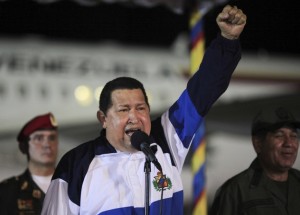
Courtesy of: Reuters
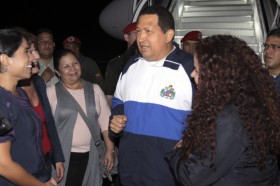
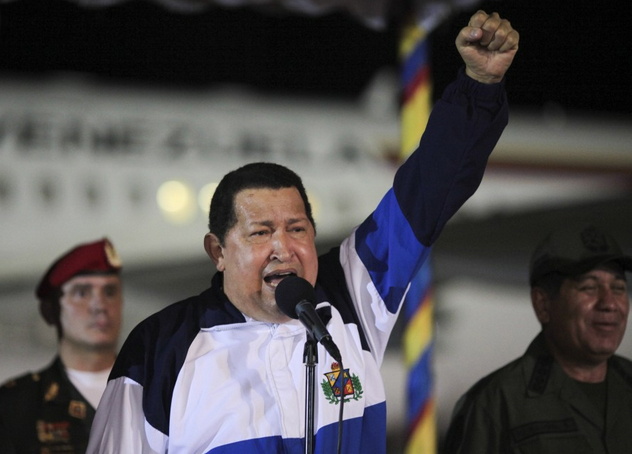
Venezuelan President Hugo Chávez appeared vigorous and in high spirits, wearing a track suit like his Socialist comrade Fidel Castro, in front of television cameras as he stepped off the plane in Caracas earlier this month. He was coming home following his latest round of cancer treatment in Cuba.
Chávez embraced government ministers on the tarmac, smiling broadly and laughing, his round face seemingly untouched by the tolls of his unspecified cancer and subsequent radiation therapy.
“I come with great optimism that this treatment will have the effects we hope for, always asking God to help us and give us the miracle of life to keep serving,” Chávez said, delivering a speech on the runway.
“But as the hours and days pass, I’m sure that with God’s favor, medical science and this soldier’s body, I will get back to where I must be, in the front line of the battle, alongside the Venezuelan people, promoting the socialist revolution,” he continued.
After Chávez orated for about 20 minutes — not long, by his standards — he broke into a rendition of a traditional Venezuelan song.
“I do not envy the flight nor the nest of the Turpial,” he sang in Spanish, a lyric referring to Venezuela’s national bird. His stout frame propelled his baritone voice with operatic vibrato, amateur yet soulful. “I am like the wind in the harvest.”
The Devil, the Clown and the CIA
Chávez has vowed to run for a fourth term in the upcoming elections in October. He has been in office since 1999.
The Venezuelan revolutionary-turned-president has developed a strong following — a cult of personality, some critics would say — among the poor and working class, cementing his popularity by committing a significant proportion of the country’s oil wealth to social programs. Venezuela has the world’s second largest known oil reserves, estimated at 211 billion barrels according to the U.S. Energy Information Administration, all owned and controlled by the state after Chávez completed the nationalization of the oil industry in 2007.
Sitting atop a sea of oil, and carrying on his Bolivarian Revolution — Chávez’s pan-Latin populist offshoot of Marxism, named for revered Venezuelan founding father and freedom fighter Simón Bolivar — he has typically regarded the U.S. icily for its free market policies and foreign interventions. He famously called former U.S. President George W. Bush “El Diablo”, and ridiculed President Barack Obama as a “clown.”
He has even suggested that the CIA might be responsible for his cancer.
“It’s very difficult to explain, even with the law of probabilities, what has been happening to some of us in Latin America,” Chávez in a televised speech in 2011, referring to several other Latin American leaders who had also contracted cancer.
“Would it be so strange that they’ve (the U.S. government) invented technology to spread cancer and we won’t know about it for 50 years?”
Capitalism and conspiracy theories aside, Venezuela remains one of the chief exporters of oil to the U.S., ranking fourth behind Mexico, Saudi Arabia and Canada in 2011 with an average of 893,000 barrels a day, according to the EIA.
‘Laboratories of Psychological War’
For almost a year, Chávez, 57, has traveled periodically to Havana for cancer treatment sessions and several operations in which two malignant tumors were removed from his pelvic region, though Caracas has withheld detailed information regarding the state of the Venezuelan leader’s health.
The secrecy surrounding Chávez’s cancer and his limited communication during trips to Cuba have sprouted rumors on his declining health, which at one point ballooned into claims that he had died.
Last month while receiving medical treatment in Cuba, Chávez called his mother to let her know he was still alive, and the next day he dialed into the Venezuelan state TV station to officially repudiate the rumors.
“Rumors sometimes hurt. Look at my poor mother. … Yesterday, I returned her call. I called my mother because she was so nervous, and truthfully, you could feel it in her voice,” he said.
Chávez blamed his political opponents for spreading the rumors, suggesting they were attempting to sabotage his re-election campaign.
“It seems we will have to become accustomed to live with these rumors, because it is part of the laboratories of psychological war, of dirty war,” he said.
The Power Vacuum
With nearly five months left until Election Day and Chávez rumored to be in the final stages of his cancer, the possibility that he may not be fit to run for office, or finish another six-year term if he is elected, is palpable, despite his display of confidence.
Chávez is such a monolithic and idiosyncratic force in Venezuelan politics — known for delivering lengthy televised speeches, announcing executive orders in between readings of poetry, and singing Venezuelan folk songs during the weekly show ‘Aló Presidente’ — that there are few that could replicate his charisma, be it an ally or a political opponent.
“The movement that supports him is very diverse, and because of his unique stature he can hold this coalition together,” said Gregory Wilpert, author of “Changing Venezuela by Taking Power: The History and Policies of the Chávez Government.”
Chávez has broad support among Venezuela’s poor and working class, which make up over fifty percent of the population, but has also the allegiance of the military. Ideologically, his appeal goes from the radical left to moderate liberals.
If Chávez were to die or become incapacitated, “a fragmentation of the movement” would likely occur, Wilpert said.
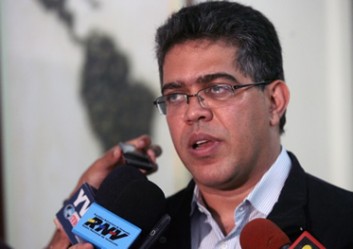
In the immediate aftermath of such an incident, Vice President Elías Jaua would take power, according to the constitution. Perhaps as an indication that Chávez is preparing for the worst, he formed a nine-member State Council earlier this month, headed by Jaua, to assist him with executive duties.
The nine “would be able to draw upon a broader leadership base and carry more authority” in Chávez’s absence, Wilpert said.
But with elections on the horizon, the Socialists’ hold on power would be threatened without Chávez heading the party.
In the Wings of the Bolivarian Stage
Recent polls generally show Chávez with a strong lead over opposition candidate Henrique Capriles of the center-right Justice First party, but Capriles has been building momentum and could perform well against a candidate less established than Chávez.
At the moment, there are five people that could potentially lead the Socialist Party, though none of them holds Chávez’s broad political support.
Jaua, as Chávez’s immediate successor, is one of the top candidates, though he is viewed as more of an administrator than a leader. Chávez appointed Jaua, 43, vice president in 2010; he served as Minister of Agriculture before then.
Having been a university professor, Jaua’s background is academic, and while he is viewed as an intellectual, he lacks the charisma and oratory skills to be a statesman on par with Chávez.
“[Jaua] represents one aspect of Chávez’s personality, but he is not the whole,” Wilpert said.
Diosdado Cabello, the current Speaker of the National Assembly, Venezuela’s unicameral legislative body, is another likely choice according to David Smilde, a sociology professor at the University of Georgia who has focused on democratization in Venezuela.
“He’s what they call part of the ‘endogenous right’ of the Socialist Party — not an ideologue, but a pragmatist,” Smilde said.
Cabello, 49, was a soldier like Chávez, though formally trained as an engineer, and fought alongside him as he led a military coup d’état against President Carlos Andrez Perez in 1992 over what Chávez viewed as a reneging on the president’s pledge to reject neoliberal economic policies that benefitted Venezuela’s wealthy elite.
The coup failed, however, and Cabello served two years in prison along with Chávez until a sympathetic new president, Rafael Caldera, was elected in 1994 and commuted their sentences.
Armed revolutionary past aside, he would likely take a reformist stance, less radical than Chávez’s Bolivarian Revolution politics.
Chávez has focused on developing close political and economic ties with other leftist governments in Latin America, something that Cabello could turn away from, though he would be expected to keep Venezuela’s popular social programs and national industries intact.
Another possible contender for party leadership is current Foreign Affairs Minister Nicolás Maduro, 50, who started off as a bus driver and became a labor union leader. Later on, he petitioned for Chávez and his allies’ release from prison following the 1992 coup attempt, as well as to put Chávez on the 1998 presidential ballot.
Maduro’s politics align very closely with Chávez’s, and his humble beginnings highlight his steady rise as a labor organizer and populist politician who would have strong support among Venezuela’s poor and working class.
Then there is José Vicente Rangel, 82, a former vice president (2002 to 2005), who Chávez has appointed to head the newly formed State Council.
He is a veteran of Venezuelan politics, having run for president three times in the 1970s and 1980s, and has shuffled around in several key posts in Chávez’s administration, including vice president, defense minister and Foreign affairs minister.
Ideologically, he is similar to Chávez, though with a background as a journalist and politician, his rhetoric is less militaristic.
Although his experience and government service are in his favor, his age is likely to be a limiting factor.
Lastly, there is Chávez’s elder brother, Adán Chávez, 59. Currently the governor of the Venezuelan state of Barinas, Adán, a former physics professor, has a long history of political activity, with views often considered even more radical than his brother’s.
Adán has more or less kept a low-profile, however, and it is only his familial connection that may serve in projecting Chávez’s popularity onto himself.
As long as Chávez’s is capable of campaigning, however, none of these potential candidates are likely to be groomed for leadership, at least in view of the public.
Should he have to drop out early, though, the Party will have to hope that Chávez’s reputation can carry one of the above candidates to the presidency, but until then,”he will run as long as he can,” Wilpert said. “(For the Socialists), even a weakened Chávez is better than the alternatives.”
A ‘Mixed Legacy’: Lessons From Lenin
Regardless of the outcomes of the election or Chávez’s health, he has already left an indelible footprint in Venezuela’s history.
Chávez has tapped into the political energy of Venezuela’s poor and working class, investing more of the country’s wealth in education, health care and other social programs that benefit them most, and they have responded with enthusiasm at the polls.
“More Venezuelans are participating in government than ever before,” said Wilpert. “They have a higher regard for their democracy than most other countries in Latin America.”
But, “he will leave a mixed legacy,” Smilde said. “On the one hand, he gave voice to the discontent in a radically inequitable society. … Huge numbers of people have now realized that they have a claim on Venezuela’s wealth. But he has also done considerable damage to democratic institutions.”
Chávez has been able to pursue his vision of the Bolivarian Revolution because he has removed political obstacles to his power.
When he was first elected in 1999, he began a constitutional reform that focused on serving the underclasses, but also concentrated power in the presidency. In 2000, he held new elections and was re-elected under the new constitution which reflected his vision for Venezuela.
In 2006, he was re-elected, and under the new constitution he would not be able to run again. In 2009, he held public referendum to abolish all term limits for public offices, and the people granted him the power to run for president as long as he was able.
This was not met without criticism from political opponents in the legislature, the courts, and the press.
But with the masses on his side, Chávez has no need to accommodate political opposition, and that populist power has allowed him to effectively silence opponents.
Human Rights Watch has identified the erosion of democratic institutions in Venezuela as a factor contributing to rights violations ongoing in the country, with the potential to degrade into further abuses.
“The weakening of Venezuela’s democratic system of checks and balances under President Hugo Chávez has contributed to a precarious human rights situation,” HRW wrote on its website. “Without judicial checks on its actions, the government has systematically undermined free expression, workers’ freedom of association, and the ability of human rights groups to function.”
That being said, the political situation in Venezuela “has been largely peaceful,” Smilde said. “There has been less repression than in previous governments.”
The danger, however, is that the current system has placed too much power in the presidency.
“Just look at Lenin,” Smilde said. “Chávez has done the same thing, concentrating power at the top and expelling political opponents. When Lenin got sick and Stalin took over, he realized he had created a monster, but by then it was too late.”
Follow this reporter on Twitter: @crvillarreal
To read this article on the International Business Times, please click here.