Apr
5
2013
Posted by
admin
Comments

In Case You Missed It… Articles Roundup Week of 4/05/13

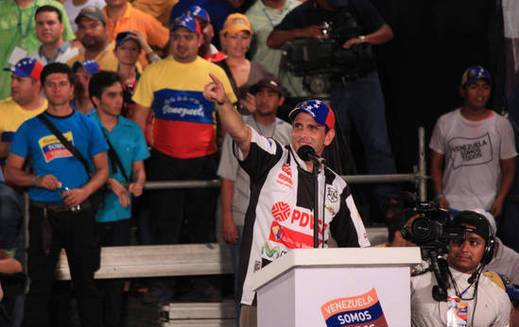
12630596 copia1.jpg.520.360.thumb 1 e1365195898833 In Case You Missed It… Articles Roundup Week of 4/05/13

Courtesy of: El Universal

This week: A month after his death, Hugo Chávez continues to cast a shadow on the Venezuelan presidential election; amid personal attacks against opposition candidate Henrique Capriles, the official presidential campaign begins in Venezuela; Capriles leads a march with supporters in Caracas to kick off his presidential campaign; and Maduro steps up insults and slurs, this time calling the country’s opposition “heirs of Hitler.” Maduro bizarrely claims Chávez appeared to him in the form of a “little bird” and blessed him; Venezuela’s opposition warns that the military should not take sides in the upcoming election; Capriles points out the Venezuelan state media’s overwhelming bias toward Maduro; and Venezuela tries to weaken the influence of the respected Inter-American Commission on Human Rights. Cuba throws its support behind Maduro in the Venezuelan elections, hoping his victory will allow them more control over the country and its resources; dollar scarcity and an inflation rate of 22 percent continue to take their toll on the Venezuelan people, as businesses in Venezuela foresee only tough times ahead;  a decade of currency controls leave Venezuelans desperate for money and vulnerable to fraudsters; and crop numbers in Venezuela show that 2012 production fell behind the already-low 2010 levels.

Chávez casts shadow on Venezuela poll, Financial Times

Last year, Henrique Capriles proved no match for the electoral juggernaut of Hugo Chávez, who won over a dozen nationwide polls in as many years.

Venezuela presidential race begins amid personal attacks and tension, The Miami Herald

Drugs, lies and murder plots. Venezuela’s compressed presidential campaign officially begins Tuesday in a race that will determine the future of the Andean nation after the death of President Hugo Chávez, who led the country for 14 years.

Venezuela Opposition Marches as Presidential Campaign Kicks Off, Bloomberg

Venezuela opposition leader Henrique Capriles Radonski led a march of supporters last night in Caracas to mark today’s formal start to the presidential campaign against Hugo Chavez’s hand-picked successor.

Maduro calls Venezuela opposition “heirs of Hitler”, Reuters

Venezuela’s acting President Nicolas Maduro on Saturday called the country’s opposition “heirs of Hitler,” accusing them of persecuting Cuban doctors working in the South American country the way Jews were persecuted in Nazi Germany.

Venezuela: Ruling Party Candidate Said ‘Little Bird’ Told Him He’ll Become President, Fox News Latino

A little birdie whistled in his ear that he’s ready to become the next president of Venezuela.

Venezuela Opposition: Military Can’t Take Sides, TIME

Venezuela’s presidential campaign on Wednesday veered between warnings of military meddling in the April 14 vote and opposition mirth at the acting president’s suggestion that the spirit of Hugo Chavez visited him as “a little bird” while he prayed.

Henrique Capriles accuses Venezuelan state media of bias in favouring political rival, The Independent

Henrique Capriles has hit out at the overwhelming bias of the Venezuelan state media, claiming that the VTV channel alone has given 46 hours and 43 minutes of coverage to Nicolas Maduro since the former bus driver became acting President after the death of Hugo Chavez on 8 March.

Venezuela Tries to Weaken Human Rights Watchdog, The Heritage Foundation

A group of populist Latin American states—led by Bolivia, Ecuador, and Venezuela—hopes to reduce the role of an international human rights commission and watchdog.

Cuba’s Venezuelan Pawn, The Wall Street Journal

Venezuela’s military government will hold what it refers to as a presidential “election” on April 14, and one of the candidates on the ballot will be Hugo Chávez’s handpicked successor, Nicólas Maduro.

Tough times ahead in post-Chavez Venezuela as dollar scarcity takes its toll, The Washington Post

Doing business in post-Hugo Chavez Venezuela is not for the faint of heart. Thousands of companies suffer under currency controls that all but deny them the U.S. dollars they need to import vital items into this oil-rich country, from food to cars to spare parts — even gasoline.

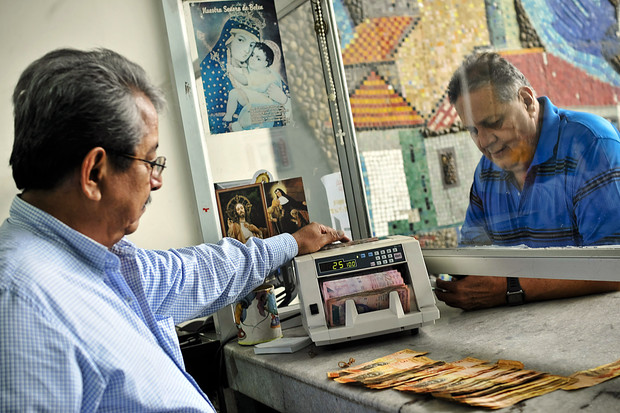
Dollar-Desperate Venezuelans Get Defrauded on Internet, Bloomberg

The retired Venezuelan teacher says he was so desperate for dollars that he wired his life savings to a front company posing as a Margarita Island inn.

Crop area in 2012 lags behind 2010 levels in Venezuela, El Universal

The results provided by the Venezuelan Ministry of Agriculture and Lands (MAT) reveal that in 2012, the agricultural activity recovered, featuring an important upturn in several highly demanded agricultural items.

 
Apr
4
2013
Posted by
admin
Comments

ICYMI: Cuba’s Venezuelan Pawn

The Wall Street Journal
April 4, 2013
By Mary Anastasia O’Grady

nicolas maduro raul castro e1365098232399 ICYMI: Cuba’s Venezuelan Pawn

Courtesy of: Associated Press

Venezuela’s military government will hold what it refers to as a presidential “election” on April 14, and one of the candidates on the ballot will be Hugo Chávez’s handpicked successor, Nicólas Maduro. The 50-year-old union leader-cum-politician was named Venezuela’s acting president after it was announced on March 5 that Chávez had died. In all likelihood, Mr. Maduro will win the election, using the dubious methods perfected by Chávez and with whatever help Havana feels it necessary to provide.

Having started out in bus-driver training, Mr. Maduro is being presented to the world as almost an accidental president. But as the Cuban-born writer Carlos Alberto Montaner explained in a column in Miami’s El Nuevo Herald last week, Mr. Maduro’s rise to power in Venezuela is anything but coincidental. Cuba has long had its eye on Venezuela’s oil, and Mr. Maduro seems to have been in training to help with that goal for decades.

Venezuela has a constitution but doesn’t use it much. Chávez’s “inauguration” as president for a new term in January, despite his failure to appear at the swearing-in ceremony, is but one example. Mr. Maduro’s appointment last month as interim president is another. According to the constitution, that job should have gone to the president of the national assembly, Diosdado Cabello.

Mr. Cabello didn’t get the nod most probably because Cuba did not approve. The tropical communist island is an economic wreck after 54 years of Castro leadership and only survives thanks to oil subsidies from Venezuela. In exchange Cuba controls all the levers of state security and intelligence that help chavismo keep a lid on dissent. That means that Cuba has both the means and the motive to ensure that someone sympathetic to the needs of the Cuban elite follows Chávez.

Mr. Cabello could not be trusted. He is known as a nationalist and, having come from the military, he maintains close ties to the men in uniform. Many of them are whispered to resent the enormous influence that Cuba has in running their country and the largess that Venezuela gives to Havana while so many Venezuelans are living in dire poverty. Allowing Mr. Cabello to sit in the presidential chair, no matter how “temporarily” was likely considered too risky by the Castro brothers.

Mr. Maduro, on the other hand, is a known quantity in Havana, according to Mr. Montaner. Indeed, as it turns out, Cuba seems to have been grooming him for just such a post for many years. Mr. Montaner based his reporting on the testimony of an alleged former Cuban agent who says that Mr. Maduro attended Cuba’s special school for political leadership, Escuela Ñico López, in the 1980s. “Judging from this information,” Mr. Montaner writes, Mr. Maduro is “an old collaborator of Castro intelligence. Because of that, Raúl Castro convinced Hugo Chávez that he was his natural heir.” All that’s left now is the formality.

To read this article at the Wall Street Journal, please click here.

 
Apr
2
2013
Posted by
admin
Comments

ICYMI: Tough times ahead in post-Chavez Venezuela

The Associated Press
April 1, 2013
By Fabiola Sanchez

ijKok4dzw3DM e1364924737530 ICYMI: Tough times ahead in post Chavez Venezuela

Courtesy of: Bloomberg

CARACAS, Venezuela (AP) — Doing business in post-Hugo Chavez Venezuela is not for the faint of heart.

Thousands of companies suffer under currency controls that all but deny them the U.S. dollars they need to import vital items into this oil-rich country, from food to cars to spare parts — even gasoline. Venezuelan firms must sell their wares at state-controlled prices that don’t reflect the 22 percent inflation rate, the highest in Latin America. Even Venezuela’s socialist government admits the controls don’t work — but its attention is focused on the April 14 election to replace the late President Hugo Chavez.

It’s a largely improvised economic policy that, despite oil earnings, has turned people’s lives upside down and produced shortages of flour, coffee, butter and medicines. It’s also a mess that will immediately challenge whoever becomes the president of this 28 million-person country.

Jeni Suarez, a 51-year-old Caracas homemaker, experienced the crisis first hand after waiting three months for a colonoscopy at a public hospital. When she got there, doctors told her they needed new parts from abroad to perform the procedure, and the deliveries weren’t coming any time soon because the hospital didn’t get dollars from Venezuela’s government to buy them.

“I have an intense pain, and I don’t know what to do,” Suarez said after the appointment at Jose Maria Vargas Hospital.

Such economic headaches have, in fact, defined much of the late president’s legacy here.

Chavez imposed draconian currency controls a decade ago to punish business leaders who had mounted a crippling opposition strike. He was also trying to stem the flight of dollars abroad as political instability spooked investors.

“The policy of currency controls is very negative for the country and hasn’t met any of its objectives,” said Alejandro Grisanti, an analyst at investment bank Barclays Capital. “It hasn’t stopped capital flight. It hasn’t stopped inflation, (and) it has been very costly for the treasury.”

Neither Chavez successor Nicolas Maduro nor opposition candidate Gov. Henrique Capriles has delivered specific proposals to address the crisis, said Alejandro Gutierrez, an economics professor at the University of the Andes. The most effective solution would likely involve unpopular measures such as a mass devaluation of the currency to spur exports, or an end to price controls.

Capriles has spent much of the campaign trying to assure Chavistas he will not take away their government-funded social programs, while Maduro vows to continue the late leader’s legacy, which would include the controls.

“We are facing a transition situation, and they are going to wait until this situation is cleared up,” Gutierrez said Monday.

Only Capriles has suggested a possible way of injecting more dollars into the economy: Ending subsidized oil exports to Cuba that began under Chavez.

The late leader had aided his allies by providing oil at preferential terms to more than a dozen countries in Latin America and the Caribbean. Cuba receives Venezuelan oil worth around $3.2 billion a year, estimates Jorge Pinon, a University of Texas energy analyst. Nicaragua gets about $1.2 billion worth of oil, according to economist Nestor Avendano.

Yet whoever wins the vote won’t be able to put off action indefinitely. The wave of national mourning for Chavez and the heated campaign have so far masked the plight of dollar-poor food makers, dairy farmers, ranchers and auto manufacturers. But consumers are feeling the shortages of appliances, automobiles and staples such as flour, coffee, butter and medicines.

Venezuela’s automakers are operating at 50 percent capacity because they don’t have dollars needed for auto parts made abroad, according to Omar Bautista, president of a national carmakers group that includes Ford, General Motors and Mitsubishi. And foreign suppliers are hesitant to sell to Venezuela because they don’t know when or if they’ll be paid, Bautista said in remarks reported by Caracas’ El Universal newspaper.

“New (parts) shipments are being held back as long as we cannot honor these contracts,” Bautista said.

Even as Venezuelans fight for dollars, the country sits atop the world’s largest proven oil reserves, with those exports delivering nearly $1 trillion in revenues to the country since Chavez was elected in 1999.

Thanks to oil, Chavez’s government had invested $500 billion on social programs since 1999, according to Planning Minister Jorge Giordani. Venezuela’s poverty rate fell from 50 percent in 1999 to 32 percent in 2011 while unemployment dropped from 13 to 8 percent.

After the 2002-03 strike, Chavez began using the enormous influx of dollars as a political weapon, with the government selling businesses limited quantities of dollars at a rate that didn’t reflect the bolivar’s real black market value. The official rate is now about a quarter of what the dollar sells for on the black market.

At the same time, the government’s own dollar supply may be diminishing. Oil income trailed off from $5.6 billion in 2008 to $3.8 billion in 2012, partly because of slumps in production and refining. The government also spent heavily to re-elect Chavez in October and help Maduro’s candidacy after the president’s March 5 death, further squeezing the dollar supply to private businesses.

As long as government dollar sales are frozen, “foreign exporters are not going to start selling to us,” said Carlos Larrazabal, president of one of Venezuela’s largest business chambers. “We cannot understand how it can be that we have a country with an oil price of more than 100 dollars per barrel and we have this scarcity of currency.”

In a bid to inject some liquidity into the economy — and a tacit admission that the currency controls aren’t working — Maduro’s interim government held a one-day auction of $200 million last week.

Jorge Roig, vice president of the Fedecamaras business chamber, said the rules for bidders were late in coming, overly complicated and discouraged small and medium-size firms from participating. At least $1 billion more is needed to keep companies rolling, Roig told Caracas’ Union Radio on Wednesday.

The Venezuelan Association of Medical, Dental and Laboratory Equipment says its members collectively owe $300 million for past imports, which were suspended in November because they couldn’t pay.

“There are no test tubes to collect blood samples. There are no colostomy bags. No electrocardiogram paper. No X-ray plates,” said Anerlin Garcia, the group’s executive director.

Simon Nobile, president of the Venezuelan Association of Pasta Foods, says more dollars alone won’t help. The government also must raise its official prices on hundreds of products because they don’t reflect the effects of inflation, he said.

Eleven manufacturers in Nobile’s association employ 5,000 people but are close to shutting down because the price of pasta has been frozen for two years. The official selling price of 68 U.S. cents per kilogram (2.2 pounds) makes up only half the production cost, Nobile said. He said firings could happen at his company as early as April.

“If the government doesn’t make a decision,” he said, “this is the end.”

To read this article at Associated Press, please click here.