Jul
9
2013
Posted by
admin
Comments

ICYMI: With Snowden offer, Venezuela’s Maduro is on world stage

The Washington Post
July 8, 2013
By Juan Forero and Will Englund

Venezuela Independence Day 00ff7 7787 e1373389435305 ICYMI: With Snowden offer, Venezuela’s Maduro is on world stage

Courtesy of: AFP

BOGOTA, Colombia —American fugitive Edward Snowden’s diminishing possibilities of remaining free to continue releasing information about secret U.S. surveillance programs increasingly appear to hinge on Venezuela, which awaited word Monday on whether the former National Security Agency contractor would accept its offer of asylum and fly to the oil-rich country.

Bolivia and Nicaragua also say they could give refuge to Snowden, who is on the run from American officials and is thought to be marooned in the vast transit zone of Moscow’s Sheremetyevo International Airport. And the president of communist Cuba, Raúl Castro, on Sunday expressed support for Latin American allies that might take in the 30-year-old computer expert, opening the possibility that Snowden could fly through Havana as a first leg on his flight to asylum.

Among those offering sanctuary to Snowden, anti-imperialist Venezuela stands out: a country with an intense antipathy toward the United States and just enough muscle to make his escape from American law enforcement a possibility. It also appears that Russian officials, eager to end the diplomatic fallout of having Snowden in Moscow, see their close ally, Venezuela, as offering the clearest solution.

“The situation with Snowden is creating additional tension in relations with Washington that are complex as they are,” Alexei Pushkov, head of the foreign affairs committee of the lower house of the Russian parliament, told the newspaper Kommersant on Monday.

Pushkov, whose comments dependably reflect the Kremlin’s position on foreign affairs, said the Snowden saga needed to be settled before President Obama arrives in September to meet with his Russian counterpart, Vladimir Putin. “And judging by the way things are unfolding,” Pushkov told the newspaper, “this is how it’s going to be.”

Over the weekend, Pushkov had also said that giving asylum to Snowden in Venezuela could not damage Venezuelan President Nicolás Maduro, because his government’s relations with Washington are already in tatters. “It can’t get worse,” Pushkov said in a Twitter message.

Late Tuesday afternoon, Pushkov said on Twitter that Snowden, “as expected,” had accepted Maduro’s offer of asylum, but he didn’t address the question of how Snowden might get to Caracas. Shortly afterward, the tweet was deleted.

Pushkov then tweeted again, claiming he had heard the news about Snowden on Russian television. “Direct all your questions to them,” he wrote.

By Tuesday evening, Pushkov had issued yet a third tweet: “According to News 24 [a TV news program], with reference to Maduro, Snowden accepted his offer of asylum. If so, he has found that to be the safest option.”

Newly elected and facing staggering economic problems at home despite the country’s oil wealth, Maduro appears to have made a high-pitched, openly hostile position against the Obama administration a cornerstone of his government’s foreign policy. He took his most provocative stand Friday in announcing that Venezuela would take in Snowden. On Monday, Maduro said that a letter from Snowden requesting asylum had been received and that the young American would simply have to decide when to fly to Caracas.

Maduro has accused the United States of fomenting protests against his government after his disputed April 14 election victory, which gave him the presidency his predecessor, Hugo Chávez, had held for 14 turbulent years until his death from cancer.

The Snowden saga — a young American revealing secrets the U.S. government wants to contain — provided the perfect opportunity for Maduro to take on the Obama administration, said Eduardo Semtei, a former Venezuelan government official.

“To figure internationally, to show that he is a player among big powers, he offered asylum to Snowden,” said Semtei, who had been close to Chávez’s brother, Adán, a leading ideologue in the late president’s radical movement. “This grabs headlines, and it shows that he’s a strong president, one with character, and that he’s capable of challenging the United States.”

Maduro and Venezuela came late to the Snowden saga, as tiny Ecuador, an ally also committed to opposing American initiatives, heaped praise on Snowden and expressed a willingness to help him after he had flown from Hong Kong to Moscow on June 23 to avoid American justice. When
Ecuador backed away from its initial enthusiasm over Snowden, Venezuela stepped in last week as Maduro arrived in Moscow for an energy summit.

The 50-year-old Maduro, who found his political calling as a socialist activist with close ties to Cuba, took a sharply anti-
imperialist stand in embracing Snowden. He said the United States had “created an evil system, half Orwellian, that intends to control the communications of the world,” and characterized Snowden as an antiwar activist and hero who had unmasked the dastardly plans of America’s ruling elite.

Political analysts say the opportunity to take sides against Washington was simply irresistible for a government that has for years characterized itself as a moral force speaking out for the weak against “the empire,” as the United States is known in Caracas. And the fact that the secrets Snowden divulged were embarrassing to the Obama administration only gave more fuel to Venezuela, former Venezuelan diplomats and political analysts in Caracas said.

“Edward Snowden became the symbol for the anti-imperialist rhetoric, for progressivism, for international radicalism,” said Carlos Romero, an analyst and author who closely tracks Venezuela’s international diplomacy.

Venezuela helped channel the fury of Argentina, Bolivia, Ecuador, Uruguay and Suriname after Bolivian President Evo Morales’s plane was apparently refused entry into the airspace of as many as four European countries last Tuesday because of the belief that Snowden was hiding aboard. And on Monday, Venezuela’s state media apparatus seemed to take more offense than the Brazilian government over revelations that the NSA had collected data on countless telephone and e-mail conversations in Brazil.

But former diplomats familiar with Venezuela say that there are other aspects to consider in deciphering Maduro’s support for Snowden.

Ignacio Arcaya, a diplomat who served the Chávez government in the United States in the early part of his presidency, said Maduro has had the challenge of trying to ease the concerns of radicalized sectors in his movement that have been worried about a resumption of relations with Washington now that Chávez is gone. Indeed, until recently, Maduro was spearheading an effort at rapprochement, as shown by a meeting in Guatemala on June 5 between Secretary of State John F. Kerry and his Venezuelan counterpart, Elías Jaua.

“What Maduro is doing is aimed at quieting the radical sectors of his party who think he is negotiating with the United States and think that he’s talking to private industry,” Arcaya said.

Maduro also has to consider his own unstable political position after the April 14 election, which is being contested by his challenger, Henrique Capriles, who says the vote was stolen from him. At the same time, Maduro faces millions of Venezuelans tired of the country’s sky-high inflation, rampant homicide rate and serious shortages of everything from chicken to toilet paper.

Myles R.R. Frechette, a retired American diplomat who served in Venezuela and other Latin American countries, said Maduro is using a tried-and-true strategy: loudly oppose the United States to distract from domestic problems.

“It plays very well,” said Frechette. “It’s the card to play. It’s what you’ve always got in your drawer. You open your drawer and play to your most radical elements.”

To read this article at The Washington Post, please click here.

 
Jul
8
2013
Posted by
admin
Comments

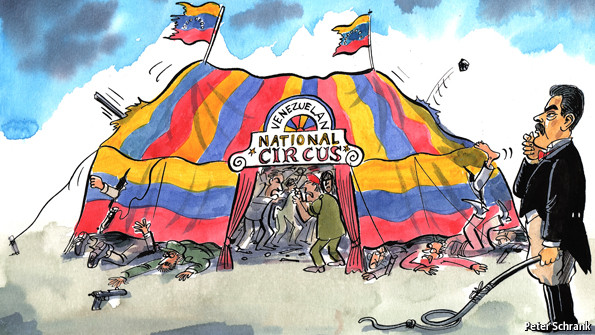
ICYMI: A circus without a ringmaster

The Economist
July 6, 2013

20130706 AMD001 0 e1373308466257 ICYMI: A circus without a ringmaster

Courtesy of: The Economist/Peter Schrank

During the presidency of Hugo Chávez, who ruled from 1999 until his death from cancer in March, the domineering personality of the comandante left no doubt as to who was in charge of Venezuela. By contrast Chávez’s successor, Nicolás Maduro, a former foreign minister, has yet to convince people that he is the one running the show. His disputed, razor-thin election victory on April 14th undermined his legitimacy (indeed, the supreme court has yet to resolve the opposition’s claim of fraud). Now the president faces problems within the ranks of the ruling coalition, and in particular his United Socialist Party of Venezuela (PSUV). In the absence of Chávez, there are worries that the PSUV will turn out to be held together, as the colourful Venezuelan metaphor has it, “with parrot spit”.

Fourteen years of chavismo have left the country in a mess. Despite the high price of oil, growth this year will be minimal or negative. Thousands of private companies have gone under, dragged down by regulations and threatened with fines, temporary closure or expropriation. Others have switched from production to importing. Even that is losing its appeal, now that foreign-exchange control mechanisms have seized up and dollars are scarce. Mr Maduro has sought to deal with the concerns of ordinary Venezuelans, as well as striking radical poses to please hard-core chavistas. Crime, poor public services, corruption and food-scarcity have been targeted with loudly trumpeted initiatives. But actually solving these problems will mean confronting powerful interests, and here Mr Maduro has little room for manoeuvre.

Moderates were encouraged when early in his presidency Mr Maduro sidelined Jorge Giordani, Chávez’s Marxist finance minister, and brought in Nelson Merentes, a former governor of the Central Bank who is seen as more ideologically flexible. But subsequent appointments seem designed to appease other interests. Amid talks with the private sector on how to get the wheels of commerce turning again, Mr Maduro last month reappointed Eduardo Samán head of the powerful consumer-protection body, a post he held under Chávez. A self-proclaimed “ultra-radical”, Mr Samán believes that inflation (heading for 40% a year) and empty supermarket shelves are caused by private-sector hoarding and speculation. “Humanity”, he has written, “will succeed in solving the food crisis only with the end of capitalism.”

Tentative efforts to tame corruption have also been undermined by a need to stay on friendly terms with the Chávez clan. On June 12th Argenis Chávez, the late president’s crafty youngest brother, was appointed head of the body that controls the administration of the justice system. On his brother’s watch, the younger Chávez had led the electricity ministry as well as Corpoelec, the graft-riddled state-run electricity giant. On becoming president, Mr Maduro quickly booted him out of both jobs. His return to office demonstrates the enduring power of the Chávez clan, as well as Mr Maduro’s willingness to subordinate the justice system to his political requirements.

Managing these rival factions has forced the PSUV to suspend internal party democracy. Grass-roots chavista radicals had backed Mr Samán’s bid to stand for mayor of Caracas. But party leaders, who see Mr Samán as a loose cannon, ruled out holding a primary that he might have won. Now the PSUV has cancelled all the primaries that were to have been held ahead of local elections, which have been postponed until December 8th. It remains to be seen whether choosing candidates by executive fiat will ruffle fewer feathers than the primaries would have done.

Our man in Havana

Rumours swirl that Mr Maduro could face a more immediate challenge to his own leadership. In a recorded conversation that was leaked on May 20th Mario Silva, the presenter of a state-television talk-show called “The Razor Blade”, was heard apparently passing information to a Cuban intelligence officer. In the recording Mr Silva warned the spy that Diosdado Cabello, the speaker of the National Assembly, wanted to overthrow Mr Maduro. It was a matter of urgency, he said, to cut off Mr Cabello’s sources of income, including the tax authority, which is run by his brother, José David Cabello. A few weeks later police arrested members of an alleged gang within the customs agency, which is part of the tax authority.

A former lieutenant who took part in a failed coup by Chávez in 1992, Mr Cabello has powerful friends in the army. The annual round of military promotions, due to be announced as The Economist went to press, may strengthen his hand. Henrique Capriles, the leader of the opposition, jeers that Mr Maduro’s role is confined to signing the promotions list. “Nicolás, you’re a laughing stock in the armed forces,” Mr Capriles tweeted.

During the presidential election campaign, Mr Maduro was seen as the favoured candidate not just of his predecessor but also of Cuba, Venezuela’s closest ally. A month ago, however, Mr Cabello made a three-day visit to Havana, holding meetings with President Raúl Castro and his brother, Fidel. The trip came shortly after the leaking of the Silva recording. No one knows what sort of deal the Cubans may have struck with Mr Cabello. For the moment, he and Mr Maduro are locked in a macho Latin embrace, of the kind some say was devised as a way for each man to frisk the other for weapons.

To read this article at The Economist, please click here.


May
3
2013
Posted by
admin
Comments

In Case You Missed It… Articles Roundup Week of 5/03/13

ay 108972837 e1367612866751 In Case You Missed It… Articles Roundup Week of 5/03/13

Courtesy of: EPA

This week: Venezuela stumbles deeper into political chaos after a bloody brawl in Congress; Venezuela’s opposition asks for an investigation into the brawl on the floor of Congress that injured several of its lawmakers and caused at least one of them to undergo surgery; Venezuela’s government charges a US filmmaker for allegedly trying to incite anti-government violence and charges an ex-general for being critical of president Nicolás Maduro; and Maduro visits Cuba to meet with former leader Fidel Castro and re-pledge Venezuela’s allegiance to the island. The government begins a partial audit of the disputed election, though the opposition rejects the move as insufficient; unable to force a sweeping review of the disputed election, Venezuelan opposition supporters march on International Workers Day; opposition leader Henrique Capriles files a lawsuit in Venezuela’s Supreme Court to overturn the election, alleging fraud in the counting of ballots and voter intimidation; and Venezuelans become increasingly upset with daily power outages, growing food scarcities and a general fear of the government. Venezuelan debt remains severe as tensions continue to rise; homicides in Venezuela reach a record high in 2013, as nearly 58 are killed per day during the first four months of the year, highlighting a dire security situation amid political instability; and the sale of Globovisión, Venezuela’s sole television station critical of the government, hurts free speech in Venezuela even further.

Political Chaos Grips Venezuela After Legislative Brawl and Rival Marches, The New York Times

Venezuela stumbled deeper into political chaos this week as legislators brawled in the National Assembly and government supporters and opponents took to the streets for rival marches amid continuing tensions over the narrow election victory of President Nicolás Maduro.

Venezuela Opposition Wants Probe of Violence, The Associated Press

Venezuela’s opposition on Thursday asked prosecutors to investigate a brawl on the floor of congress that injured several of its lawmakers and forced at least one of them to undergo surgery.

Venezuela Charges U.S. Filmmaker, Arrests Ex-General, The Wall Street Journal

Venezuelan authorities brought criminal charges over the weekend against a U.S. filmmaker for allegedly trying to foment antigovernment violence, and arrested a retired Army general who has become a vocal critic of the government.

Venezuela’s New Leader Visits Cuba, Meets With Castro, The Wall Street Journal

Nicolás Maduro met with former Cuban President Fidel Castro in Havana on Saturday, an indication Venezuela’s new president will maintain the same close relations with the Communist island nation as that of his predecessor Hugo Chávez, who died last month after a battle with cancer.

Contentious Venezuela vote audit begins, AFP

Venezuela began a partial audit of the disputed election won by the late Hugo Chavez’s handpicked successor, as the opposition rejected the move as insufficient.

Venezuelan opposition protests vote, The Washington Post

Unable to force a sweeping review of last month’s disputed presidential election, opposition supporters marched in the streets Wednesday to demonstrate their fury at the ruling party’s efforts to blunt a recount.

Venezuelan Opposition Sues to Overturn Election, The Wall Street Journal

Venezuela opposition leader Henrique Capriles filed a lawsuit Thursday with the Supreme Court that seeks to overturn April’s presidential election, alleging fraud in the counting of ballots and pre-election voter intimidation.

Venezuelans on the Brink, Putting Up With Daily Outages, Growing Scarcity and Fear, Fox News Latino

There’s an old joke about the rabbi who explained to his congregants that Adam and Eve were the first communists, because they wore no clothes, had one apple between them, and thought they lived in paradise.

Venezuelan Debt Under Pressure As Tensions Rise, The Wall Street Journal

Abating a week ago, tensions in Venezuela are fast rising again, and it doesn’t bode well for the country’s debt.

Venezuelan Homicides Reach Record High In 2013, InSight Crime

Murders in Venezuela reached a record high of 58 per day during the first four months of the year, according to police figures contested by the government, highlighting a dire security situation amid political instability.

What the Sale of Venezuela’s Opposition TV Station Means for Free Speech, The Atlantic

Globovision is Venezuela’s last-remaining television station that is openly critical of the government of Hugo Chavez, (and his chosen puppet successor Nicolas Maduro) but on April 15, the majority shareholder Guillermo Zuloaga sold his portion to businessman Juan Domingo Cordero, sending both members of the opposition and some journalist rights groups into a frenzy.