Jul
5
2012
Posted by
admin
Comments

Who’s Next Venezuela: Another Potential Successor

Over the past several months, What’s Next Venezuela has reported on the uncertainty surrounding Hugo Chávez’s health, including the speculation about who will take Chávez’s place on the ballot should he be unable to stand for re-election on October 7. We continue examining potential successors today, with a profile of Foreign Minister Nicolás Maduro.

Nicolás Maduro, Foreign Minister
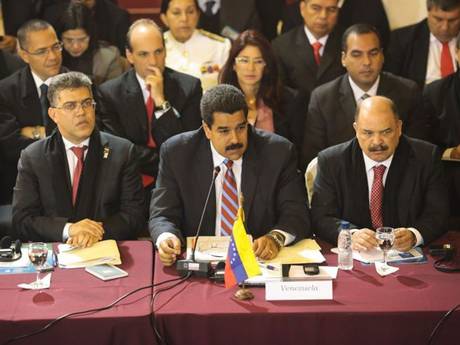
Nicolas Maduro Who’s Next Venezuela: Another Potential Successor

Courtesy of: AVN

From lowly beginnings as a bus driver for political campaigns, Nicolas Maduro has risen to power and influence as the Foreign Minister in Hugo Chávez’s administration and a leading candidate to succeed the president.

Since June 2011, around the time Venezuelans first learned of Chávez’s cancer, Maduro has emerged as one of Chávez’s closest officials and advisors, both in Cuba and in Venezuela, and the one in charge of announcing the president’s messages to the Venezuelan public. He took a leading role after Chávez announced his intent to leave the Inter-American Commission on Human Rights (IACHR), voicing accusations against the IACHR and making headlines while Chávez received treatment in Cuba. Speculation intensified earlier this year as rumors swirled that Chávez was poised to name Maduro as Venezuela’s new Vice President.

That Chávez trusts Maduro with his most important assignments is corroborated by a Wikileaks cable which suggests Maduro may be at the top of the list because of his fierce loyalty to Chávez. The two have a long history, going back to the founding of the PSUV and Maduro’s work on Chávez’s 1998 presidential campaign. Maduro has already spent six years as chancellor, an unprecedentedly long spell in Chávez’s administration.

The leaked e-mail also asserts that Maduro is a more pragmatic leader than others in the PSUV, which might be necessary to keep the party from fracturing during the transition. It may help him to prevent infighting within the PSUV, which could cause serious problems in addition to any opposition challenges the transition leader will face.

Moreover, through the foreign ministry, Maduro has become the darling of Havana, establishing strong ties with the Castros. This may be critical, as recent news stories have shown that maintaining the relationship between Venezuela and the Castros will be a key expectation of any Chávez successor.

He has popular appeal as well, and charisma that technocrat Elias Jaua lacks. He has fared better than other PSUV members in polls when pitted against opposition candidate Henrique Capriles, although he would still have to make up a significant gap in just a few short months. Meanwhile, Maduro’s profile within Venezuela has continued to grow as he routinely appears both in pictures and videos next to the president, both in Cuba and during the recent announcement of Chávez’s signature new labor law.

However, several things indicate that Maduro may not be the chosen one. Many argue that although he has gained international approval needed to be president, he has not done the same within his own party. He is also untested in close elections; his only electoral victory was in a 2005 legislative race in which he ran unopposed.

In fact, many analysts believe that Maduro’s best shot at the presidency came last year when Chávez first got sick. He quickly took charge of the leadership of Venezuela. Now it appears that he is slated to run for governor of Carabobo, a state now run by a member of the MUD. Maduro himself has even denied that he is being considered as a successor to Chávez.

For his part, Maduro argues that the majority of Venezuelans will reelect Chávez on October 7. Should Chávez’s health take a turn for the worst, however, we may yet learn if he is as trusted as the Wikileaks cable claims.

 
Jul
3
2012
Posted by
admin
Comments

Who will Succeed Hugo Chávez?

Over the past several months, What’s Next Venezuela has reported on the uncertainty surrounding Hugo Chávez’s health, including the speculation about who will take Chávez’s place on the ballot should he be unable to stand for re-election on October 7. Over the next several weeks, we will profile the most likely successors to Hugo Chávez, starting today with Elías Jaua.

VICE PRESIDENT ELÍAS JAUA

elias jaua Who will Succeed Hugo Chávez?

Courtesy of: Reuters

Named earlier this year as the head of the newly-created Council of State, current Vice President and Minister of Agriculture Elías Jaua is one of several on the short list to succeed Venezuelan President Hugo Chávez.

Since the return of Chavez’s cancer in February, Jaua has spent significant time in the spotlight. Polls show that he is the most popular member of Chávez’s party, after the president himself. In recent months, he has served as a proxy for Chávez, leading rallies, giving speeches, and attacking the opposition while the president received treatment in Cuba. He remains the government’s point-man for denying any negative reports about President Chávez’s health; when bad news breaks in Venezuela about Chávez’s cancer, Jaua is often the first to brand the stories as rumors and publicly state that the president is in recovery.

He also made headlines after the public allegations of judicial corruption made by former Supreme Court judge Eladio Aponte Aponte. Aponte claims that Jaua held weekly meetings with judges of the Venezuelan high court, telling them how to rule on sensitive cases.

Despite his high profile, Jaua lacks the charisma and eloquence of Chávez, who seems to keep Jaua by his side for his fierce loyalty. Recently, the president showed his gratitude, by putting Jaua in charge of the new Council of State, which many have claimed is charged with planning the transition of power if Chávez succumbs to his battle with cancer. If recent history is any indication, Jaua may just have both the political clout and leadership skills to keep things on track within the PSUV, even if Chávez continues his long absences from the political scene.

Legally, he is next in line should Chávez no longer be able to serve. Article 233 of the Venezuelan constitution states that if the president cannot execute his responsibilities, the vice president will take his place until the next election. If Chávez dies, or is declared incapable performing his duties, Jaua will become the next president of Venezuela, at least until October. Such a scenario would only increase the likelihood that Jaua, as incumbent president, would seek outright election against MUD candidate Henrique Capriles Radonski. As of now, Jaua plans to run for governor of Miranda state in the fall, but if Chávez becomes gravely ill or incapacitated, anything goes.

Originally from the Miranda state, Jaua made his name as a student leader in the 90s. His first meeting with Chávez was in 1996, when he participated in the founding of the Fifth Republic Movement, which is now the PSUV. He was one of the authors of the 1999 Constitution, and has since held various positions under Chávez, mostly in economic roles. He was named Minister of Land and Agriculture in 2006 and Vice President in 2010.

Jaua is currently the default replacement for Chávez, and it’s clear, given his appointment to the Council of State, that he has the leader’s trust. But his apparent lack of personality may be a liability in what will certainly be a difficult election. Timing may be everything; if Chávez is able to win re-election himself he might simply pass on the reigns to Jaua to manage his government. But if his health takes a turn for the worst, he may need to pick someone with more public appeal to get his party past its biggest hurdle yet on October 7.