Jun
11
2013
Posted by
admin
Comments

ICYMI: Looking for toilet paper in Venezuela? There’s an app for that

Financial Times
June 10, 2013
By Benedict Mander

venezuela toilet paper reuters 1200 ICYMI: Looking for toilet paper in Venezuela? There’s an app for that

Courtesy of: Reuters

It turns out that President Nicolas Maduro thinks that the plan to introduce food rationing in Zulia, Venezuela’s most populous state, is “crazy”.

Regardless of whether he always thought that, or whether, perhaps, the increasingly unpopular president was responding to widespread rejection of the plan, he’s right – it is not the way to put an end to the problem of shortages that has become so acute that someone has even invented an app to help Venezuelans locate specific goods they are having difficulty finding.

Maduro was also right when he said that “the answer to our problems is to produce more”.

Let’s just forget for the moment that in saying this he was rather undermining the Zulia governor, Francisco Arias Cardenas, who had denied that the scheme even amounted to rationing in the first place, and that in fact it was aimed at preventing smuggling (if you wanted to do something about that, you probably wouldn’t produce more, but instead perhaps try and do something about the irresistible arbitrage opportunities in Colombia thanks to Venezuela’s price controls, or at the very least introduce stronger controls on the border).

Let’s also ignore the fact that the government has already put in place another rationing scheme in Zulia, for petrol, which by Maduro’s logic ought probably be pretty “crazy” too. Again, officials insist the idea is to prevent gasoline contraband, which is indeed rife in Zulia since it is magnificently profitable – some suggest it is an even bigger business in Venezuela than the cocaine trade.

In any case, increased production would certainly go a long way to solving Venezuela’s shortages problem. Ideally it would be an increase in the production of the goods that are scarce, especially food, but increased oil production might do too, as crude exports could provide the dollars needed to import more. This would probably be more practical in the shorter term, given the problems Venezuela has producing just about anything that is not oil (although that is not to say state oil company PDVSA does not have serious challenges of its own).

The problem is that, in the current conditions, Venezuelan businesses are unlikely to start producing much more. In order for this to happen, a lot needs to change: for starters, the business climate must improve, and that includes doing something about price and currency controls, something which Maduro has shown no signs of doing. And don’t expect state companies to pick up the slack – the government is even said to have seriously considered the offer of Venezuela’s largest private company, Polar, to help run underperforming state-owned food processing plants.

The app that aims to help Venezuela’s long-suffering shoppers, known as Abasteceme (or Supply Me) and which uses Google Maps and “crowdsourcing” to enable users to notify one another where a certain product is for sale, has so far only been downloaded 12,000 times. It is a scheme that promises to be infinitely more successful than Zulia’s still-born rationing plans.

To read this article at Financial Times, please click here.
 
Jun
5
2013
Posted by
admin
Comments

Nicolas Maduro’s Embarrassing Week

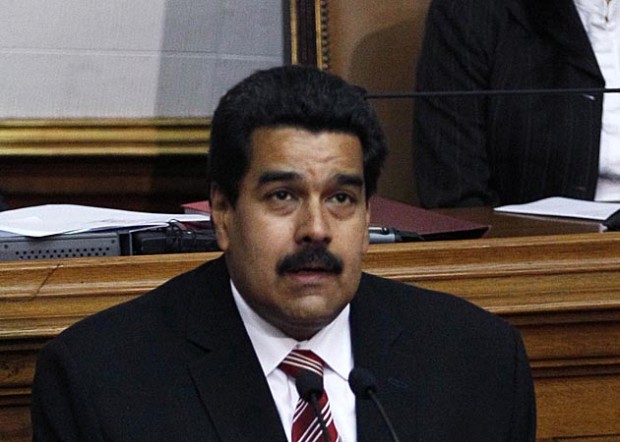
Nicolas Maduro1 620x442 e1370466156876 Nicolas Maduro’s Embarrassing Week

Courtesy of: Associated Prses

The presidency of former bus driver Nicolás Maduro began inauspiciously, his government using intimidation and threats to consolidate power.  Now, two months after he claimed victory in an election fraught by irregularities, things have only gotten worse for Maduro. The aftermath of Venezuela’s election controversy have caused Maduro to lose support and popularity among his own people. And as violence and a sinking economy continue to take their toll on Venezuelans, Maduro is now coming face-to-face with the consequences of years of Chávez’s failed socialist policies.

Maduro reacted like a spurned child when news emerged that opposition leader Henrique Capriles had traveled to Colombia and had been received there by President Juan Manuel Santos. As Venezuela’s socialist policies have kept the country in economic squalor, Colombia is one of Latin America’s success stories, and a strong U.S. ally in the region. Capriles met with President Santos, along with members of the Colombian parliament, where the leaders discussed Venezuela’s narrow presidential election along with the country’s dire economic situation.

“We are taking the voice of millions of Venezuelans beyond our borders,” Capriles said in Colombia. “The fight for democracy has to be everyone’s fight.” Indeed, news emerged this week that voter rolls indicate that deceased Venezuelans had “voted” in recent elections – the latest in a series of disturbing revelations about the state of democracy in Venezuela.

Economically, the situation is perilous and getting worse. With inflation near 30 percent and Venezuelans struggling to find basic goods like toilet paper, the country’s economy is heading for a recession sure to make matters worse. The Venezuelan government plans to institute restrictions on the sale of 20 basic items subject to price controls in Zulia, the country’s most populous state. Starting next week, the state will issue computer chip cards that will limit consumer purchases of certain products. Though the government has spun the move as a fight against contraband on the Colombian border, it is another clear sign that Venezuela’s shortages are worsening.

Meanwhile Venezuela’s bonds have bottomed out; Moody’s now rates them as junk status, a sign that the financial community has lost faith in Maduro’s government.

Indeed, criticism from the international community and from watchdogs continues to ratchet up. The meeting between President Santos and Capriles embarrassed Maduro on the world stage; the shootings of two U.S. embassy officials only further underscored the dreadful violence that plagues Venezuela. Desperate to quell the concerns of the international community, Venezuela has requested a meeting with top U.S. Diplomat John Kerry. Kerry will meet with Foreign Minster Elías Jaua at the ongoing Organization of American States General Assembly session in Guatemala. The meeting – the first at the cabinet level between the nations in several years – will explore ways to improve fractured relations between the two nations.

The only hope for Venezuela’s economy and her people lies in moderation, yet the signs often point in the opposite direction. Maduro has grasped for scapegoats, blaming Venezuela’s scant remaining private industry for the problems caused by the government. Venezuela’s last independent television station, Globovisión, was recently purchased by a group of businessmen with ties to the country’s ruling party. Now, as if on cue, the station has pledged to curb criticism of the government on its airwaves.

With Venezuela’s media already almost entirely controlled by the government, Globivision represented the last semblance of free media in the country. Its sale “appears to represent a new extension of the Venezuelan government’s control over broadcast media,” write Latin America experts Hugo Pérez Hernáiz and David Smilde.

All in all: it paints an embarrassing picture for Venezuela’s new president. Lacking in legitimacy before the international community and his own people, his government unable to reverse the economic calamity it caused, Nicolas Maduro’s first months in office started poorly, and have only gotten worse. And the Venezuelan people are feeling the consequences.

 
May
8
2013
Posted by
admin
Comments

Nicolás Maduro off to an inauspicious start as Venezuela’s dubiously-elected president

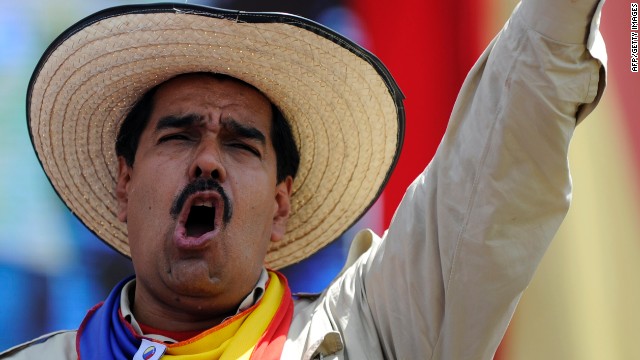
Nicolas Maduro e1368042661461 Nicolás Maduro off to an inauspicious start as Venezuela’s dubiously elected president

Courtesy of: Agence France Presse

Almost immediately after Venezuela’s partisan electoral authority declared Nicolás Maduro the winner of last month’s presidential election, he and his ruling PSUV party faced a choice that may yet define Venezuela’s future for years to come. Reports of thousands of irregularities in the voting process, including suspicions of fraud, sparked fears about the election’s legitimacy. The actions of Maduro – who first consented to the opposition’s calls for a full and transparent recount, later issued a hasty retraction, and then began a crackdown on peaceful opposition protestors – has only deepened those fears.

Maduro’s desperation is perhaps well-founded: a poll today found that a majority of Venezuelans believe the country is on the wrong track and, if given the chance, most would now choose Henrique Capriles for president over Maduro. The uncertainty and repression surrounding the Venezuelan election has grown so egregious that President Obama has abstained from recognizing Maduro as the winner. The President observed that the “entire hemisphere has been watching the violence, the protests, the crackdowns on the opposition.” ABC reports:

President Barack Obama avoided recognizing the government of Venezuela during an interview with Univision, explaining that he was concerned about recent “crackdowns” against members of the Venezuelan opposition. He also said that recent reports suggest that basic principles of democracy and human rights are not being fully observed by Venezuela’s government.

Obama and the U.S. State Department are among a growing chorus calling for a full and transparent recount of the Venezuelan election, a chorus that now includes the Organization of American States, former Colombian president Alvaro Uribe, and internationally-respected human rights watchdog groups. Though Maduro may lack Hugo Chávez’s charisma and support among Venezuelans, he evinces the same contempt for the international community.  That contempt, combined with Maduro’s increasingly flagrant repression of his own people, mean that recent weeks for Venezuela have been turbulent indeed.

It’s hard to deny that Maduro’s “election” lacks legitimacy, before the eyes of both Venezuelans and the world. The partial audit the government agreed to is viewed as little more than a public relations gesture, and hardly sufficient to investigate the serious voting irregularities that led many to wonder whether Capriles was the election’s true winner.

As those doubts grow, Maduro has flexed the government’s authoritarian muscle to stifle dissent and cow the opposition into obedience. The state-run media – which recently tightened its grip on the airwaves by purchasing the previously-independent TV station Globovision – has dutifully propagandized on behalf of Maduro; the government recently severed the video feed of a Capriles speech, preventing the opposition leader from making his case to Venezuelans.

Such tactics haven’t prevented the opposition from making their voice heard. The din of “Cacerola” protests resounds throughout the country. Capriles has filed an official protest with the country’s Supreme Court which, comprised of Maduro’s political allies, is unlikely to intervene. Maduro and the PSUV have met these peaceful expressions of dissent, however, with strongman tactics. Capriles called off an opposition March after the government issued a veiled-threat of violence against the protestors. Opposition lawmakers have been barred from speaking in the National Assembly. And a bloody brawl in the National Assembly injured 17 opposition lawmakers. Now the government has intimated it may throw Capriles in jail.

Such tactics, though they fly in the face of democracy and human rights, at least demonstrate that Maduro is feeling the pressure. The Economist opined after the election that “without Chávez at the helm, chavismo, a noxious cocktail of populism, incompetence and repression, is a far less potent force.” Nicolas Maduro cannot strong-arm his way to legitimacy. But that hasn’t stopped him trying.